I wonder if anyone prepared a Venn Diagram to represent the intersection of those who are fans of the opera with those who collect modern US commemorative coins to assess the potential of the following coin bill before it was introduced in Congress? I'll bet a nickel that if they did, they would have found that the overlapping segment between the two groups was on the thin side!In October 2004, Peter T. King (R-NY) introduced a bill in the House of Representatives ("House") that called for the minting of coins to commemorate and support the Washington National Opera. The bill requested up to 300,000 Silver Dollars of then-standard specifications (i.e., a diameter of 1.5 inches, a fineness of 0.900 silver and a weight of 26.73 grams).
The bill was immediately referred to the House Committee on Financial Services, with a further referral to its Subcommittee on Domestic and International Monetary Policy, Trade, and Technology.
As had become the norm for standalone commemorative coin bills, the legislative proposal included a "Findings" section to provide background and context:
The Congress finds as follows:
(1) The Washington National Opera has served as the Nation's opera since its creation in 1956.
(2) In 2000, the Washington Opera was designated the "National Opera" by an Act of Congress to reflect the significant national arts leadership role of the Opera.
(3) The Washington National Opera educates and inspires students of all ages through engaging educational programs and innovative partnerships that broaden public awareness and appreciation for opera and are accessible to people of all abilities through needs-based scholarships and accommodations.
(4) The education programs of the Washington National Opera strengthen and enhance local, State, and national standards for learning.
(5) The Washington National Opera has worked since its inception to encourage the development of gifted young American artists.
(6) It is appropriate to authorize coins commemorating the 20th anniversary of the Washington National Opera Education and Community Programs with proceeds from the sale of the coins being deposited for the Washington National Opera Education and Community Program with the specific purpose of aiding in the education of students, broadening awareness and appreciation for opera, and enriching standards for learning.Kennedy Center for Performing Arts - Washington, DC - Home of the Washington National Opera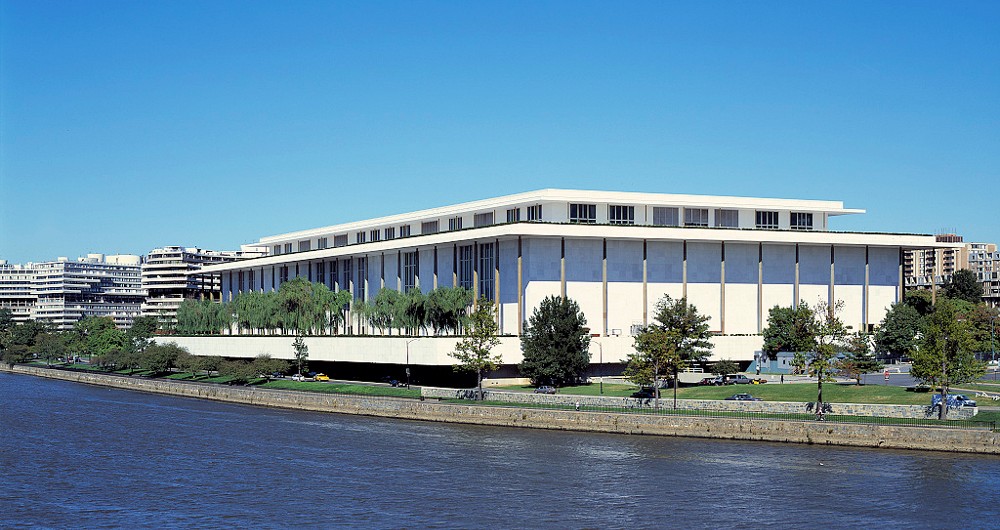 (Image Credit: Library of Congress, Prints and Photographs Division. Public Domain.)
The bill's included coin design provisions featured the standard generic language format: "emblematic of the Washington National Opera" vs. a detailed description. The coin was to include the standard inscriptions and feature a "2010" date; the coins were to be struck only in 2010. The final design was to be selected by the Secretary after consultation with the Commission of Fine Arts and the Board of Directors of the Washington National Opera. The Citizens Coinage Advisory Committee was to serve in a review capacity.
The SDs were to be struck in Proof and Uncirculated versions, with one mint facility used to strike both versions. (A bit atypical, as individual mint facilities were often restricted to either Proof or Uncirculated strikes for a given denomination.)
A $10 surcharge was to be included in the coin's Issue Price. Collected surcharge funds were to be paid to the Washington National Opera Board "on behalf of the Washington National Opera Education and Community Program to be used to aid in the education of students, broadening awareness and appreciation for opera, and enriching standards for learning."
The bill was not reported out of Committee or considered by the House under a suspension of the rules - it was not to be. Opera buffs would have to support the National Opera via means other than a commemorative coin!
As opera is not within the top ranks of popularity among music fans in the US, it would have been interesting to see what level of support this commemorative coin achieved had it passed. Personally, I think it might have struggled to "find its audience."
I think I'll sit back and listen to Puccini's
La bohème as performed by the National Symphony Orchestra of the Washington National Opera at the Kennedy Center for Performing Arts and contemplate what might have been. Or, I might put on Queen's
A Night at the Opera CD and revel in the incredible textures of "Bohemian Rhapsody." It's a toss up!

For other of my posts about commemorative coins and medals, including other What If? stories, see:
Commems Collection. 









 Posted 07/04/2025 06:33 am


