








 Posted 08/04/2025 7:41 pm


I'm not a banknote or Civil War expert, but I'm happy to contribute my two Confederate cents worth.
My general rule for such things would be to check the fake serial number databases and if it's not there, assume it's genuine.
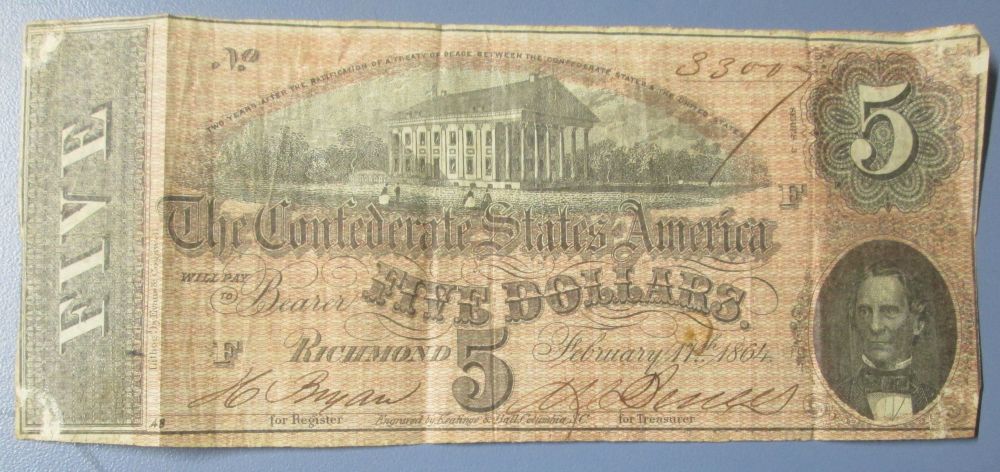
I'd also point out the damage in the corners; this note was clearly glued or otherwise adhered to some kind of display board or photo album, a fate which was more likely to happen to a genuine note rather than a replica.
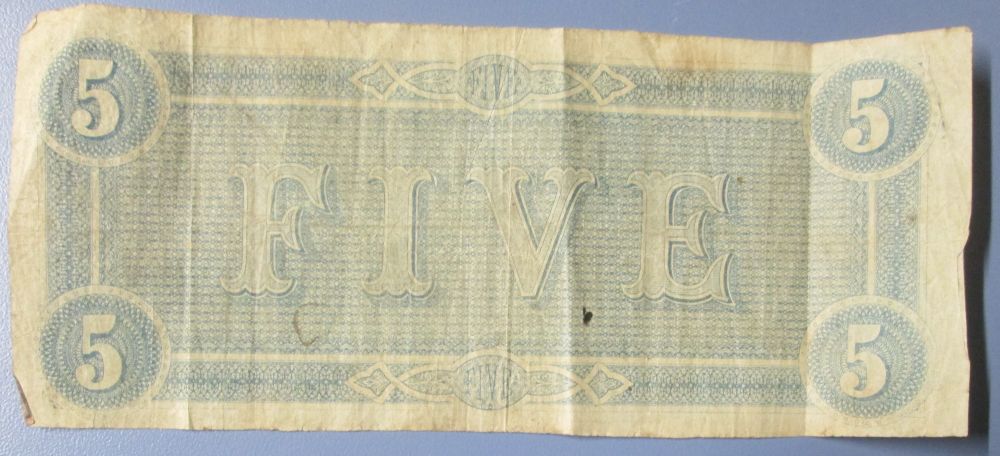
There is another positive sign: the fountain pen ink used back then was usually iron gall ink, which looked nice and black when it was fresh but rusts over time; this rusted ink tends to leach through the paper more than the black intaglio or lithograph printing, leaving a brown stain visible on the back of the note in places where the hand-written ink is darkest. It's really hard to replicate this aging process on a counterfeit note. On the back of your note, above the F of the large FIVE, is a nice clear diagonal brown line, which corresponds precisely to the diagonal dark line coming down from the pen-written 7 in the serial number. This is exactly the kind of "good sign" I'd be looking for on an old hand-signed, hand-numbered note like this.
If the only thing condemning this note is guilt by association (having been found with a bunch of definitely fake notes) I'd conclude that the owner of the accumulation simply wasn't very good at telling the difference between fake and genuine (or simply didn't care), and happened to get lucky with this note and pick up a genuine (but damaged) example.
My general rule for such things would be to check the fake serial number databases and if it's not there, assume it's genuine.
I'd also point out the damage in the corners; this note was clearly glued or otherwise adhered to some kind of display board or photo album, a fate which was more likely to happen to a genuine note rather than a replica.
There is another positive sign: the fountain pen ink used back then was usually iron gall ink, which looked nice and black when it was fresh but rusts over time; this rusted ink tends to leach through the paper more than the black intaglio or lithograph printing, leaving a brown stain visible on the back of the note in places where the hand-written ink is darkest. It's really hard to replicate this aging process on a counterfeit note. On the back of your note, above the F of the large FIVE, is a nice clear diagonal brown line, which corresponds precisely to the diagonal dark line coming down from the pen-written 7 in the serial number. This is exactly the kind of "good sign" I'd be looking for on an old hand-signed, hand-numbered note like this.
If the only thing condemning this note is guilt by association (having been found with a bunch of definitely fake notes) I'd conclude that the owner of the accumulation simply wasn't very good at telling the difference between fake and genuine (or simply didn't care), and happened to get lucky with this note and pick up a genuine (but damaged) example.
Don't say "infinitely" when you mean "very"; otherwise, you'll have no word left when you want to talk about something really infinite. - C. S. Lewis


