| Author |
 Replies: 11 / Views: 1,055 Replies: 11 / Views: 1,055 |
|
|
Valued Member
United States
77 Posts |
I've been going through my stash of error coins my mother set aside for me while she was working in a local bank and I'm posting this one of two which I think might be the inner core to a quarter, if it is possible to get a total delamination. I'll be looking forward to your replies. The one I'm showing here has green corrosion dots on one face only. The edge is fully reeded, but I did not count the number of reeds. I'll have to figure out a way if that is needed. The other one does not have any corrosion. Weight: 6.588 grams Diameter over reeding: 0.960" or 24.384 mm Thickness same between middle and edge: 0.0643" or 1.633 mm My big question concerns the weight. A finished quarter weighs 5.67 grams. Mine is way over it already. And it does not have cladding. From the US Mint production videos I've seen they punch out the planchets from strip that is already clad. I'm confused, what coin blank do I have? Is it a medal blank? 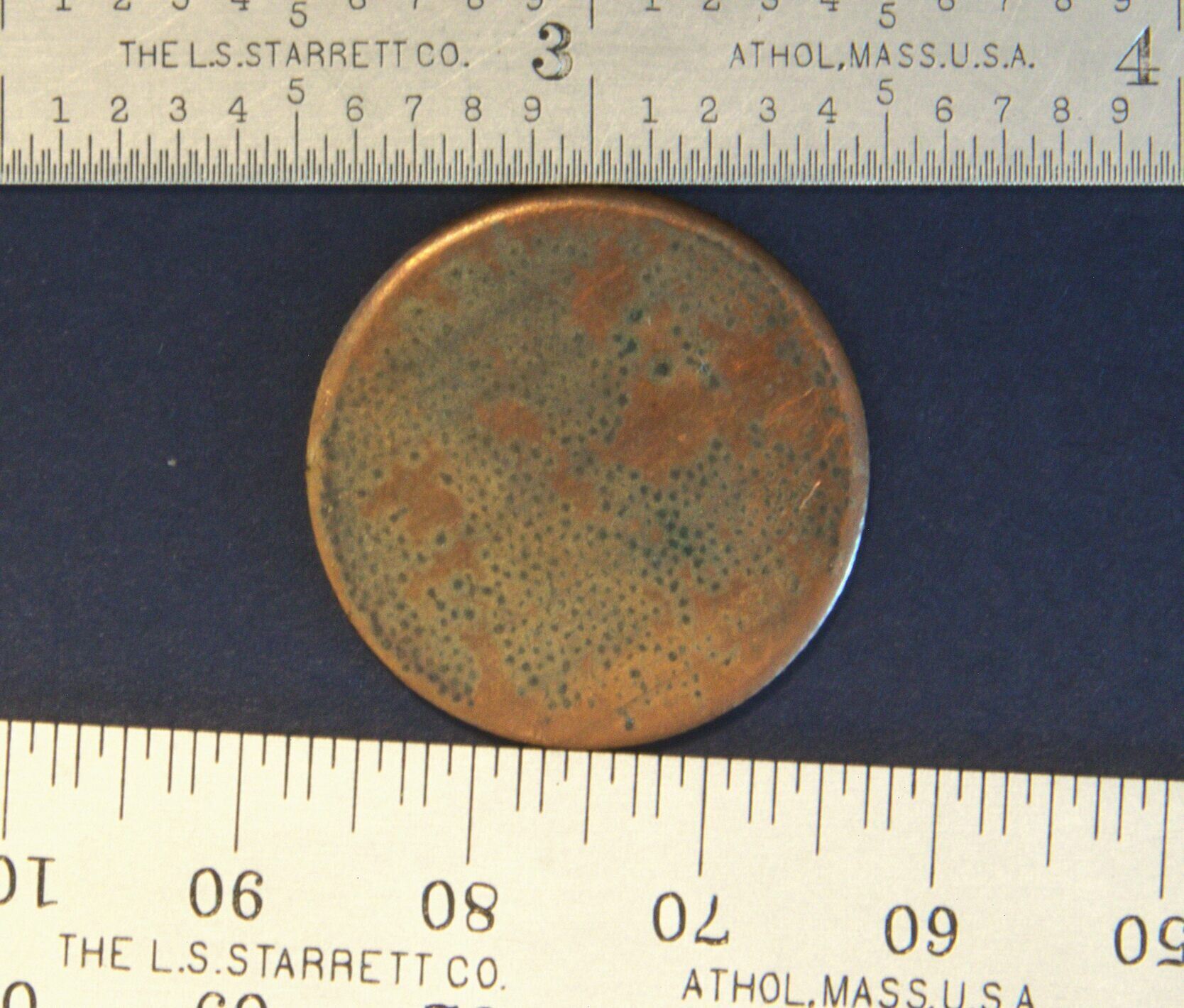 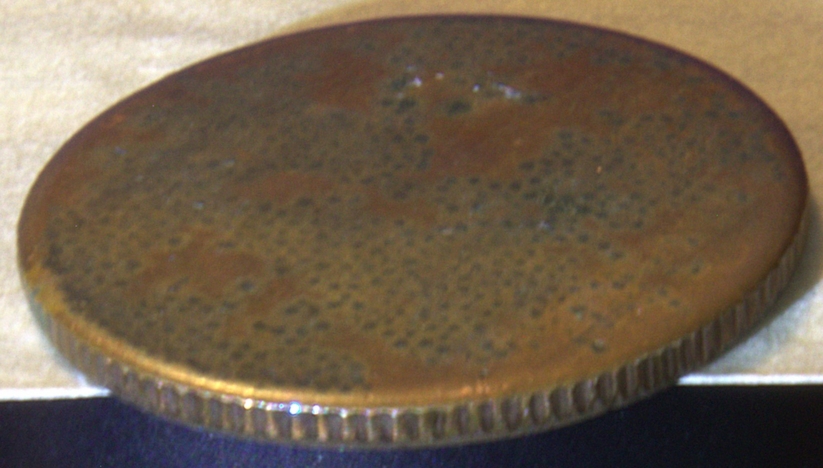 |
|
|
|
Pillar of the Community
United States
6880 Posts |
Typically reeding is applied to a coin by a ridged collar during striking. It seems odd that the planchet surfaces would be blank, but the reeding is already applied. Really unusual, looking forward to the answer! =)
|
|
Bedrock of the Community
Canada
21865 Posts |
I think it is a preformed blank for producing medals.
The fact that it has reeding means that it couldn't have
been produced to strike coins as the reeding would not
have been there until the coin was struck.
This would also account for the extra weight and thickness.
|
|
Bedrock of the Community
 United States
10601 Posts |
 A medal or a token blank. There has been topics of this mentioned before on here. |
|
Moderator
United States
105745 Posts |
 to CCF. and I agree with above. |
|
Bedrock of the Community
United States
78479 Posts |
To CCF! Nice find.  Errers and Varietys.
|
|
Moderator
Australia
16967 Posts |
It's not a medal blank.
First, medals don't normally have reeded edges.
Second, nothing - and I mean no coin or medal - is ever struck using a blank that is already reeded. The reeding would be a redundant second step and would just make the production more complicated.
While it's possible it's some kind of blank medal or token that was deliberately made to be blank with a reeded edge, that seems improbable. Instead, what I think you have here is a foreign coin that's been ground down flat on both sides. It would have originally weighed more than 6.58 grams.
Quick question: is it magnetic? That might help narrow down an ID. But my initial assumption would be a 50 eurocents, which would be made of aluminium-brass and would have originally weighed 7.08 grams.
Don't say "infinitely" when you mean "very"; otherwise, you'll have no word left when you want to talk about something really infinite. - C. S. Lewis
|
|
Moderator
United States
194816 Posts |
|
|
Valued Member
 United States
77 Posts |
Hi Sap
These blanks are not magnetic. And they date back to the mid 1970's at the latest when my mother worked in the bank. Or I suppose I could have found them later on and dropped them into my coin box, but I don't remember now if that is what happened.
Grinding: As a retired toolmaker that specialized in grinding I was thinking about this. If it started as a coin it would have an uneven surface on both sides. That makes it difficult to hold the coin to grind. The surfaces are very parallel. When I measured the thickness I found very little variation around the coin from middle to edge and around. Easily within 0.0003". You will never get that by hand. Not me at least.
If a surface grinder you'd have to hold it in a collet with very little edge to grip, and it is reeded making it more difficult to grip. I've held non magnetic parts on the magnetic chuck with double stick tape, but a coin is not even and wouldn't hold with tape. Sometimes we used Silly Putty or clay to hold parts, but no coolant and very light cuts. Once flat you could flip it and hold with double stick tape. And you'd have to lap the ground surface to remove the grind marks, which would be straight lines.
A double disk grinder is a possibility, but you need a lot of blanks at once, not just one or two. The ground surface would not have straight lines.
Holding by hand on a belt sander would be next to impossible to do while maintaining perpendicularity to the reeds. You'd burn your fingers as the blank got hot, or you'd sand your fingertips as you held it.
Turning it in a lathe presents the holding problem again. It is way too thin.
And then I wonder what the purpose of going through all of that work would be? To counterfeit a quarter for use in a vending machine? Not worth it.
I have seen and used calibration disks for a surface hardness testing machine, but they usually have a marking on the edge to show what hardness they are.
|
|
Pillar of the Community
 United States
8038 Posts |
Interesting mystery.
If you're confident the surface was not removed by mechanical means, that leave things like heating, chemical means (which could help explain the small corroded craters), etc.
Or, that the surface was not removed, but was flattened (pressure)
In cases like this one can never fathom intent, but we can at least come up with possibilities on how the thing was made.
|
|
Pillar of the Community
United States
586 Posts |
Two additional items to consider:
1. The reeding could have been added by some mechanical means other than striking, such as a knurling tool. The reeding looks uniform from the pictures, which suggests striking, but they aren't great for evaluating them.
2. Does the object show a proto rim on both sides? The photos aren't clear on this either and appear to show only one side.
|
|
Valued Member
United States
77 Posts |
Quote:
HGK3
Two additional items to consider:
1. The reeding could have been added by some mechanical means other than striking, such as a knurling tool. The reeding looks uniform from the pictures, which suggests striking, but they aren't great for evaluating them.
2. Does the object show a proto rim on both sides? The photos aren't clear on this either and appear to show only one side. 1. Glad to take more photos. I'll try to get the focus better. 2. I have two of these blanks, but only showed one. Both are very parallel from inside to outside, within 0.0003". The surface is flat, not raised. I went to the company I retired from yesterday and was going to take better photos and investigate the alloy a bit. But the microscope I was going to use was out of commission and the XRF was also unavailable. I'll have to wait. There is a new owner since late Spring and things are changing there. |
| |
Replies: 11 / Views: 1,055 |
|








 Posted 08/09/2025 6:26 pm


