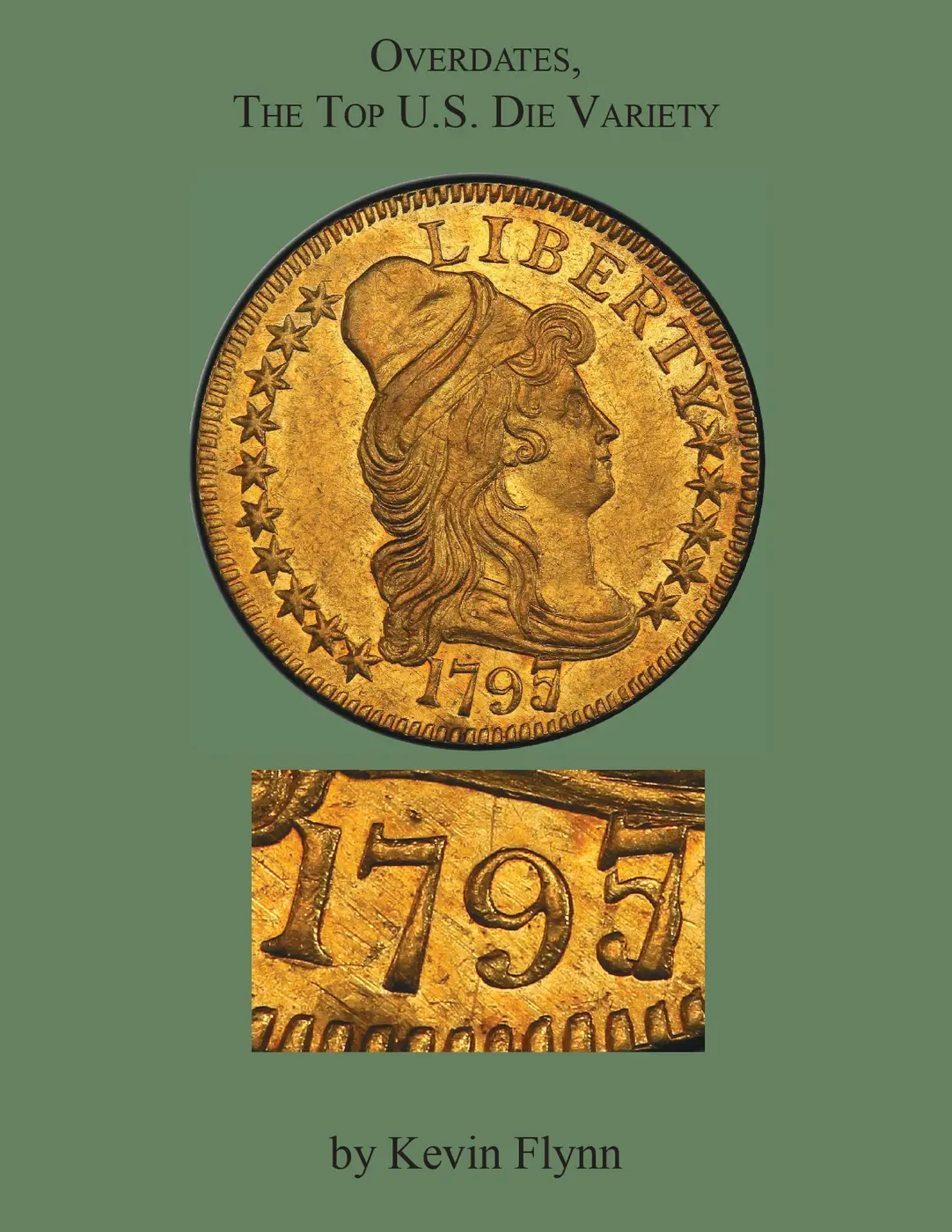
Overdates, the Top U.S. Die Variety by Kevin Flynn is currently at the printers. This book is being self-published, with only a limited number printed. The book is 8 ½ by 11, 240 pages. Softcover Retail $64.95 plus $5 for media rate shipping.
Overdates are one of the most sought after and in demand type of die variety. An overdate is a coin that exhibits more than one date or part of a date than intended for that coin. Over the 230+ years the U.S. Mint has been striking coins; there are only approximately 112 overdates that have been documented. The majority of these overdates were created in the first 50 years of the Mint's history. Of the 112 overdates known, 71 (67%) were created between 1796 and 1929.
These die varieties are sought after because they are sometimes so dramatic and visually stimulating, especially on the early overdates, whereas you can sometimes see the full current and previous digits overlapping. Rarity is normally relatively high for overdates, leading also to very high demand. Most overdates command a nice premium over the normal date, with the exception only a single die was used for a date in a series and denomination, making all coins struck from that die an overdate.
Many of the early overdates are believed to have been created intentionally with the objective of reusing unused or slightly used working dies from previous year's coin production. Die steel was expensive, the die making process time consuming, and there probably only a handful of coin collectors, which created an environment for saving money and time, without concern of public opinion. Other overdates are believed to have been created accidentally or by inexperienced Mint employees, such as a Mint employee accidently picking up the wrong date punch. Another scenario occurred when the date was part of the working hub and if on subsequent hubbings and working hub with a different date was used. There is a great deal of mystery and lure on how and why they were created. There are
no mint records that document the origins or cause for most of these. For many overdates, the evidence on the coins is the primary resource to learn about these die varieties.
Overdates also present a general mystery on how and why they were created. Were they created intentionally, accidentally, to save time and money in creating dies, not wanting to waste die steel, as a novelty, for financial benefit, to make something cool, or for some other reason. Were overdates created for different reasons during different time periods? What was the process used in creating overdates? Dates were struck into the working up through 1908 by hand. Were dates ever struck into working dies outside of the Mint? What Mint employees were tasked in striking dates into the working dies? Was this the low man of the totem pole responsibility? It is believed that working dies were annealed to soften them to be able to strike the dates into them, were the working dies annealed to a lesser degree than if they were being hubbed? These are only a few of the many questions on overdates and how they were created. There are
no mint archive records regarding the creation of overdates.
Another challenge is sometimes establishing whether a coin exhibits an overdate or is incorrectly listed as an overdate. One of the more frequent problems seen is when a valid overdate is found for a given year and denomination and coins from other dies are classified as overdates, even though the underlying remnants do not have the characteristics of a digit. For example, many of these refuted overdates are more likely the result of a die crack. Take for example the 1869/(8)
Two Cent Piece that has extra metal between the knob and middle of the 9. This was refuted by showing an early die state that did not have the die crack below and through the date and in the 9. By studying all overdates in one book, we can better establish criteria to determine whether a variety should be listed as an overdate. We can also attempt to establish patterns that might help us understand how and why overdates were created.
Price for the softcover is $64.95 plus $5 for media shipping. To order, send a check or money order to Kevin Flynn, P.O. Box 1043, Troy, VA 22974. Venmo is also accepted at kevinjflynn, please write first to kevinjflynn88@yahoo.com.










 Posted 02/04/2026 12:28 pm


