Legislative evolution on display here - another step closer to reality...In March 1973, John William Wright Patman (D-TX), on behalf of himself and Leonor Kretzer Sullivan (D-MO), William Beck Widnall (R-NJ) and Chalmers Pangburn Wylie (R-OH), introduced a bill proposing "a new coinage design and date emblematic of the bicentennial of the American Revolution for dollars and half-dollars."
While having roots in Representative White's bill (see,
What If? 1973 American Revolution Bicentennial - Dollars & Half D - Again), the new bill represented an enhanced version with several important differences.
Unlike White's bill, the new bill proposed:
1. Circulation Coin Replacement vs. Circulation Coin Supplement: The Patman bill called for the reverse designs of the standard dollar and half dollar coins to be replaced with designs "emblematic of the bicentennial of the American Revolution." The White bill, in contrast, sought bicentennial-design coins that were to be in addition to the regular circulating designs (i.e., additional circulation coins).
2. Issue Dates: The Patman bill specified an issue date for the bicentennial coinage that was to begin on July 4, 1975 and extend "until such time as the Secretary of the Treasury may determine" - the time frame was indirectly proposed to extend until January 1, 1977. The White bill lacked an issue date specification.
3. Coin Date: The coins were to be issued with the dual "1776-1976" dates. The White bill did not include a coin dating provision; presumably, the year of issue would be used.
British 1781 Surrender at Yorktown (Circa1870)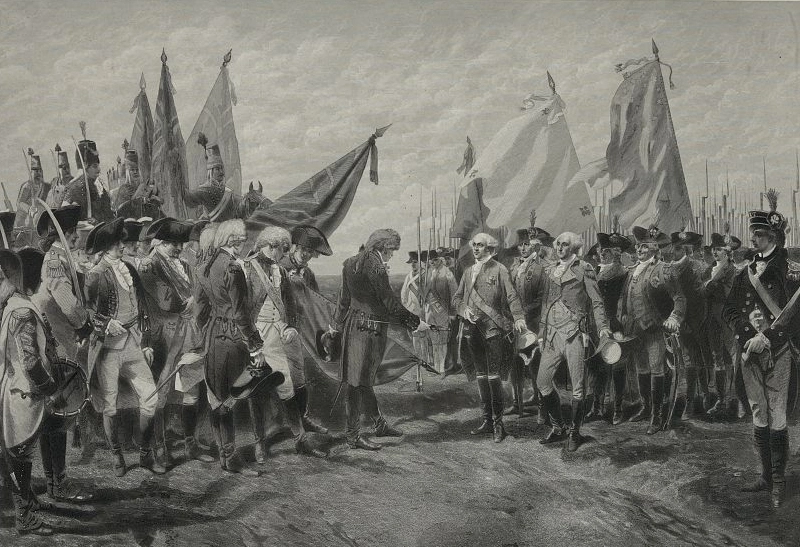 (Image Source: Library of Congress, Prints and Photograph Division. Public Domain.)Note: General Cornwallis is not shown in the print; he claimed to be "too ill" to attend the surrender. British Major General Charles O'Hara represented the British at the surrender ceremony and is depicted in the print presenting his sword to the Comte de Rochambeau, the French General standing to the right of General George Washington (viewer's left).
Upon its introduction, the Patman bill was referred to the House Committee on Banking and Currency.
The Patman bill was actually initially drafted by the Treasury Department, and thus included its preferences for Bicentennial coinage (vs. the White bill). The Treasury's strong support of the legislation triggered the bill's inclusion in a May 1973 Hearing before the House Subcommittee on Consumer Affairs (under the House Committee on Banking and Currency) that was scheduled to review a long list of commemorative coin and medal proposals.
Representative White's bill was included in the Hearing, though it appears more as a courtesy than for genuine consideration. He did not testify live - his written Statement was entered into the Record - and his bill was never part of the core Hearing discussion.
The Treasury Department and United States ("US") Mint were represented at the Hearing, respectively, by Edward L. Morgan, Assistant Secretary of the Treasury for Enforcement, Tariff and Trade Affairs and Operations,.and Mary Brooks, Director of the Bureau of the Mint. Each was clear by their testimony that they supported the coinage proposal.
Assistant Secretary Morgan testified first, and quickly made it clear where the Treasury Department stood regarding the coinage:
"The birth of self-government by a free people is a great moment, certainly the greatest moment in the history of our country. I believe a reminder of that critical period in our history from which all our freedoms flow would be a most worthwhile contribution to the celebration of our 200th anniversary of independence.
"Changing the designs on the reverses of the dollar and half dollar honoring this milestone event and "1776-1976" replacing the date on these two denominations, the Treasury Department feels, would help accomplish this goal and add significantly to our bicentennial observances."Director Brooks followed with:
"I believe we all want to do everything we can to recognize and honor the 200th birthday of American freedom. It is indeed an auspicious occasion for our Nation, and our people, and changing the designs on the reverses of the circulating dollar, and half dollar would place a symbol in the hands of every American that would bear visual witness to the enduring qualities of our form of government."Such emotional, patriotic sentiments delivered by the Treasury!
But why did the design replacement bill have such strong Treasury/Mint support?
1. Production Capacity: The Mint believed it had the production capacity to meet the potential coinage needs of the country - including the projected number of coins that would be pulled from circulation by coin collectors/souvenir seekers - if it substituted bicentennial designs for the regular designs vs. having to strike two new coins with bicentennial designs.
2. Lower Demand for Dollars/Half Dollars: The Treasury believed the targeted denominations would be the least disruptive to the Mint's operations due to their lower general demand. That said, it was still believed that the coins would "both be of interest to numismatists."
Director Brooks further noted that the Treasury/Mint expected to produce collector versions of the coins (in Proof and Uncirculated qualties) for inclusion in its special annual sets.
Director Brooks concluded her Bicentennial coinage comments with:
"I would like to emphasize the need for lead time in order to produce sufficient dollars and half dollars for distribution to the public beginning just after July 4, 1975. In the development of newly designed coin dies, recent experience indicates that several months may be required in the mechanics of developing dies of varying combinations of relief and border detail before reaching the point where suitable production dies are developed. Six months was required for this phase of development work on the Eisenhower dollar coin.
"To complete this work, produce sufficient dies, and strike 60 to 100 million of the dollars and 125 to 175 million of the half dollars, which the Federal Reserve banks estimate they will need for the initial distribution, the mint hopefully could begin its development work on the dies early in 1974."The Treasury's support and eagerness notwithstanding, the bill did not move through Congress and achieve approval. It was a definite "next step" in the process, however.
We haven't reached the end of the story yet! More to follow!For other of my posts about commemorative coins and medals, including more "What If?" stories, see:
Commems Collection 






 Posted 03/30/2026 10:19 pm


 with jbuck, these are just great to read.
 Uncirculated American Silver Eagles


