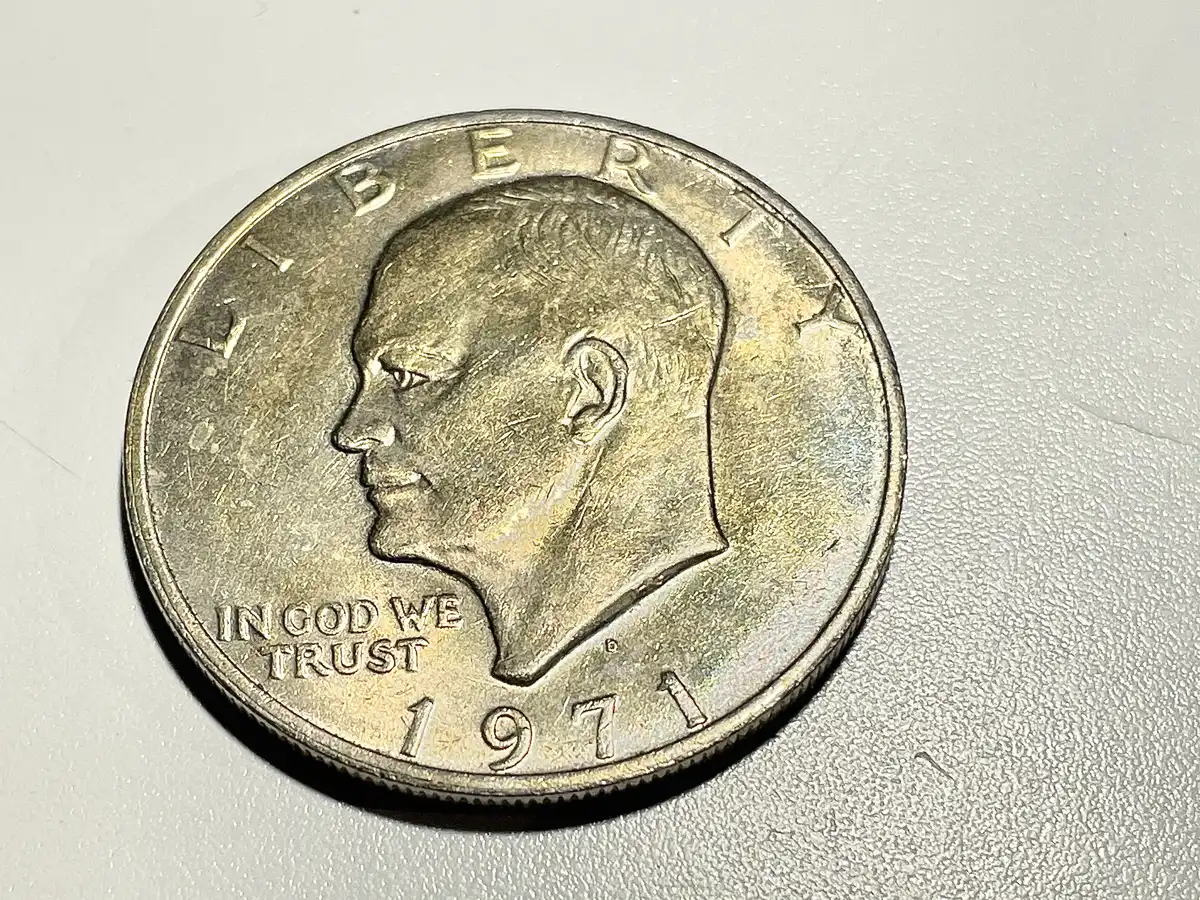
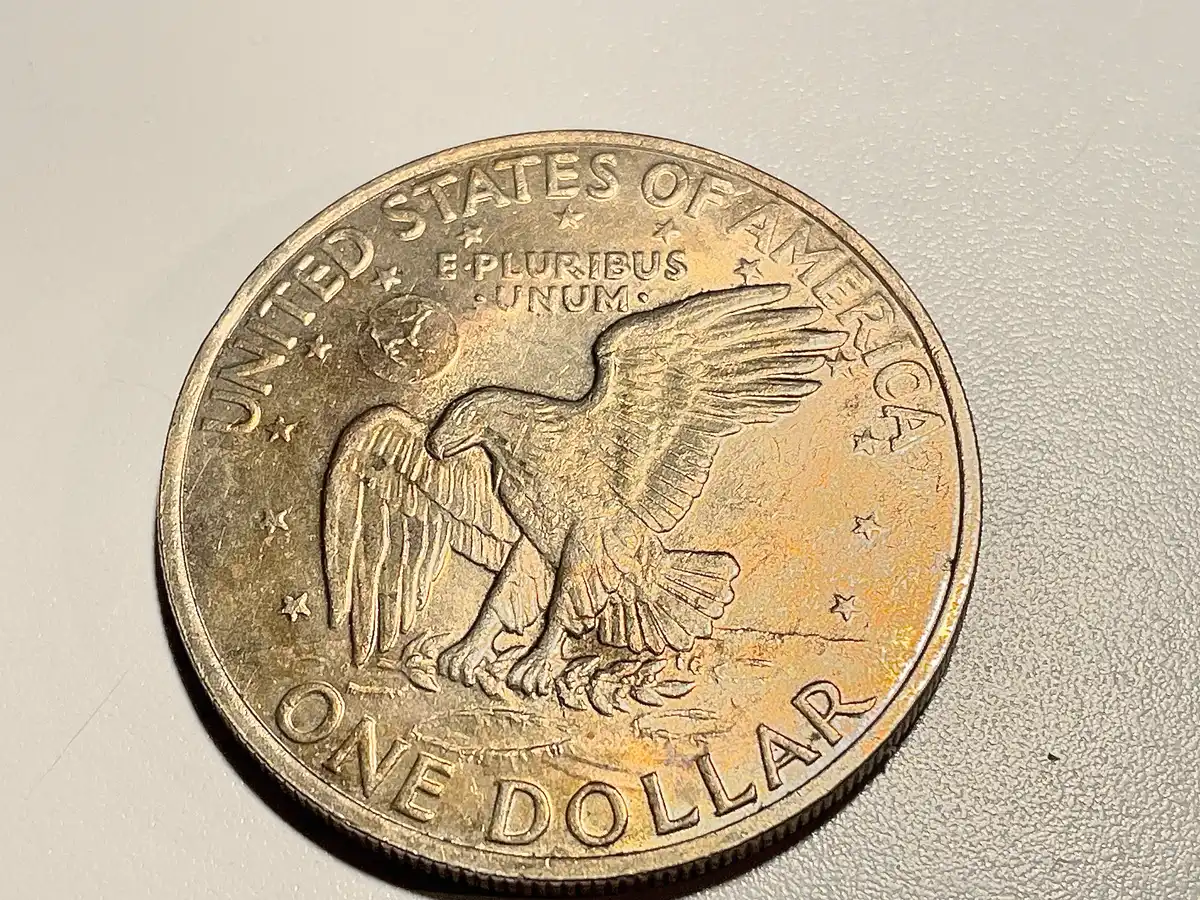
Based on the photos and my attribution framework, I would argue the case this way that this is an IA error and not environmental toning. This is the toughest attribution IMO between original surfaces and the first oxidation state proposed in my upcoming paper I call OX I (One). Golden hue tone. The reverse has a left side darker tone but this is just shadowing and the entire is of a golden due with some original surfaces. See below:
1. Color Distribution
If this were ordinary environmental toning, I would expect the color to follow the storage environment. That often produces crescent patterns, peripheral bands, target toning, album-edge toning, or localized patches where sulfur-bearing materials had greater access to the surface.
On this Ike, the gold coloration appears broadly distributed across both sides of the coin. The obverse and reverse exhibit a similar overall gold-amber appearance rather than a distinct exposure pattern. That is more consistent with a planchet-wide phenomenon that existed before striking, which is what would be expected from improper annealing.
2. Color Sequence
Environmental rainbow toning typically progresses through a sequence of interference colors as film thickness increases:
Gold &→ Orange &→ Red &→ Rose/Magenta &→ Violet &→ Blue &→ Green to eventually charcoal black.
The Ike does not appear to show the classic rose, violet, blue, or green stages. Instead, the visible color is primarily within the:
Gray &→ Gold &→ Amber range.
That does not prove improper annealing, but it is more consistent with an early oxidation state (OX-I) than with a fully developed sulfur-driven rainbow toning progression.
3. Edge Evidence
This is probably the strongest argument. I call this Fred Weinberg Principle.
Environmental toning can produce beautiful colors on a coin's faces, but it does not readily explain a well-defined red copper-core edge stripe. The edge is often where the strongest evidence of a clad-planchet annealing event survives.
If the coin exhibits:
Broad gold coloration on both sides, and
A distinct red copper-core edge stripe, then both observations point toward the same explanation: oxidation associated with the clad strip and core before striking.
In this framework, the edge is not a secondary feature. The edge is one of the primary diagnostic areas because annealing affects the entire planchet, including the exposed copper core.
Putting It Together
The argument is not:
"The coin is gold, therefore it is improperly annealed."
The stronger argument is:
"The coin exhibits planchet-wide gold coloration on both sides, lacks the later magenta-violet-blue-green stages commonly associated with rainbow toning, and retains a characteristic red copper-core edge stripe. Taken together, these observations are more consistent with an early-stage improperly annealed (OX-I) clad planchet than with ordinary environmental toning."
The gold color alone is weak evidence. The gold color plus the red edge stripe plus planchet-wide consistency becomes a much stronger IA case.
See this example from Heritage:
https://coins.ha.com/itm/errors/197...sults-012417This is much easier as the reddish-dark brown (mostly brown) OX II + OX III (combined) covers both obverse and reverse in the IA Color Oxidation Pathway of IA errors. PCGS & NGC seem to have the later colors down pact.
Once we get into the laboratory we will confirm low S & Cl levels as compared to "CONTROL" Rainbow toned examples where these levels are elevated. Furthermore the Cu/O ratios will be LOWER going from gold to black. Thicker oxide levels (black) will register higher oxygen levels (i.e., more oxidation) therefore the Cu/O (larger denominator) its values will be lower. Its for this reason I have heard PCGS and NGC has had issues with grades below MS60 to confirm if a coin is an IA error or environmentally toned or artificially toned. You can see how it may get complex
WHEN these two pathways crossed paths. In my paper I will try to troubleshoot these issues. FYI.





 Replies: 0 / Views: 8


 Posted Today 15M ago


