Posted 07/15/2009 10:35 am


Quote:
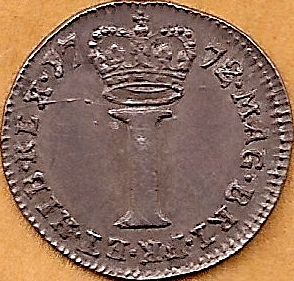
I could be wrong, but from what I understand, Maundy money's design (a large denomination with a crown above) was truly unique...
I could be wrong, but from what I understand, Maundy money's design (a large denomination with a crown above) was truly unique...
Sorry, WpgLwr, but you're mostly wrong.

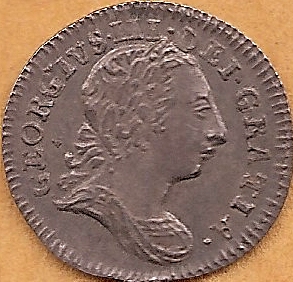
The "crowned value in wreath" was the normal design for small circulating silver coins from the time of James I up to George V. Telling Maundy coins from regular coins for the times in between these periods isn't simple. For very early types (pre-1820) there is no difference; the coins distributed at the Maundy ceremony were normal coins, though in many cases (such as the silver penny) the only time they were ever struck was for Maundy.
Any tiny silver 1 penny coins you might find can legitimately be called Maundy pennies; there effectively were no 1 penny coins in circulation for most of the 18th century, apart from the ones made for Maundy.
The one-and-a-halfpence coin was only made for circulation and not included in the Maundy set.
Twopences with the "Maundy design" were made for general circulation in 1838 and 1848. These were made for circulation in the colonies, though they also saw some use in Britain itself. These circulation twopences are often mistakenly sold as "Maundy coins"; you need the provenance of their being part of a set to count these dates as Maundy coins.
Up until 1926, the design of the Maundy threepence and ordinary everyday threepences were identical. I believe the strike was slightly better, but if they entered circulation and became worn, there isn't much to tell them apart. One tends to assume that all threepences before 1926 are NOT Maundy threepences unless they come in a set. From 1926, the crown-and-wreath threepence was only used on the Maundy coins.
WpgLwr's statement is, however, quite true for fourpences. Circulation groats were issued from 1836 to 1855, but these had the picture of Britannia on them. Maundy coins of those years have the crown-and-wreath.
Don't say "infinitely" when you mean "very"; otherwise, you'll have no word left when you want to talk about something really infinite. - C. S. Lewis