| Author |
 Replies: 13 / Views: 9,923 Replies: 13 / Views: 9,923 |
|
|
New Member
United States
20 Posts |
Hello - I'm trying to organize my father's old coin collection for possible sale and am trying to put together as accurate an inventory as possible as well as my best guesstimate for values. For this coin I understand that typically there isn't a fixed date but instead a date range. Could someone please let me know how I should list the date for this particular coin? Also, best guess at very approximate value? Does the inverted 'A' signify anything valuable? Thanks! 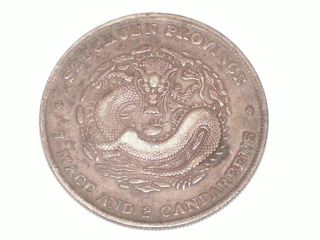 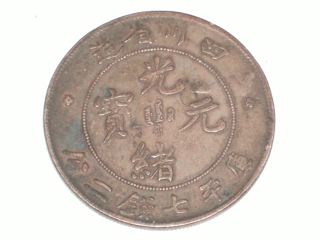 |
|
|
|
Pillar of the Community
United States
3098 Posts |
The date is just the reign of the emperor, since modern Western silver coins were minted through his reign.
But the first thing is that we have to determine if it's real, since there are counterfeits of this coin (particularly this design) in the millions. Do you know where your father got this piece?
|
|
New Member
 United States
20 Posts |
I don't know exactly, although my sense based on other coins from China from around the same period (and opinions of some posters here) is that it is not a fake. If I'm remembering correctly he got the collection from his uncle, probably in the 30s or 40s.
|
|
Pillar of the Community
Australia
2830 Posts |
G'day, I suggest that you weigh the coin. Forgeries are usually light.
Peter in Oz
|
|
New Member
United States
20 Posts |
How much should it weigh?
|
|
New Member
United States
20 Posts |
Have I been abandoned? :) Let's assume, for the sake of argument and my general laziness, that the coin is legit. Should I bother with listing a date or is it understood simply as Szechuen 7 Mace and 2 Candareen? Also, guesstimate value?
|
|
Pillar of the Community
United States
3098 Posts |
No, you haven't been abandoned. If your post gets buried, you're always welcomed to bump it up. As for weight, it should be 27.7 grms (or was it 26.7?) Anyways, here's a good reference link http://www.silver-coins.org/chinese...rovince.htmlIt's understood as a 7 mace 2 candareen or "silver dollar." You might also want to write Sichuan since that's the way to write it now. **oh right, value, $50 to $75 sounds about right (or what I'd pay) Is it magnetic? If you tap it while balancing it on the tip of your finger does it ring for a long time? If you have a Morgan or other silver dollar, tap both. They should sound very similar. Edited by wd1040
08/18/2009 5:02 pm
|
|
New Member
United States
20 Posts |
Thanks! Slightly lower pitch, but the resonance after the tap is the same length as a Morgan. Not magnetic. I don't have an appropriate scale, but my magical hands say it's about the same weight as a Morgan.
Value raises an issue I have: Based on my completely amateur method of trying to find a similar item on e-bay and guesstimating value based on bids for that particular coin (in approximately same condition as whichever coin I have), I have what I'm sure is a total crap valuation of the coins in this collection. Your value is significantly higher than what I would have guessed based on e-bay. Is there a way to get a reliable, independent valuation online (or 2 or 3)? At a local collector store? There are a lot of coins, as well as currency (approximately 300 items combined), none of them professionally graded. I don't want to go through the official grading process unless it's going to make a significant difference. How do I resolve these issues without getting ripped off?
Sorry if this isn't the correct forum for those questions. lol
|
|
Pillar of the Community
United States
3098 Posts |
I guess it's real then! I think the fineness is not .900, so that accounts for the pitch. As long as its resonance is pretty long it's not cupronickle or some other cheap metal. Well, you can always get a Krause and start flipping through it. Otherwise, ebay is the way to go to get values on some popular ones. As for the ebay Chinese silver dollars, everyone is scared that the item is a fake, so prices get pushed down. I think $50 would be right for a piece like this. But if you need more help, you're welcomed to post them here. Currency, eh? Let me see them! |
|
New Member
United States
20 Posts |
Excellent. Thanks for your help on that.
My instinct would be to post batches here and let folks hash out grading/value a few at a time so it's not ridiculous and overwhelming. I suppose this presents an ongoing project for the next few weeks.
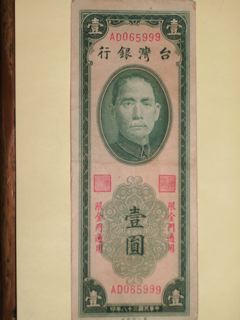
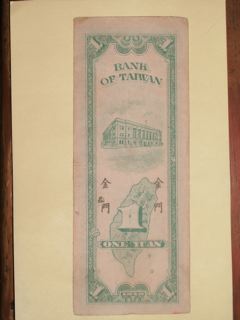
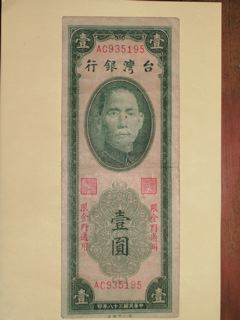
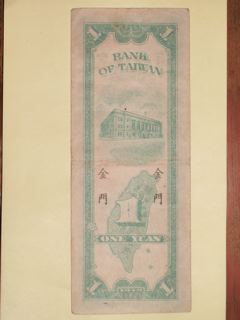
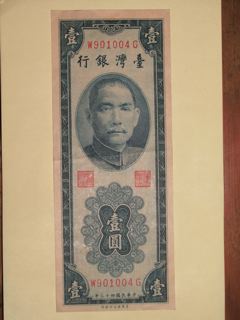
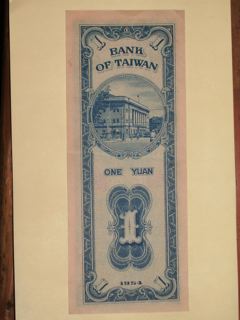
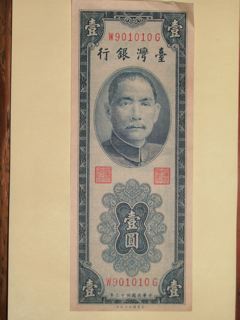
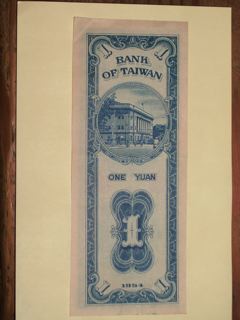
As for currency, let me get through my initial pass at trying to organize/value what I've got, and then I'll come back around with posts of bills. They're primarily Korean Hwan of various dominations from 1953/54 and Taiwanese 10 and 50 Cent notes from 1950 as well as a few Yuan notes from 1949 and 1954. One of the batches (I think the Hwan) is essentially mint (though I'm assuming circulated if such a thing is possible) and sequential.
|
|
Pillar of the Community
United States
3098 Posts |
As for the Korean Hwan, the wikipedia article is pretty knowledgeable on that.
Whoa... 1949+1954 Yuan?! Show me please! I'm looking for these!
|
|
New Member
United States
20 Posts |
|
|
Pillar of the Community
United States
3098 Posts |
oh... they're from Taiwan. I thought you had mainland notes.
Anyways, create a new topic. I'll tell you more about it there. You have a very interesting one in there.
|
|
Pillar of the Community
United States
5362 Posts |
pixel11 - I am no expert at Chinese dollars but I do know something about forgeries in general. I have a couple quick comments: First - you need a digital scale. If you have more than a couple coins it will help with buyer confidence if you can provide an accurate weight. A cheap scale that reads 1/10th gram is under $40 usually and is accurate enough for your purposes. Most Fake Chinese Dollars are a gram or MORE off in weight. Unless you possess super human powers you can not detect a 1 gram deviation by hand. Second - you need to look at the edge of the coin. The originals were Reeded ||||||||||||||. This design was struck into the coin in a closed collar press all in one operation. There is NO SEAM or OVERLAP in the reed pattern. Counterfeits usually have bad edges. Look for uniform reed spacing - they are EXACTLY the SAME no variation at all on originals. Counterfeits are often of variable spacing and some have overlaps in the reeds depending on application. Also look for splits in the top and tails of the reeds caused by application of the edge reeds with a ring die (a procedure that has been around for a while. Here is a sketch I made of the way a split tail reed looks. 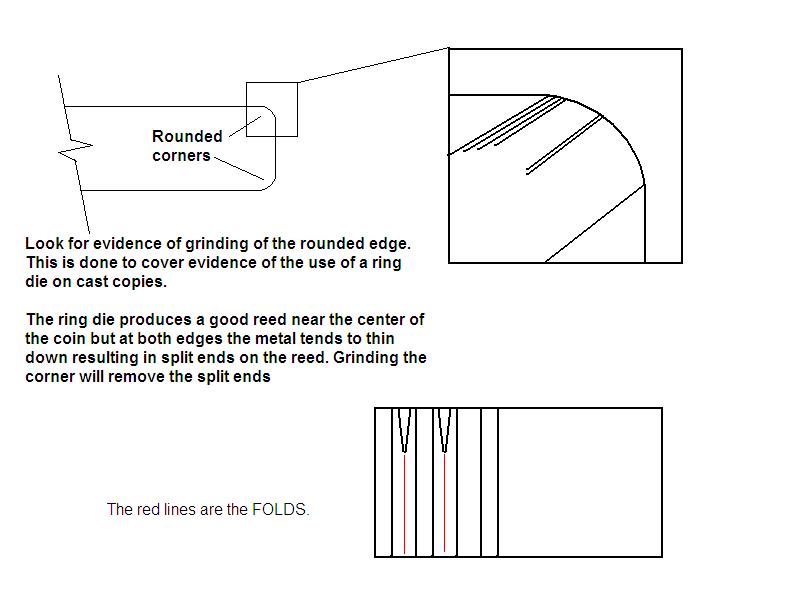 Here is a photo of an edge of a Counterfeit Chinese made dollar. The corners were ground off. In the picture you can see parallel lines on the rounded corner that all go UP and TO THE RIGHT at about 45 degrees. Also on the reed at the right you can see the central void at the top of the reed due to the folding in of the metal to form the reed. Over time the Chinese forgers have perfected the process but coins from the WWII era usually have easily spotted split tail reeds. 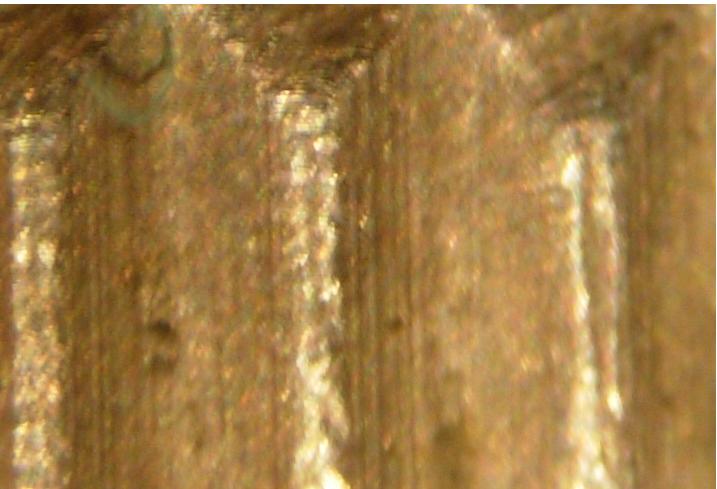 My next comment is on the AGE of the accumulation. I have a question. If the collection came as a SINGLE group a date of the 30s or 40s is NOT as likely as the late 50s or 60s. I always look for the newest items in a single group and the wear - I date accumulations in that way. Here you may have worn 1950's bank notes in the accumulation which makes the date later - Post WWII. That coincides with the first massive influx of forged Chinese coins into the market. Soldiers in WWII were a mark for forgers who sold them old silver dollars for 10 or 25 cents each. The soldiers thought they had a bargain until they got home and discovered the coins had ZERO silver in them. Final comment an alloy of nickel and copper is NOT MAGNETIC.
|
| |
Replies: 13 / Views: 9,923 |
|










 Posted 08/12/2009 7:44 pm