











 Posted 09/28/2009 11:56 am


They experimented and fiddled a lot with the SMS production.
The proof presses from Philly were shipped to San Francisco for use to make coinage without a mint mark to help alleviate the coin shortage of the time caused by massive hoarding of silver coin. The 1964 date was frozen and when the '65 clad coinage went into production this date was frozen as well.
Late in the year it was determined that they could make some collector sets but rather than make either the unc or proof sets that had been popular for many years they made the SMS's. Most collectors considered these neither fish nor fowl and turned their collective noses up at them. But the mint didn't seem to settle on any single process for their production until near the end of the program. The trials and experiments were packaged up and shipped to collectors. This no doubt accounts for the huge range in early reports about these sets. Some coins were hideous and some were near proof. There may have even been a few proofs sneaked into these sets.
Some dies were basined, some were not. Some dies were highly polished, some lightly polished and some got none at all. Some dies were frosted and some were not. By 1967 it's possible that all were frosted but none were refrosted. This may not apply to penny dies. Some dies appear to be just polished regular dies. The bulk of the dies were finely made and all were used in low speed presses at high pressure but it appears that in a few cases coins were struck twice. This is so unusual that it appears likely the second strike was inadvertant. Sometimes when this happened there was a polished planchet struck by basined dies so these would be technically proof coins.
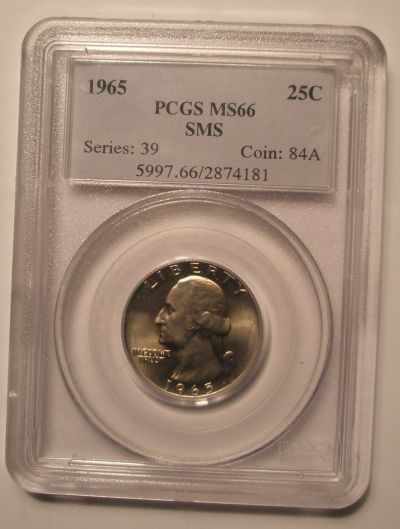
You can find a very wide range of qualities and finishes on all three dates of the SMS's though the '67 is mostly just PL.
The proof presses from Philly were shipped to San Francisco for use to make coinage without a mint mark to help alleviate the coin shortage of the time caused by massive hoarding of silver coin. The 1964 date was frozen and when the '65 clad coinage went into production this date was frozen as well.
Late in the year it was determined that they could make some collector sets but rather than make either the unc or proof sets that had been popular for many years they made the SMS's. Most collectors considered these neither fish nor fowl and turned their collective noses up at them. But the mint didn't seem to settle on any single process for their production until near the end of the program. The trials and experiments were packaged up and shipped to collectors. This no doubt accounts for the huge range in early reports about these sets. Some coins were hideous and some were near proof. There may have even been a few proofs sneaked into these sets.
Some dies were basined, some were not. Some dies were highly polished, some lightly polished and some got none at all. Some dies were frosted and some were not. By 1967 it's possible that all were frosted but none were refrosted. This may not apply to penny dies. Some dies appear to be just polished regular dies. The bulk of the dies were finely made and all were used in low speed presses at high pressure but it appears that in a few cases coins were struck twice. This is so unusual that it appears likely the second strike was inadvertant. Sometimes when this happened there was a polished planchet struck by basined dies so these would be technically proof coins.
You can find a very wide range of qualities and finishes on all three dates of the SMS's though the '67 is mostly just PL.
Time don't fly, it bounds and leaps.


