| Author |
 Replies: 9 / Views: 2,358 Replies: 9 / Views: 2,358 |
|
|
Pillar of the Community
United States
588 Posts |
How does an overdate error happen? Thank you
|
|
|
|
Pillar of the Community
Australia
1040 Posts |
Here is a question for DV, who will answer better than I can. Basically, a die is used from a previous year and the new digit is simply punched over the top of the wrong digit for the new year. That is the short and simple explanation. DV will be along shortly to clean up my mess.  Edited by latman100
10/29/2009 12:44 am
|
|
Bedrock of the Community
United States
20753 Posts |
I too would like to know if anyone really knows that one. I've heard so many different explanations over the years that I really wonder if anyone knows. I can see the explanations of an RPM but many overdates don't make CENTS. For example why would there be so many 1942/41 Mercury dimes? With coins minted of over hundreds of millions, why bother to try lining up a coin for a new date? Then too some are vague and I really wonder how they were ever figured out. The Indian Head cent 1888/7 or is it 8/8 or 8/9? Of course 8/9 may be a little nutty for me to say. I can't tell and wonder if anyone really can why this all happens. |
|
Bedrock of the Community
United States
12437 Posts |
The use of date punches was phased out by the time 20th century series coins came into existance. The 20th century "overdates", 1942/1 Mercs and 1918/7-S SLQ and 1918/7-D Buffalo, are actually doubled dies. Dies were impressed on a hub twice but it was a multi-step process. The dies were annealed(heated) to soften the die steel. They were then hubbed once, reannealed, and then hubbed again. The modern "overdates" were created with the use of hubs from two different years. They would be Class III doubled dies (design hub doubling). Mid-late 19th century coins typically used a logotype punch for the date where all the digits were added at once so you will typically see doubling on more than one digit. The late 18th and early 19th century issues were hand punched individually on each die which is how you can end up with so many overdates for a workhorse coin like the Bust Half dollar. One Half Cent that I recently saw is about as obvious of an overdate that you can find  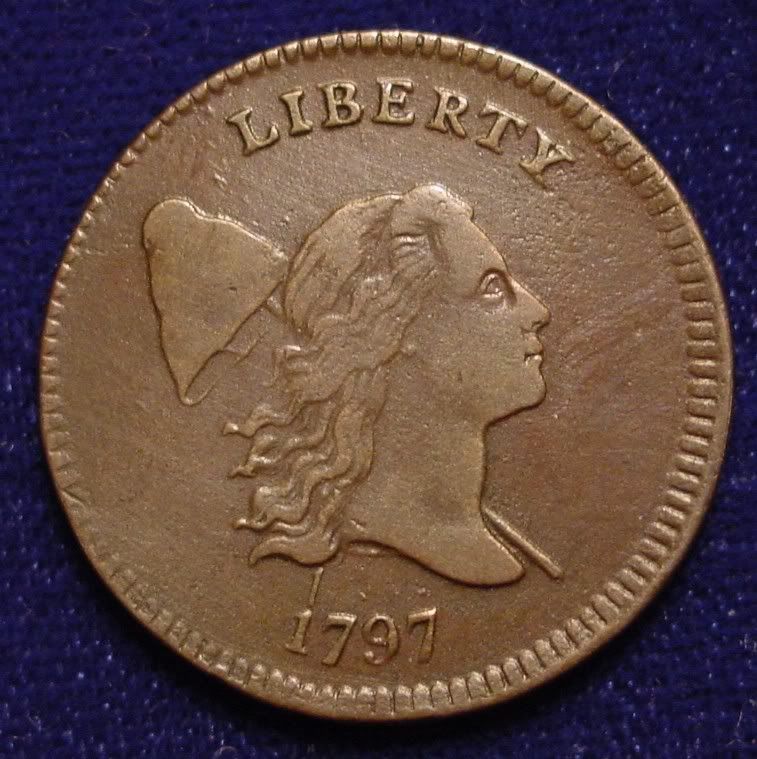 |
|
Bedrock of the Community
United States
10045 Posts |
This topic has been covered pretty well. At least for 19th C. overdates, the primary cause is probably economics, where a surviving die from the previous year's run is impressed with a new date. This can be documented when overdate dies match strikes from the previous year. Some cases might be unused dies from the prior year or new dies were mistakenly impressed with an older date punch and fixed- there is no real way to know because mint records never disclose mistakes. The only evidence we have is what remains of the prior date--after the majority is polished away of course. Thanks to a friend, here's a great example of a doubled-hubbed overdate, which shows on most of this Australia 1933 1d.  I would call this a 1933/1932 overdate because two whole dates are involved.  The number of digits repunched depends a lot on the processes used to make the die. I have quite a few overdates from Sweden, where only the last 2 digits were involved. Overlays can help clarify what happened. This overdate has been confirmed as a 1875/74.  Sometimes all 4 digits were obviously repunched, as in the case of this 1901/1891 ½ Dinero from Peru:  Btw, that's one nice 1797 large cent! Edited by DVCollector
10/29/2009 1:33 pm
|
|
Bedrock of the Community
United States
20753 Posts |
Quote:
The use of date punches was phased out by the time 20th century series coins came into existance. The 20th century "overdates", 1942/1 Mercs and 1918/7-S SLQ and 1918/7-D Buffalo, are actually doubled dies. Dies were impressed on a hub twice but it was a multi-step process. The dies were annealed(heated) to soften the die steel. They were then hubbed once, reannealed, and then hubbed again. The modern "overdates" were created with the use of hubs from two different years. They would be Class III doubled dies (design hub doubling). I really have no idea how overdates occur and have heard many different concepts. Stating the 42/41 Mercury dime is a Double Die is in my estimation rediculous. The one is very, very plain and not just a doubling of the 42. The rest of these explanations are interesting and something I'll really look into. Overdating really is odd for many coins of large minatages. |
|
Bedrock of the Community
United States
20753 Posts |
The overdated Working Dies were re-processed by grinding down and polishing away as much of the overdate as was possible. Each die was identified, and re-worked to remove traces of the underlying "3" in the last numeral of the date. Full article>>> OverdateA variety created when all or part of the date is engraved over another date on a die, part of the old date is still visible under the new one. For example, the 1942/1 Mercury dime. ... Full article>>> Overdate - A variety in which at least one digit of the date has been hubbed over or altered to a different number in the die. Recessed - The lowering or sinking of a specific area on a coin, usually the date, so that it does not wear as quickly. Full article>>> Obviously per this article on mimi.hu and several other sites the over dates are not double die coins at all. They are simply reused dies from one date, ground down and a new date entered. If the process is incomplete, some or parts of the previous dates appear. Per a Google search of overdates it appears that this is the case in all entries. Not sure how to Link those but one is https://www.bestcoin.com/overdate-error-coins.htm Like I said I'm not a good Link person but a search on Google produced numerous stories about over dated coins and none are explained as double dies. |
|
Bedrock of the Community
United States
12437 Posts |
justcarl, Google has failed you and you have no idea what you just typed. Did you even bother to read the link you posted? Quote:Another way an overdate might have happened by accident was when a die was hubbed at the end of the year. The working hub of one year was used to hub the working die, and then when the die was returned to be rehubbed after annealing, a working hub of a different year was used to hub the die. This happened for the 1918 over 1917 Buffalo nickel and the 1942 over 1941 Mercury dime. That is precisely what I typed, why is that so hard to understand? 20th century overdates are Class III doubled dies and some bunk website with a Hungarian Internet domain is not going to change that fact. So many websites are filled with clueless and completely wrong information. But I guess I am wrong, along with Kevin Flynn(who wrote the above quote), JT Stanton, CONECA, PCGS, foundinrolls, coppercoins, and many others with considerably more gravitas than myself. It seems like you were on some mission to prove me wrong but you failed miserably. Your estimation is precisely that- ridiculous... Quote:Beginning with the 20th century types, the date was included in its entirety somewhere in the hubbing process so that by the time the working dies were hubbed, the entire date was placed into the die by machine, not by hand. This removed all possibility for repunching date digits, henceforth removing the possibility of repunched and over dates. ALL 20th century coins exhibiting two different dates on one coin are doubled dies, NOT over dates. This includes the 1918/7D nickel, both 1942/1 dimes, the 1943/2 Jefferson nickel, and others. These are the result of hubbing two different designs into a die (a class 3 design hub doubled die), instead of the result of erroneously punching the wrong date into a die (an over date). ALL series of coins that started during the 20th century had the dates completed in the epoxy stage, so there IS NO SUCH THING as an overdate or a repunched date on Buffalo nickels, Lincoln cents, Mercury dimes, Standing Liberty quarters, Walking Liberty half dolalrs, Peace dollars, or any coin that came out after those QFT from coppercoins |
|
Bedrock of the Community
United States
10045 Posts |
 Coppercoins (naturally) has it right, specifically for US coinage of the 20th C. It could also be said that no RPDs were possible after working hubs were dated. That said, there are a few exceptions to 20th C. overdate coins, where new digits were individually punched into dies. For example, the Copenhagen mint (Denmark) repunched individual digits into dies when making coins for Iceland prior to the 1940s. I'm sure something similar was done on my Sweden overdates 1912/1 and 1906/5. The first two digits were on the hub, the second two were added later--shown by the different positions on individual coins. At some point, everyone went to dated hubs in the 20th C., but for earlier coins there's quite a mix of methods used on dies of coins I collect. Btw, I read this at the site mentioned above--isn't that the general consensus for US 20th C. overdates?  Quote:The working hub of one year was used to hub the working die, and then when the die was returned to be rehubbed after annealing, a working hub of a different year was used to hub the die. This happened for the 1918 over 1917 Buffalo nickel and the 1942 over 1941 Mercury dime[s]. Edited by DVCollector
10/30/2009 4:22 pm
|
|
Bedrock of the Community
United States
20753 Posts |
As I originally stated I know nothing about this subject and spent some time on Google looking it all up. And as biochemst6 noted all that is on the internet is not always complete, exact, realistic, etc. or whatever. So I think I may now also know a bit about how over dasted coins are produced.
I would really like to have been there though to discuss things like this with the people that produced them.
|
| |
Replies: 9 / Views: 2,358 |
|
To participate in the forum you must log in or register.
Disclaimer: While a tremendous amount of effort goes into ensuring the accuracy of the information contained in this site, Coin Community assumes no liability for errors. Copyright 2005 - 2026 Coin Community Family- all rights reserved worldwide. Use of any images or content on this website without prior written permission of Coin Community or the original lender is strictly prohibited.
Contact Us | Advertise Here | Privacy Policy / Terms of Use
|
| Coin Community Forum |
© 2005 - 2026 Coin Community Forums |
| It took 0.36 seconds to rattle this change. |
 |
|








 Posted 10/29/2009 10:39 am


