| Author |
 Replies: 6 / Views: 1,977 Replies: 6 / Views: 1,977 |
|
|
Pillar of the Community
United States
3499 Posts |
I just got this cash coin from a dealer's junk box today. The obverse looked rather nice, but the reverse was covered in some kind of gunk. I was able to throw it in some alcohol for a few hours and get it off the reverse. But now that I see the reverse, I am rather alarmed that there is not a clear mint mark. There are just two lines on either side of the central square. In fact, these lines almost remind me of what a coin looks like that has been made into a button, but even if that had been so, why would the mint mark and dynasty character be missing? So what do you make of this? Is this a variety that I am unaware of or is it fake? 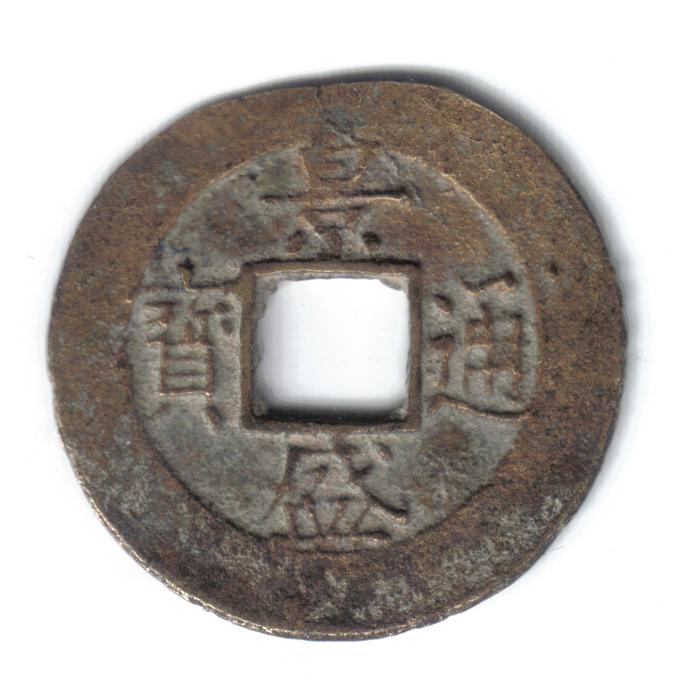 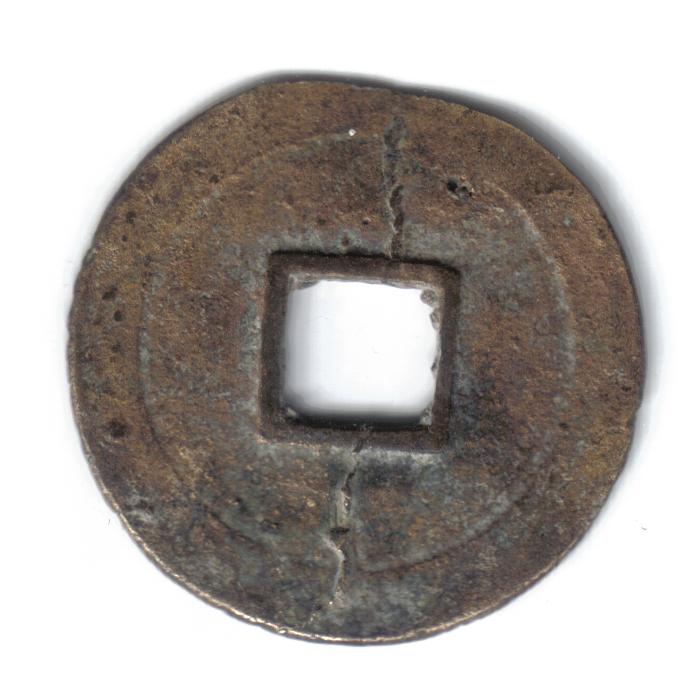 |
|
|
|
Pillar of the Community
United States
2605 Posts |
Actually this looks more like a Vietnamese cash (phan) coin. Many of those have a plain reverse. I'm not 100% sure but it looks very much like Krause C# 51.1 (the very first entry for Annam/Viet Nam in 1800's catalog). If it's true then it was issued under Emperor Canh Thinh, 1792 - 1801, cast brass (which may explain the line on the reverse).
Edited by svslav
11/11/2009 10:41 pm
|
|
Moderator
 United States
23731 Posts |
I agree it does appear to be 1 Phan from Viet Nam KM#160.1/C#51.1.
|
|
Moderator
Australia
16982 Posts |
Agreed; it's an Annamese cash coin. they don't have the Manchu mintmarks that Qing Dynasty Chinese coins have.
However, this doesn't explain the "two lines". It looks like a mould crack - the equivalent of a die crack for a cast coin. The crack seems to continue around and onto the obverse, at the top.
These coins were cast in fine sand; if the sand shifted before the brass was poured in, the molten metal would fill the crack. Such coins would normally be noticed and rejected, but I think quality control in Annam was much slacker than in China.
Further, it could be a privately made contemporary copy, with even more amateur coin smelting techniques than usual. From the way the crack carries right through the rim, it appears to me that this coin was never "finished off" properly - but I don't know if that's usual for Annamese cash.
Don't say "infinitely" when you mean "very"; otherwise, you'll have no word left when you want to talk about something really infinite. - C. S. Lewis
|
|
Pillar of the Community
 United States
3499 Posts |
Thanks for the input, everyone! Now that I look at my Krause, it looks as thought this coin may be a Phan, KM# 160.1. So if this guy is in fact real, how would you grade it (despite the crack in the mold)?
|
|
Moderator
Australia
16982 Posts |
I'd call it Fine; the pitting seems stronger than what one would expect just from the casting process.
Don't say "infinitely" when you mean "very"; otherwise, you'll have no word left when you want to talk about something really infinite. - C. S. Lewis
|
|
Valued Member
Canada
480 Posts |
I have seen similar breaks on coins from many of the asian countries- it is not uncommon on Vietnamese coins of this period, and also found, although not as frequently, on Chinese coins.
|
| |
Replies: 6 / Views: 1,977 |
|










 Posted 11/11/2009 10:39 pm


