| Author |
 Replies: 16 / Views: 6,856 Replies: 16 / Views: 6,856 |
|
New Member
United States
5 Posts |
I am just wondering what I have here. It says 1939 and as far as I can tell it also says Deurtches Retch on the front.   Identified - moved to World Coin forum - Sap Identified - moved to World Coin forum - Sap |
|
|
|
Pillar of the Community
Canada
1082 Posts |
Yep, German 5 pf, 1939. I can't make out the mintmark, but its under the "5" between the oak leaves.
|
|
New Member
 United States
5 Posts |
|
|
Pillar of the Community
United States
812 Posts |
That would make it a 5 Pfennig (5 Reichspfennig) coin, minted in Stuttgart.
Mintage of over 10 million.
|
|
New Member
United States
5 Posts |
So whats its value in U.S?
|
|
Pillar of the Community
Poland
3201 Posts |
The book says $1.00 in VF, $1.50 in EF. Not much, but better than the zinc ones.
|
|
Moderator
 Australia
16990 Posts |
...and for the record, it says "Deutsches Reich" on the front.  Fraktur Fraktur, the official font of Nazi Germany until about halfway through the war, is a difficult script to read, with some letters taking on peculiar shapes. Don't say "infinitely" when you mean "very"; otherwise, you'll have no word left when you want to talk about something really infinite. - C. S. Lewis
|
|
Valued Member
Australia
432 Posts |
Fraktur is fun - really hard to read at first, but after a little while, like any font, becomes pretty easy; The capital letters can be a challenge and you need to watch out for 'compound' letters (like 'tz' is often drawn as one character) but the umlauts and etc, look MUCH nicer in a Fraktur face (stuff like '#643;' which is generally pronouced as 's'; 'ß' - Eszett, sometimes also appears as '#383;#658;', which looks like 'sz' --> Straße)... Plus some of these letters show up on German coins:
The Reichskreditkassen 5- and 10-Rpf show 'Reichskreditka#643;#643;en' while Deutsches Reich is spelt 'Deut#643;ches Reich'...
|
|
Valued Member
Australia
432 Posts |
aww come on! The Character set doesn't allow me to display certain symbols here!
|
|
Pillar of the Community
United States
2605 Posts |
Zaggy, Would something like that help? 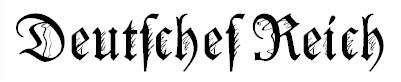 If you'd like to post special characters here, do it on your own program that allows it, take a snapshot of the screen (Ctrl + Print Scr) and convert it into an image rather than a piece of text. |
|
Pillar of the Community
Canada
1248 Posts |
How about:
Deutsches Reich.......... NOT f's, but s's
|
|
Pillar of the Community
United States
2605 Posts |
That's the thing! The characters in Fraktur may not look what you'd expect.
|
|
Pillar of the Community
Germany
1238 Posts |
Quote:
Would something like that help? Hmm. If you spell "Deutsches" in Fraktur, the first S would be a long one, as in your image. But the one at the end of the word should be round. Like ... in the very first image of this topic. As that Wikipedia article says, nowadays Fraktur is only used for newspaper names on front pages, or pubs  (if you want to convey "old", "traditional", etc., and in those cases you don't really care about a long S which in "regular" texts does not occur ... Christian |
|
Pillar of the Community
United States
2605 Posts |
If you'd like to experiment with different old fonts, including a handful of varieties of Fraktur, click here. You can type in any text you want. My example above was the "Iron Fraktur". |
|
Valued Member
Australia
432 Posts |
Ja hhb, as Chris says, the FIRST 's' (deutSches) should by the 'long s', while the SECOND (deutscheS) is the regular 's'... Chris being a German speaker can probably explain better, but the 'long s' and 'eszett' (the thing that looks like a 'B') are NEVER used as the first letter of a word, while the 'long s' can never be used as the LAST letter of a word - in all these cases, the Regular 'S/s' are used.
The Umlauts on the other hand, can be used as first letters - as for last letters, I do not know; I have never seen a situation where you could use the umlauts (ae, oe and ue = ä, ö and ü) as the last letter of a word...
Fraktur faces are fun - I've done a lot of reading of old German legal texts (Reichsgesetzblatt), publications and newspapers from the 20's, 30's and 40's. Once you come to grips with the forms, its actually quite 'pleasant' to read - that said, as soon as you loose any level of detail (for example through photocopying, blurry or low-res scan's), it becomes a NIGHTMARE. You cant make out the Capitals, and the 'long s' starts looking like an 'f', the 'eszett' becomes hard to make out... Handwriting is also difficult; documents written in very good hardwritting are WONDERFUL, but as soon it becomes rushed or just not as neat, again NIGHTMARE! I know Germans who cant read 75-80 year old handwriting...
Edited by Zaggy
12/10/2009 07:55 am
|
|
Pillar of the Community
Germany
1238 Posts |
As a rule of thumb you can say that in Fraktur the S is "round" at the end of a word or syllable; otherwise it is "long". But as I wrote, it is about as common in German these days as some blackletter script is in English. Now the Ä/ä, Ö/ö, Ü/ü and ß are "normal" characters that everybody uses (and which appear on every German keyboard) just like A, S, D, etc. The ß is indeed not used at the beginning of a word. In case you need to use ALL CAPS and have a name that has an ß (a passport maybe), you can theoretically use an uppercase ß. That character is part of Unicode (1E9E), and you can even use it with a computer http://www.signographie.de/cms/fron...hp?idcat=136 but I don't think it will ever become common. Christian Edited by chrisild
12/10/2009 09:49 am
|
| |
Replies: 16 / Views: 6,856 |







 Posted 11/20/2009 2:02 pm





