| Author |
 Replies: 39 / Views: 15,806 Replies: 39 / Views: 15,806 |
|
Pillar of the Community
3660 Posts |
Until I saw an 1876 dime that Bryan posted a picture of in a recent post, I had considered toning to be ugly and totally undesirable. Toning, to me, had always served to distract from, and even hide the strike and features on coins. Bryan's dime, which I have added pictures of here, presented itelf to me in a different light, and has actually made me a believer out of me.  I am now of the notion that it may depend on the coin or the coin type. I have yet to see a Peace dollar that I thought toning added a touch of beauty to, nor a Standing Liberty quarter for that matter.  I guess that since my previous notions on toning were so biased, that I never really paid any attention to toned coins. Now though, I would like to learn a bit more about them, and hope that some folks here may have some answers or at least opinions.  Is the most desirable toning a result of natural or artificial affect?  Is desirable toning restricted mainly to silver, or are metals and alloys such as nickel and copper also included?  I have a hard time telling sometimes, the difference between toning, corrosion and dirt. Is it the colors or the patterns that rate the aesthetic value of this phenomena?  Will toning adversely affect the coin over the long haul (60-100 years)?  I doubt that there is any question that chemically toned coins will probably suffer, but what 'is' the effect vs affect of natural toning?  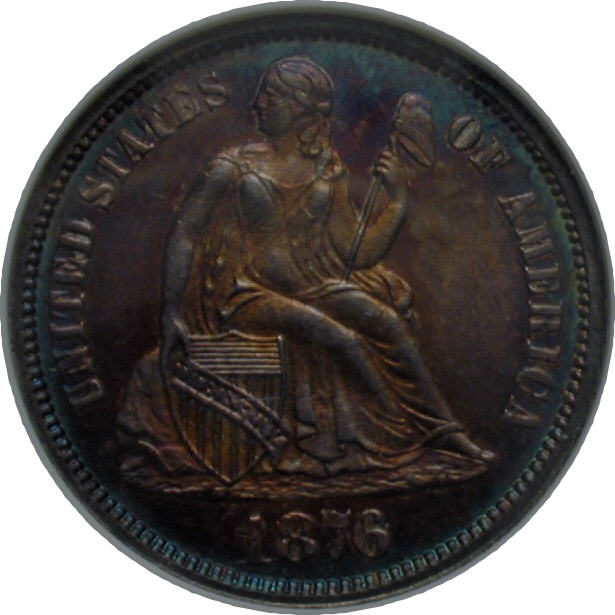 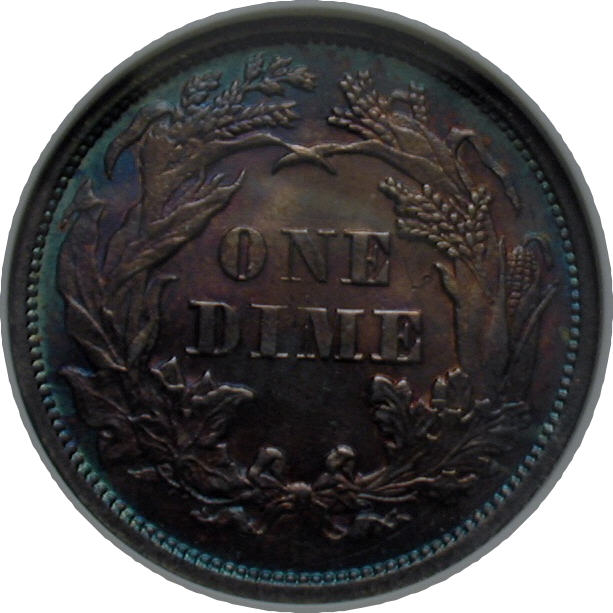 I am of the belief that without the toning on this coin the strike would not show up nearly as well. I really love this coin.  |
|
|
|
Valued Member
United States
434 Posts |
Luke... come over to the dark side.... I like it.
|
|
Bedrock of the Community
United States
14454 Posts |
Silver is usually the ones that tone beautifully like Morgans. Peace dollars do not tone well because the way the planchets were prepared before striking, it is hard to find a beautifully toned Peace dollar. Gold will tone but its not as reactive as silver is, copper turns brown and can also tone but seems like silver is more apt to tone from the environment easier than any other metal. Kind of like a silver candle holder that tarnishes when left out or even stored where the air can get to it easily |
|
Bedrock of the Community
United States
12437 Posts |
Quote:
Is the most desirable toning a result of natural or artificial affect? Natural, hands down. Natural toning can produce colors in the proper tones and shades that cannot be recreated by coin doctors. Most AT coins come out looking like an explosion at a paint factory  This Morgan is a good example of AT, notice the spotty "sprayed on" appearance-  Quote:
Is desirable toning restricted mainly to silver, or are metals and alloys such as nickel and copper also included? Nickel can tone nicely as well as copper, but silver tends to tone the easiest and prettiest. This 1950D Jefferson has rainbow target toning from long term album storage-   Quote:
Is it the colors or the patterns that rate the aesthetic value of this phenomena? Bingo Eye appeal plays a huge role in the desirability of toning. Anyone that says this Silver eagle is an ugly damaged coin needs an eye sight test(or maybe tested for colorblindness...)-   Quote:
Will toning adversely affect the coin over the long haul (60-100 years)? It can have an affect on a coin if it is continually subjected to the environment that causes the toning. Given enough time and exposure, the toning on silver can transition to grey or black  However, unless the coin is in a really harsh environment, this is a process that could take decades naturally. |
|
Pillar of the Community
 3660 Posts |
Peaceman, I assume that you are not referring to me, or maybe have me confused with someone else. My name is not Luke. I do like world coins though. Thanks very much bio and Bryan. Excellent explanations and photos, which lead me to further questions: In reference to silver, 'the way the planchets were prepared before striking' is a very interesting notion to me. I am rather ignorant of this concept. Would this be associated with the strip rolling, annealing, tallow application, sulfuric acid dip, and riddling? It seems to me that if it were a matter of specific density, weight would become an issue. Yes, I have considered the word 'toned' may be just a nice short word for 'tarnished'. Would the planchet preparation difference between the 1921 Morgan and Peace dollars of the same year also explain the stark contrast in the ratio of DMPL and PL examples to be found today between Morgan & Peace? I had rather assumed that die preparation played a major role in all of this, but your explanation is quite sensible. To achieve a high level of toning, a less granular coin is optimal? Possibly toning and PL surfaces somehow compliment and are dependent upon each other? I have seen the term ' nice chocolate color' referred to when advertising copper coins. I had presumed that this was in respect to toning? I have doubts now that it just may be inherent in the aging of the element 'copper'. |
|
Moderator
 United States
194504 Posts |
Quote:
Luke... come over to the dark side.... I like it. Quote:
Peaceman, I assume that you are not referring to me, or maybe have me confused with someone else. My name is not Luke. I do like world coins though. I believe that he was making a Star Wars reference. I have to admit it took me a lot longer than it should have to catch this, given the usual context of "Dark Side" in the Community! |
|
Pillar of the Community
3660 Posts |
Oh, I see buck, thanks for the interpretation. Star Wars came out before I was born, and I never saw the movie or got into the fad. (This causes the post to become even more of interest to me however. Was it something that I said)?
|
|
Moderator
United States
194504 Posts |
I think he was referencing the fact that you once thought toning was bad, but have now found an appreciation for it.  |
|
Pillar of the Community
United States
1304 Posts |
biokemist6,
I was looking at the 1950D I recently bought from you and I noticed it was starting to tone. I like it.
Wornslick
|
|
Bedrock of the Community
United States
14454 Posts |
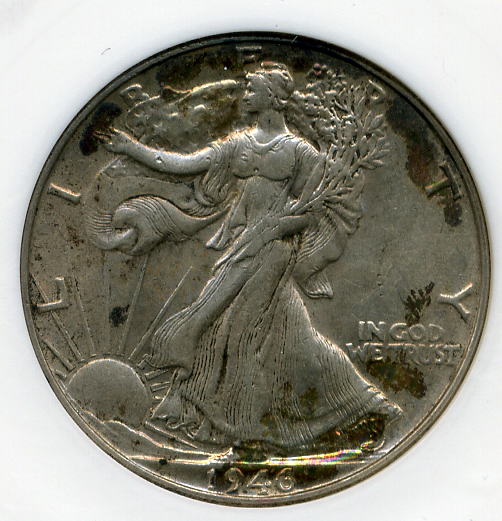
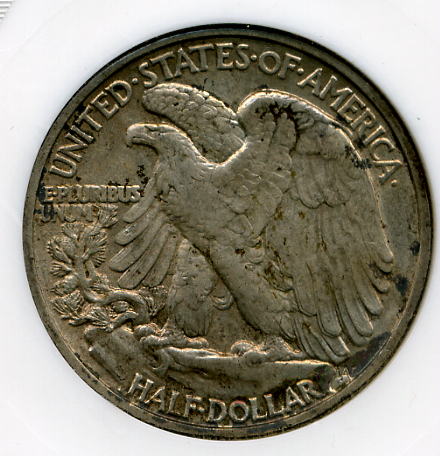
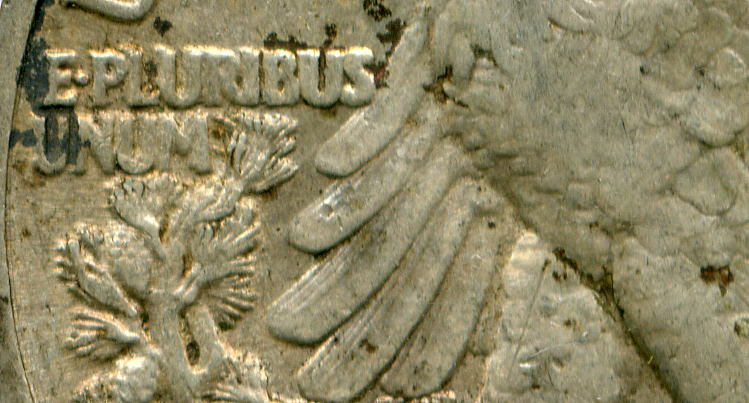
CP: Morgan dollars tone more beautifully than Peace dollars because the planchets of the latter were given a more concentrated acid bath at the Mint. Walking Liberty half dollars tend to acquire unbalanced toning as a result of their asymmetrical design. Many commemorative halves from the 1930s have "tab toning" resulting from their original cardboard holders. The same coin types can also tone in different ways. The toning of any given coin depends on a host of different factors, including how it was handled (oil and dirt from fingers and hands), how it was stored (canvas bag, paper bag, envelope, exposure to rubber band or glue, cardboard album, cardboard 2x2 holder, etc.), the quality of the external environment (heavily polluted, high humidity, sunlight, outgassing from different types wooden cabinets and bureaus, etc.), and external contaminants (different types of dust and dirt, grease, spilled coffee or beer, rain, moisture from sneezes and breath, and other stains whose consequences may be blatant or subtle). |
|
Pillar of the Community
3660 Posts |
Excellent Bryan !! A most excellent explanation.
|
|
Pillar of the Community
United States
1080 Posts |
Quote:Morgan dollars tone more beautifully than Peace dollars You got that right!  |
|
Moderator
Australia
16963 Posts |
Quote:
I have a hard time telling sometimes, the difference between toning, corrosion and dirt.
...
Yes, I have considered the word 'toned' may be just a nice short word for 'tarnished'. While "dirt" is foreign material that has somehow or other become attached to the coin's surface, from a chemistry point of view, there is no objective difference between "toning", "tarnish" and "corrosion". What coin collectors call "toning" and antique dealers call "tarnish" is really just a very, very mild form of corrosion. The Earth is not a very friendly planet for a numismatist. Our highly reactive mixture of atmospheric gases means that bright shiny metal does not, except for gold and certain rare platinum-group metals, occur naturally. From the moment a coin is struck, the Earth's environment is doing it's best to turn that coin back into the minerals from whence it came. In my opinion, it is our job as numismatists to try to slow this process down as much as possible. Quote:
Is the most desirable toning a result of natural or artificial affect?
...
I doubt that there is any question that chemically toned coins will probably suffer, but what 'is' the effect vs affect of natural toning? The two types of toning on a silver coin are caused by the exact same chemical process: reaction with atmospheric sulfur compounds, such as hydrogen sulfide. Intrinsically, they're the same. The aesthetics, however, are different; the "coin doctors" try to imitate the "naturally occurring" toning colours and patterns. The "bad" coin doctors fail, miserably. The "good" coin doctors that have worked out a method of making "market acceptable" toning are probably getting away with it. It's kind of like comparing a Van Gogh painting with a paint-by-numbers I did when I was ten. Both are "intrinsically the same", just splotches of paint on a canvas. But people will pay millions for a Van Gogh (or a well-made fake Van Gogh), while my childhood artworks are valued by no-one except my mother. The difference is all in the aesthetics. Quote:
Is desirable toning restricted mainly to silver, or are metals and alloys such as nickel and copper also included?
...
I have seen the term 'nice chocolate color' referred to when advertising copper coins. I had presumed that this was in respect to toning? I have doubts now that it just may be inherent in the aging of the element 'copper'. Pure gold won't tone; not unless it's been exposed to an atmosphere much more reactive than ours. The .900 fine alloy used for American circulating gold coins will tone slightly, due to corrosion of the copper diluent. But if you could bury a .999 fine gold bullion coin in the ground and dig it up a few million years later, it would still look the same. Silver is almost as chemically unreactive as gold; it'll take a long, long time for a silver coin to turn back into silver ore. This is mainly because metallic silver does not readily form silver oxide by reacting with air; you need to hit it with something wierder, like ozone. Sulfur is one of the few things it will react with, forming dark-coloured silver sulfide tarnish. Chlorine is another; silver chloride, or "horn silver", will turn a silver coin greyish-white. Chlorides can't get airborne as easily as sulfides, so silver chloride formation is only a problem in salty places, like near a windy seashore, or if a coin is buried in salty soil, or if lost at sea (eg. shipwreck salvage). In short, while a silver coin will easily "tone", it won't easily "corrode". Other metals, suck as copper, zinc, nickel, iron, and the exotic alloys many modern coins are made of, are all much more reactive than either silver or gold, especially with other elements in the atmosphere such as oxygen. Coins made of these materials can develop thin films of corrosion just like a toned silver coin, but this toning is usually just the first step on the way to corrosion and eventual full mineralization. A "chocolate-coloured" copper coin has a nice thin layer of copper oxide on it. Ancient copper and bronze coins that have been buried in the ground for 2000 years often have a "tone" or "patina" that can be more than half the thickness of the actual coin, with only a small core of actual metal remaining. So in short, "silver toning" is more usually found, and more usually talked about, because it's a lot harder to stop the corrosion process for a base metal coin at just the right moment to create "toning" before it evolves into full-blown "corrosion". The number of otherwise "nicely toned" copper coins that are starting to turn green can attest to this. Don't say "infinitely" when you mean "very"; otherwise, you'll have no word left when you want to talk about something really infinite. - C. S. Lewis
|
|
Pillar of the Community
3660 Posts |
Ah Sap, you speak-a my language. I cannot express how refreshing it is to discover those as yourself, Bryan and several others here who possess the ability to take things down to the most basic of levels; to the science, mechanics, and history behind the coins and banknotes, which to me, transcends the typical question of "Identify this coin for me and tell me ow much I can make off of it."
|
|
Valued Member
United States
118 Posts |
this thread makes me want to find a nice toned coin haha
|
|
Pillar of the Community
3660 Posts |
|
| |
Replies: 39 / Views: 15,806 |
To participate in the forum you must log in or register.
Disclaimer: While a tremendous amount of effort goes into ensuring the accuracy of the information contained in this site, Coin Community assumes no liability for errors. Copyright 2005 - 2026 Coin Community Family- all rights reserved worldwide. Use of any images or content on this website without prior written permission of Coin Community or the original lender is strictly prohibited.
Contact Us | Advertise Here | Privacy Policy / Terms of Use
|
| Coin Community Forum |
© 2005 - 2026 Coin Community Forums |
| It took 0.63 seconds to rattle this change. |
 |
|










 Posted 01/20/2010 10:25 am