Bought this one, unidentified, a couple of years ago from a local dealer. It's in pretty sorry state, but I thought I could read enough of the legend once I got it home to get an ID.
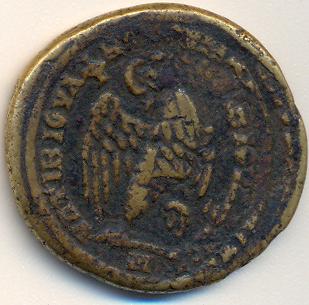
I was wrong. The only part of the legend I could unambiguously read was "TIBI", from about 8 o'clock to 9 o'clock on the pic. There's also the greek letter phi (looks like a TIE figher from Star Wars [:p]) at about 11 o'clock, so I knew it was Greek Imperial, bit that's all I knew so far.
Curiously, the exact same legend seems to repeated on the other side,
inside the eagle's wing. Obviously it was struck off-centre, so the ancient mint-worker had another whack at it, only between whacks it was rotated a full 180°. Unfortunately, it makes the job of IDing harder. I haven't tried to show you the obverse, it's in even worse state - a fuzzy blur which you can see was someone's portrait once, and the letters AVT - but that's it. Equally unhelpful.
It's sat in my "Unknown Greek Imperial" file until today - when on a whim I tried the
Wildwinds partial legend search engine. I hadn't tried before because the site was down for maintenance when I bought the coin. I entered "TIBI" in the field and...
Magic! There it is, number 1 and number 4 in the list - it's from the city of Marcianopolis, in modern-day Bulgaria on the Danube frontier of the Empire, during the reign of emperor Severus Alexander (222-235 AD). Unfortunately, the name of the city itself is in the "missing" part of the legend. Even knowning now what it's supposed to say, I can't read it there. But at least it's one less unidentified coin.

Don't say "infinitely" when you mean "very"; otherwise, you'll have no word left when you want to talk about something really infinite. - C. S. Lewis










 Posted 06/06/2006 9:01 pm


