| Author |
 Replies: 10 / Views: 2,316 Replies: 10 / Views: 2,316 |
|
|
Valued Member
United States
232 Posts |
Hello, I was looking at the currency production figures (get them here: http://www.moneyfactory.gov/uscurre...figures.html) and I noticed that in 2009, 2008 and 2006 more $100 bills were produced than $20 bills. What are all these bills used for?  When I see $100s it is on TV as part of something illegal, or the grand prize in a poker tournament. I know that some folks just pay cash for everything, but I assumed that many more $20 would be used. Are these bill used for some sort of transactions between businesses or between banks? Do nations that have dollars as part of their foreign reserve like to keep some part of that as actual bills? Any insight is appreciated. Thanks |
|
|
|
Moderator
 United States
6563 Posts |
I have heard that there are more $100 US notes overseas then stateside. Never did find any facts to back that up though
|
|
Pillar of the Community
United Kingdom
2838 Posts |
3/4s of $100 bills are outside of the US - they are used in countries with fluctuating currencies (Russia was a big user in the 90s and Africa is now) as the $ has generally been stable in the past. It means local wealth can be protected from these fluctuations and still easily converted back into the local currency when needed as $s are accepted worldwide.
The reason its all 100s is because its the largest available US note. The larger the note the better for storing and transporting etc. Surprisingly this has worked well for the US as initially they never expected the notes to get back home so it worked as a huge interest free loan.
More recently though with the Euro becoming known and trusted many people are now keeping 500 Euro notes ($684) instead.
The dollar has also in the past been the chosen currency for shady dealing throughout the world, again because everyone accepts it and it was stable.
Edited by bobbyhelmet
03/11/2010 10:41 pm
|
|
Pillar of the Community
United States
1523 Posts |
When traveling overseas I always use 100's because in countries like The Philippines,Thailand you get a much better exchange rate.
|
|
Pillar of the Community
Canada
3692 Posts |
How come the $50 bill was discontinued during some runs?
|
|
Pillar of the Community
United States
3098 Posts |
Yup, I think overseas is correct. When I went back to China this year and asked for dollars to bring back (to pay for tuition) all the notes were Series 2006 (Cabral-Paulsons). I commented that these new notes weren't even widely available yet in the states, and the teller commented "China's sending goods for America's paper. It's just how the word works."
|
|
Moderator
 Australia
17025 Posts |
Quote:
Are these bill used for some sort of transactions between businesses or between banks? In this day and age, physical movement of bits of paper is avoided if possible. Most high-value above-board interbank and inter-business transactions are electronic. Quote:
Do nations that have dollars as part of their foreign reserve like to keep some part of that as actual bills? Some do, but most are content with electronic holdings. Most of the physical notes held by foreign governments would be held by governments unfriendly to the US, such as Libya, North Korea and Iran. Dollarized economies (countries which have declared the US dollar to be their own currency) would need to acquire supplies of US notes for their own people, but they'd presumably need the same mix of notes the US itself uses, with a few local variations. Ecuador, for instance, hates your $1 note (they simply don't last long enough in circulation under equatorial conditions) and imports quantities of golden dollars to use instead. Most of the actual physical $100 notes held overseas are in private, not foreign government hands. Besides the drug barons and organized criminals, ordinary wealthy foreigners and legitimate businesses often prefer to store at least some of their wealth in the form of physical US notes rather than their own country's notes, because they trust in the stability of the US dollar more than they do their own country's money... or their own country's banking system. Don't say "infinitely" when you mean "very"; otherwise, you'll have no word left when you want to talk about something really infinite. - C. S. Lewis
|
|
Pillar of the Community
United Kingdom
2838 Posts |
An excellent example of foreign use of US$s is in Zimbabwe. Their inflation was 240,000% in 2009 - In real terms that meant that anything you bought today would cost double tomorrow. This hyper-inflation meant that the government had to keep issuing larger and larger notes. Below is a Zimbabwean $100,000,000,000,000 note - It could only buy you a dozen eggs! At one point the size of the wad of notes needed to buy a loaf of bread was larger than the loaf itself! 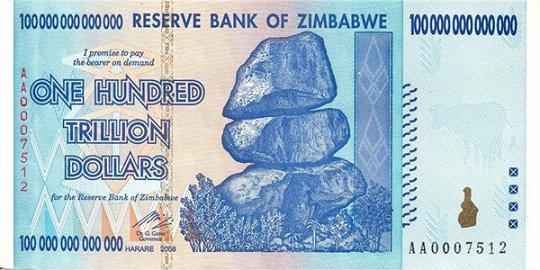 If you had Zimbabwean money at this time it meant that every day that went by its value halved so most people converted all their cash into US$s. Even though its a very poor country they still have small number of super-rich who needed to do this. Workers would not work unless their bosses paid them in US$s so all the companies had to convert to US$s too. Eventually the country gave up on their own money and they only use US$s, £s, Euros, Rands and Pula now. |
|
Valued Member
United States
323 Posts |
Haha, I love the Zimbabwean $100,000,000,000,000 note. I wonder how much that costs?
|
|
Pillar of the Community
United States
3098 Posts |
I think average ebay price is around $5 shipped. |
|
Pillar of the Community
United States
535 Posts |
Quote:
How come the $50 bill was discontinued during some runs? The bills are printed based on demand from the FRBs If the banks arn't asking for them, the BEP doesn't print them. People don't use $50's as much, so there is less of a demand, so fewer are printed. Look at the production figures for $2. Very little demand for those, so they are only printed every few years. The $2 Federal Reserve Notes have only been printed on 4 different series - 1976, 1995, 2003, 2003A. |
| |
Replies: 10 / Views: 2,316 |
|







 Posted 03/11/2010 10:38 pm


