Coin Community Family of Web Sites Join Thousands of Coin, Bullion, & Money Collectors
Coin, Banknote and Medal Collectors's Online Mall 300,000 items to help build your collection! Vancouvers #1 Coin and Paper Money Dealer Royal Canadian Mint products, Canadian, Polish, American, and world coins and banknotes. Specializing in Modern Numismatics Royal Estate Auctions - $1 Coin AuctionsJoin Thousands of Coin, Bullion, & Money Collectors


Username:
Password:
Save Password
Forgot your Password?


This page may contain links that result in small commissions to keep this free site up and running.

Welcome Guest! Registering and/or logging in will remove the anchor (bottom) ads. It's Free!

1929 National $20

To participate in the forum you must log in or register.
Author Previous TopicReplies: 6 / Views: 4,807Next Topic  
Valued Member
adco1149's Avatar
United States
147 Posts
 Posted 05/08/2010  12:43 am Show Profile   Bookmark this topic Add adco1149 to your friends list Get a Link to this Message Number of Subscribers
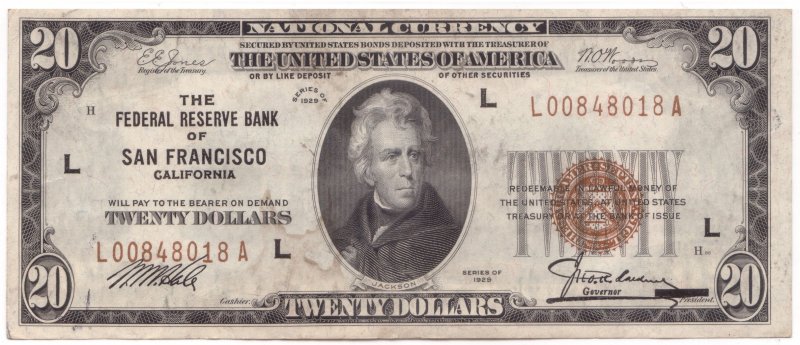
Anyone tell me the difference between Type1 and Type2?
Can't seem to find info.

Also there are no folds or creases, just that nasty stain
to the bottom left of portrait. How much will that affect
value?

I have two of these and thinking of putting this one on
ebay. Trying to set starting price.

Any thoughts are always appreciated. Thanks


1929-National-$20

1929-National-$20

Edit to add punctuation and spelling
Edited by adco1149
05/08/2010 12:46 am
Valued Member
Whytlash's Avatar
United States
407 Posts
 Posted 05/08/2010  03:14 am  Show Profile   Bookmark this reply Add Whytlash to your friends list Get a Link to this Reply
"Backed by bonds deposited with the Federal Government, this kind of money says "National Currency" at the top center of the note. These notes were issued by banks who received a Charter from the United States government allowing them to issue money. The Government Printing Office printed these notes with the same design except for the name of the banks, signatures of the bank officers and the Charter number. National Currency notes were made from 1863 to 1929.

The 1929 notes are the only small size notes and come in two types. The Type I note has a brown seal with the charter number only in large black numerals. Type 2 notes have in addition the charter number printed with brown letters near the serial number of the note."

This will not apply to the note you have shown as it is a Federal Reserve Bank Note, issued by one of the branches of the Federal Reserve rather than a Chartered Bank that the above types apply to.

I have a full set of $5 to $100 all FRBN's, from VF to CU and were all fairly reasonable in price. Pricing is dependent on the Federal Reserve Branch the note is issued from as well as condition. The stain, as I see it, is not that bad and I'd figure it to knock maybe 10% off the value of this note. Some may think more though.

The notes issed by chartered banks seem to carry much more value than FRBN's, probably due to a lower population. Although 14,000 charted banks produced notes, many were not in large quantities. Some day I should acquire AT LEAST one of those!

Additional info:

"Today, collecting National Currency notes is very popular and a lively collector market exists. However, there were more than 14,000 issuing banks all over the United States making this a very complex area to value. You should take your note to a numismatic expert that has access to a special register of these banks. This register lists how many notes were printed as well as the number outstanding when the bank was closed. It also lists approximate prices that these notes are worth.

The most common National Currency notes seen are worth 100% to 400% above face value in average circulated condition."

Hope this helps,

Steve
Valued Member
Whytlash's Avatar
United States
407 Posts
 Posted 05/08/2010  03:32 am  Show Profile   Bookmark this reply Add Whytlash to your friends list Get a Link to this Reply
Type 1

1929-National-$20

Type 2

1929-National-$20

Steve
Pillar of the Community
wd1040's Avatar
United States
3098 Posts
 Posted 05/08/2010  04:02 am  Show Profile   Bookmark this reply Add wd1040 to your friends list Get a Link to this Reply
Scranton? Scranton?! Haha... I get that reference :D

I don't think the stain would detract from the value that much. Although paper color isn't at is best, having no folds still makes it very attractive.

Also, is it true that the ones issued by smaller banks cost more than those issued by the FRBs?
Valued Member
Whytlash's Avatar
United States
407 Posts
 Posted 05/08/2010  04:40 am  Show Profile   Bookmark this reply Add Whytlash to your friends list Get a Link to this Reply
Although it is stained, it doesn't appear, from the scan, to detract significantly from the note. It appears to be about EF and is not unattractive. But it will take some value simply because it exists, and you can see it.

When I was hunting down 29's for my collection I saw a lot of notes. Although all banks are "smaller banks" compared to the Federal Reserve, many of the banks that were chartered were not "smaller banks". We're simply talking about a Bank or the Fed. In all that looking I did, National Banknotes (the chartered bank notes) had higher prices than a comparable note issued by the Fed. Some of them SIGNIFICANTLY so. The populations are much smaller than the Fed notes, and collectors often buy them based on an emotional attachment to the chartered bank location.

Rummage through the notes on ebay (National Currency, then sorted for 1929) and you'll see some of the pricing I'm talking about. It's not a hard and fast rule, some have reasonable values, but many are a bit pricey. There are some FRBN's that have substantial values, but a large percentage are reasonable. For example, I believe all of mine are from the Chicago branch, and it had a very high issue quantity (may have been the highest) across all denominations. That makes them quite reasonable and would be why I have them - because I got them at a good price. I wasn't looking for particular rarity, or a particular branch, just an attractive example of the note that goes in the album between 1928 and 1934.

And by the way, what happens in Scranton stays in Scranton!

Steve
Valued Member
adco1149's Avatar
United States
147 Posts
 Posted 05/08/2010  1:13 pm  Show Profile   Bookmark this reply Add adco1149 to your friends list Get a Link to this Reply
My thanks for opinions.
Pillar of the Community
3660 Posts
 Posted 06/29/2010  02:14 am  Show Profile   Bookmark this reply Add zeewool to your friends list Get a Link to this Reply
Adco, allow me to clear things up for you as there seems to be great confusion here as to the differences between three very different types of US currency, National Bank Notes, Federal Reserve Notes, and Federal Reserve Bank Notes.

The Federal Reserve Bank Note (FRBN) is what you have pictured. There is no such thing as type 1 or type 2. They are all the same.

What Whytlash described is not an FRBN, but what is known as a National Bank Note (NBN). Although FRBN and NBN share a very similar appearance, they are very different animals. (Like comparing Silver Certificates to United States Notes). I will try to explain the best I can:

National Bank Notes were first issued (via charter) in 1863 (as large size notes) under the National Banking Act of that same year. The notes were printed by the US government and issued to private banks across the nation. These private banks were required to deposit government bonds with the Treasury in order to be issued NBNs. The bank could then circulate NBNs up to 90% of the face value of the bonds that they had on deposit at the Treasury. If a bank were to fail, and many did, the NBN became an obligation of the US Government rather than the failed bank (however, the failed bank lost all interest in its bond on deposit). This relationship between the government and the private banks continued until the government no longer renewed the charters with these private banks after 1929.

In 1913, another government act known as the Federal Reserve Act became law, and the Federal government set up 12 Federal Reserve Banks across the nation. They remain today in the same capacity of issuance as they were then. The government prints the money, ships it to each of these twelve Federal Reserve Banks, and the FRBs distribute the notes into circulation. The first Federal Reserve Notes were printed and issued in 1914 as large size notes.

The Federal Reserve Act was created to get a handle on the nation's currency crisis which in essence was a tidal wave of failing private banks (broken banks). Rather than currency floating around with the name of a bank that no longer existed, the Federal government would issue the money (Federal Reserve Notes) directly from its own banks (the 12 FRBs). By 1918, the FRNs accounted for the vast majority of all bank notes in circulation (including National Bank Notes, United States Notes, Silver Certificates, Gold Certificates, etc).

Federal Reserve Bank Notes or FRBNs (also authorized by the Federal Reserve Act of 1913), were intended to be the replacement for the National Bank notes, and were first issued in 1915, and again in 1918.

The price of silver rose significantly in 1918 however, and it became far more profitable for the government to melt down silver dollars and sell the silver abroad. Since the Silver Certificates circulating at that time were backed by silver dollars, if the silver dollars were melted, the silver certificates had to be removed from circulation. Hence the Pitman Act of 1918. Three hundred and seventy million silver certificates were removed from circulation (to correspond to that number of silver dollars melted) and were replaced with FRBN. (The death of the National Bank Notes would have to wait).

In 1921, silver prices fell, and silver dollars were back in production big time at the mints, and so were silver certificates to back them up. By the mid 1920s, the FRBNs had served their purpose and were pretty much out of circulation. In 1928, the change over from large size notes to small size notes took place.

Although all small sized FRBN are dated 1929, they were not actually printed until four years later as a form of emergency money. All FRBN were hastily printed in March 1933, in response to a 'heads up' concerning the US departure from the gold standard. All gold coins and Gold certificates were recalled in the spring of 1933. The small sized FRBN now served the purpose of replacing gold certificates, and as the Treasury saw it, the FRBN had the advantage of not requiring the 40% gold cover that the FRN of that era did. (Look at your 1928 FRN gold clause).

Being a rush job of emergency notes, there was not sufficient time to design and develop new plates to print the small size FRBN, and the Treasury did not want the FRN's gold clause to be an obligation of this note as the current FRNs would also have to be removed from circulation as well, so the most practical thing to do was to use what was handy, and that was the plates of the 1929 NBN.

So many FRBN were printed in March of 1933 however, that many of them were not actually issued until the WWII years of 1942 and 1943.

I know that was long and dry, even though I really did try to condense a major block of US history there, so if clarification is required, just say so.


Large size FRBN
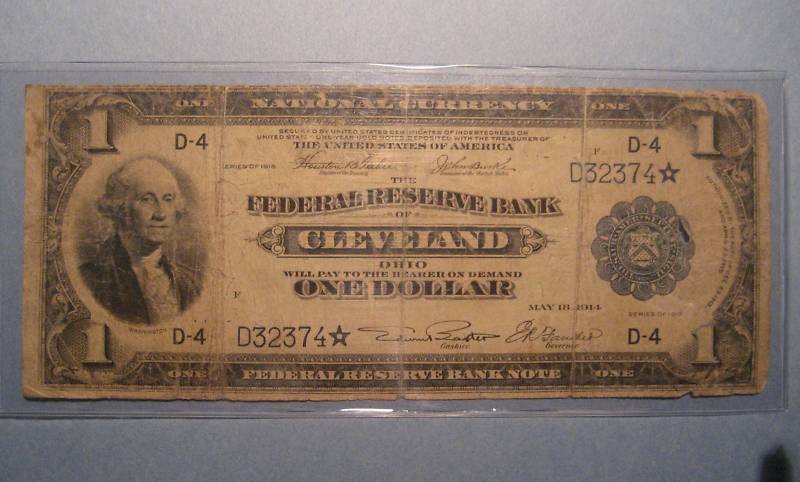

1929-National-$20


Small size FRBN (lowest known serial on a Chicago $100)
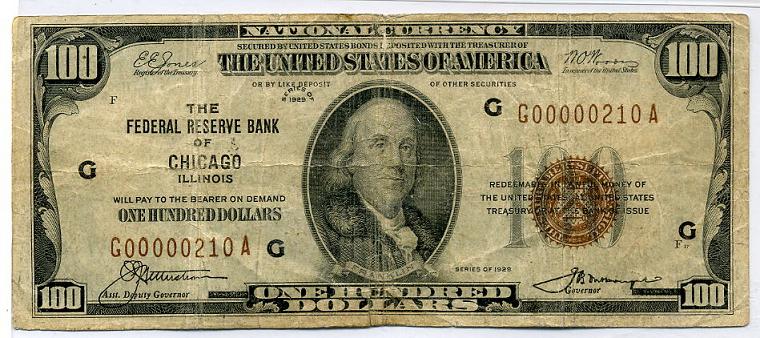


1929-National-$20
Edited by zeewool
06/29/2010 08:21 am
  Previous TopicReplies: 6 / Views: 4,807Next Topic  

To participate in the forum you must log in or register.


Disclaimer: While a tremendous amount of effort goes into ensuring the accuracy of the information contained in this site, Coin Community assumes no liability for errors. Copyright 2005 - 2026 Coin Community Family- all rights reserved worldwide. Use of any images or content on this website without prior written permission of Coin Community or the original lender is strictly prohibited.
Contact Us  |  Advertise Here  |  Privacy Policy / Terms of Use

Coin Community Forum © 2005 - 2026 Coin Community Forums
It took 0.34 seconds to rattle this change. Forums