| Author |
 Replies: 15 / Views: 4,667 Replies: 15 / Views: 4,667 |
|
|
New Member
United States
1 Posts |
|
|
|
|
Valued Member
United States
407 Posts |
Hi there, and welcome to CCF!
What you have is pretty much what you see;
1934 $10 FRN (Federal Reserve Note)(Light vivid yellow/green seal-also called Lime Green seal)
1934A (Series A) $10 FRN (green seal)
1934 $10 Silver Certificate (blue seal)
1963 $5 United States Note (red seal)
1963 $2 United States Note (red seal)
(2) 1957 $1 Silver Certificate (blue seal)
Unfortunately, in the condition shown, they do not have much value. The two '34 FRN's are about $12 each, the '34 Silver Certificate is about face value, $10, the $5 red seal about $10, the $2 red seal about $5, and the two $1 Silver Cert's about $2 each.
I can't help you with the foreign notes, but I think the 50 Centavos is Japanese Occupation money of the Phillipines.
Hope this helps,
Steve
Edited by Whytlash
05/23/2010 6:04 pm
|
|
Pillar of the Community
United States
3098 Posts |
The Philippine note is exactly what Whytlash said: Japanese Occupation money or Japanese military currency. There's good information online about those so I'll leave you to that and google. However, the two holes mean two things: that it was canceled after the war, or they were dropped by airplanes as propaganda to the Japanese controlled areas. The holes prevented the Japanese from using it, and upset the Japanese-controlled economy.
|
|
Valued Member
United States
407 Posts |
Well, I guess he wasn't wondering too hard.....  |
|
Pillar of the Community
3660 Posts |
Paid $75 for $39 face value? Now is a great time to start wondering too. (Phil might be a congressman).
|
|
Valued Member
United States
407 Posts |
Face value isn't really the issue. Condition is. These notes just don't happen to be in a condition that will price them, as a group, at even 2x face. If they had, his $39 face would have a value of $78. Given the condition of the notes, the most I can see is $53 of value. Still more than face but not equal to what he paid.
That's the, sometimes, unfortunate result of thinking that just because something is old it has value, and not having prior knowledge of even a general value based upon condition.
Under the right circumstances, 2 1/2 times face can end up yielding considerable profit. There are many notes (and coins) that hold considerable value in close to the same condition. These just don't happen to be any of those.
One good example is the 1899 $5 silver certificate, otherwise known as the "Chief" note. In a condition similar to any of these, that $5 face carries a value of $200 to $500. I'd gladly plunk down $12.50 for a Chief in the condition of any of the above notes. I'd even go "over the top" and go 5x face, or 10x face. $50 for a $200 note? All day long man, all day long!
Steve
|
|
Pillar of the Community
3660 Posts |
Very interesting Steve. I am not a dealer, or even a 'serious' collector of banknotes, so I really am not armed with much knowledge of value on such notes. I have always been more interested in the historical process rather than the collector value of banknotes. Given the pictures above (although I do like the colors), I didn't see anything that I would hesitate in spending, as I saw no value beyond face (to me). I do have a few red, blue, green, etc notes that I keep in plastic, no large hoard. I even have a few of the big size notes that I keep because I just like the designs. Maybe if I can dig them up and post a few pictures, you might attach a collector value to them for me?
|
|
Valued Member
United States
407 Posts |
I love the history of our coinage and paper currency. Actually, diversity used to be the watchword for our notes. I think there is a consensus that over the years we have lost the creativity of design and relegated our paper to a more utilitarian nature. Prior to 1928, when the first "small size" notes (our current size) were printed, the designs were often works of art. Our paper money not only served the function of daily commerce, but also told, very often, the "Story of America". One of my favorites in that regard is the 1914 series of notes, from the $5 to the $100. The reverse of each note bears two vignettes signifying an important topic in American history. The $5 illustrates Columbus sighting land and the Pilgrim's landing at Plymouth. The $10 illustrates farming and industry. The $20 shows a steamship and locomotive signifying transportation. The $50 shows an allegorical figure of Panama between a merchant ship and battle ship, and the $100 bears allegorical figures representing labor, plenty, America, peace, and commerce. I have all but the $100. I have to leave something "yet to be acquired! Plus, it's the most pricey. I like this series because, in comparison to other years, they are still quite affordable, even in higher grades. There are some much more valuable notes in earlier years, particularly the "Educational" notes from 1896. Here's the Wiki on those (get out your checkbook!) http://en.wikipedia.org/wiki/Educational_SeriesIf you want to picture your notes I can give you a fair read on their value. Being large size notes, it might surprise you. But never discount those small notes, some have exceptional value. A few years ago I nailed a 1934 $1 Silver Certificate in AU-CU for $90. That's 90 times face for those keeping score.  But the 1914 $50 (just last year) in EF-AU was only 5 1/2 times face. But that's nothing compared to the first 1909vdb Lincoln Cent I purchased many years ago in BU for $10. That's ONE THOUSAND TIMES FACE VALUE! So if you really want to "save" money, buy larger denomination stuff. A good clean $500 bill will only run you about 2-3x face. I still haven't conned myself into pulling the trigger on one of those. Or the "Big G". Sitting on a thousand dollar note that "only cost me" two or three large makes the hair stand up on the back of my neck! Hope this helps, Steve |
|
Pillar of the Community
3660 Posts |
Yeah Steve. Here is one that probably relates to the condition of the OPs notes. Value= $200 ? 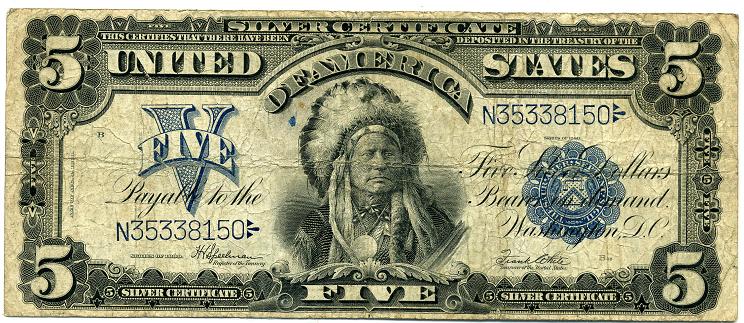 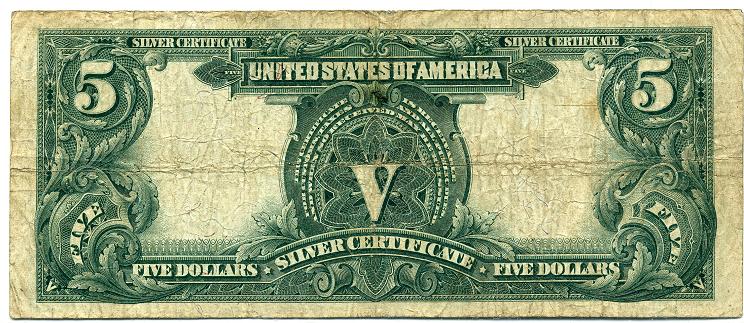 |
|
Valued Member
United States
407 Posts |
That's the one I was talking about earlier. $200? Not a chance! Are you out of your mind? Look at the condition that poor thing is in! It looks like it just crawled out from under a rock!  But, I feel for you. I'm so generous I'll give you two crisp new Bennies for it if you really want.  I dropped out on an auction on one of those a few months ago in lesser condition at $350. Couldn't justify it for the grade. Yours is no less than VG 10, could possibly make a Fine 12, but not any higher than that. It is complete with an overall pleasing circulated appearance. The only distraction, and it's not much of one, is the red and blue dots to the left of Onepapa. Here's a recent auction with a PMG Fine 15 for comparison: http://cgi.ebay.com/1899-5-SILVER-C...EF_W0QQitemZ a href= https://www.coincommunity.com/go/link.asp?target=https://www.ebay.com/itm/-/350090731113 target= _blank rel= nofollow 350090731113 /a QQcategoryZ149945QQcmdZViewItemQQ_trksidZp4340.m263QQ_trkparmsZalgo=SIC&its=I%252BC&itu=UCI%252BIA%252BUA%252BFICS%252BUFI%252BDDSIC&otn=20&pmod=140412047294&ps=63&clkid=7960048384389280020 What you've got is a hunk of paper with a cool picture on it that should bring anywhere from $300 to $500 depending on the day of the week and which way the wind is blowing. The market is like that. Especially now when a lot of people are looking hard at their elective spending. But, being a desirable note, with no major flaws, other than that noted, I think you could get $350 for it fairly easily. [DISCLAIMER: All indications given regarding condition are only opinions. I am not a classically trained paper currency grading expert. I only play one on the Internet.] Hope this helps, Steve |
|
Pillar of the Community
3660 Posts |
Yes it does Steve. Thanks! Here's one more. This one might measure up to the original pictures in this thread. (At least I think it might). 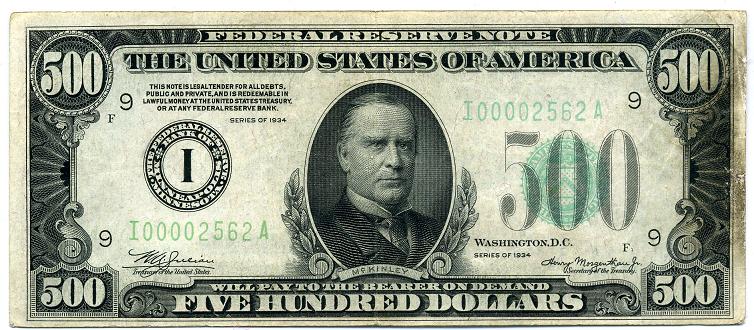 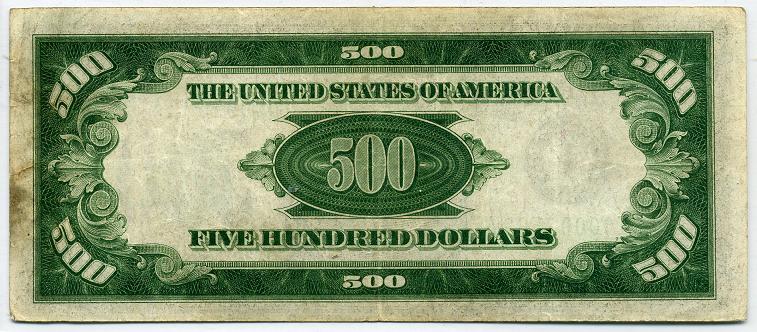 |
|
Valued Member
United States
407 Posts |
Appears VF, about a VF30, due to the smudging or staining on the right side (which might drop it to a 25), and there appears to be a pinhole to the lower left of McKinley's ear(that seems to show through to the watermellon on the reverse) and possibly one on his cheek.
Nonetheless, it's in the about the $750 range. The quad digit serial might help it a bit.
A nice note.
Steve
|
|
Pillar of the Community
3660 Posts |
Amazing Steve. I don't see how folks can keep up with all of these value figures which must change constantly. 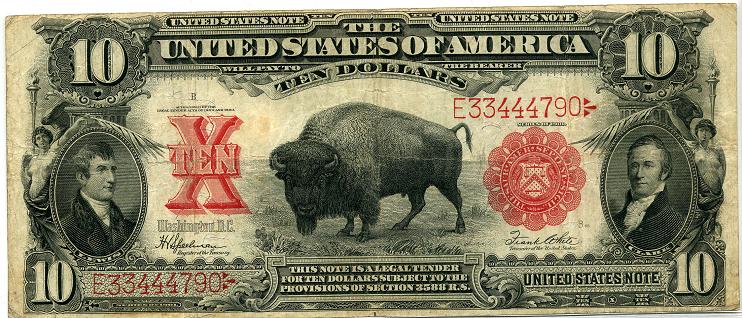 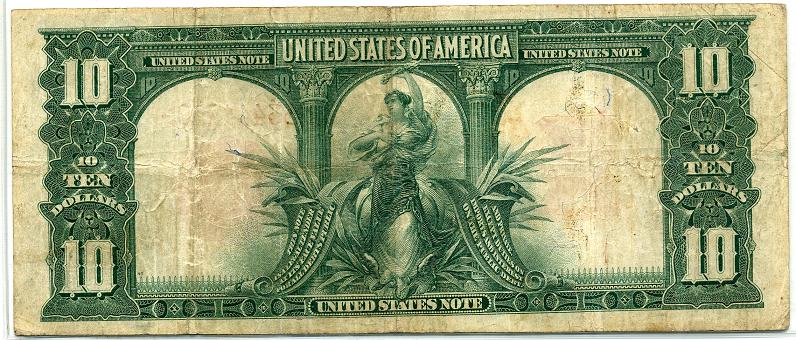 |
|
Pillar of the Community
3660 Posts |
Do you think that this 1928 rag is worth anything at all over face? 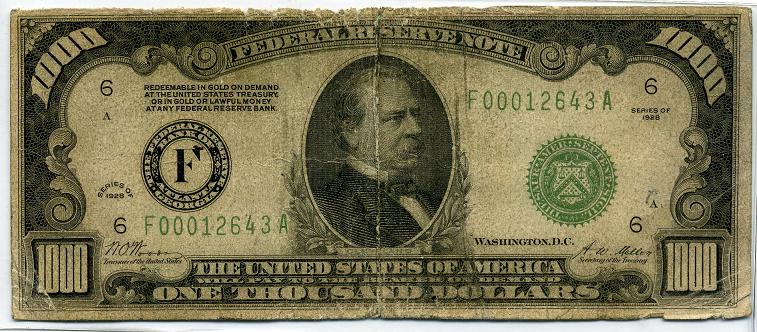 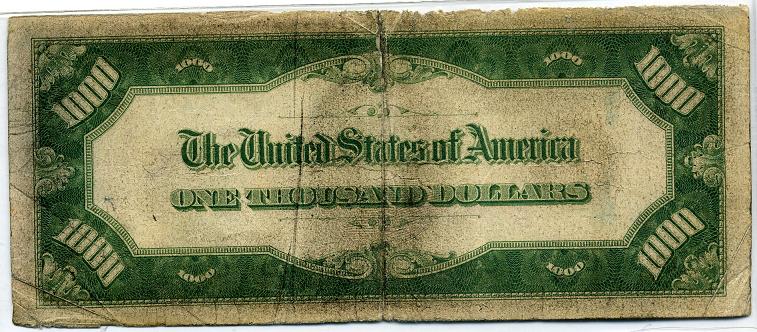 |
|
Valued Member
United States
273 Posts |
zeewool you have some really nice notes. Did you get them from a family member or something? That Lewis and Clark Bison note is awesome! I would love to have one and yours appears to be in at least very fine 25 shape. I would guess it is pushing $1000 in value. As for the $1000 yes it is a rag but it is still cool and still worth about $1200 to $1300 or so. As Whytlash states what I said is a matter of opinion and my opinion is you have some really nice bank notes  |
|
Pillar of the Community
3660 Posts |
I appreciate your saying so siuoL, but I do realize that only the types are nice; the examples are not. No melt value, (and even less burn value). I am trying to get on the bandwagon with star notes, but I have a hard time seeing anything scarce or special about them at all. I went through a box of old notes I came across in my basement this morning and it seemed as though at least 25% of the notes that I looked at were stars. Are some of the emergency issue or earlier silver certificate stars more desirable than modern FRN? Yes, most were from family. I also realize that this note is not a star note, but it is one of my favorite designs. 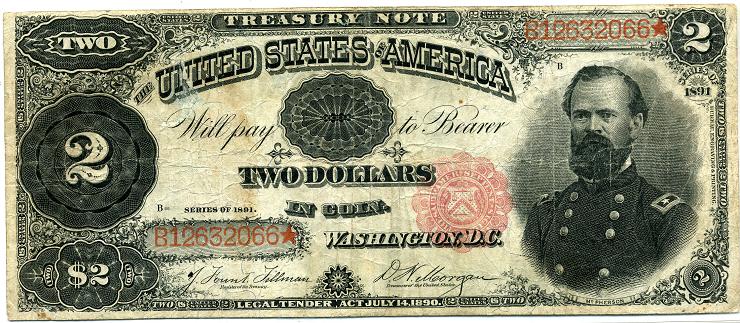 |
| |
Replies: 15 / Views: 4,667 |
|










 Posted 05/23/2010 6:04 pm


