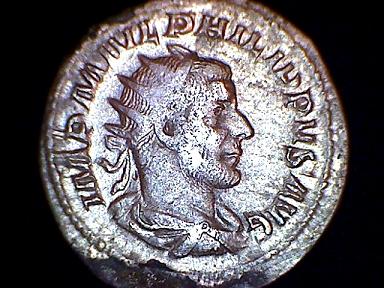
I should point out that "large silver coins" are largely a mediaeval invention; few ancient civilisations ever struck silver coins that would qualify as "large" by modern standards, and the Romans never did so.
It also depends on how you define "silver". If you want it to be relatively pure silver, the cheapest are denarii of Trajan, Hadrian, Marcus Aurelius and Septimus Severus (110-210 AD). These coins can be had in clear, identifiable condition for as little as $40;
FORVM has several of them for sale at prices ranging from $50 to $200.
The denarius is quite small, typically about the size of a US dime. The double-denarius or antoninianus, first struck circa 200 AD, is slightly bigger.
Roman silver coins began to be debased after this, but up until the time of Valerian (to 260 AD), they are still recognisably silver coins But by the time of emperor Gallienus, the "silver" coins were basically pure bronze. The fineness of the antoninianii of Aurelian was officially set at .050 fine. These coins are among the cheapest and commonest of ancients, but may not quite fit your definition of "silver". From then on, Roman coins of fine silver are scarce and relatively expensive.
Don't say "infinitely" when you mean "very"; otherwise, you'll have no word left when you want to talk about something really infinite. - C. S. Lewis










 Posted 05/26/2010 04:32 am