











 Posted 05/27/2010 3:49 pm


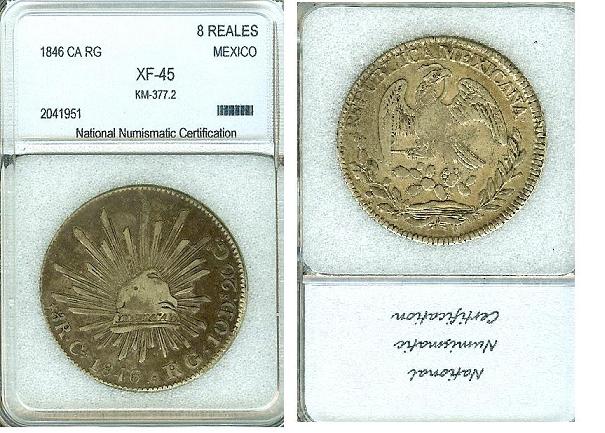
This particular forgery (which is very common and is sometimes found in very high grades) is rarely seen heavily worn or cancelled like typical period forgeries. There are a few, but there seem to be too few, if you understand what I mean. Based on a population analysis I suspect they are recent not contemporary.
For that reason, and a couple others I will go over, I classify it as a very late bullion or early modern numismatic copy. If I had to guess I would date production to the period after WWII (possibly until present). I have seen these for many years and a few have developed a deep toning, so I believe they have been in production for a number of years.
Initially, I thought they were very modern (crude) numismatic copies because the first few I encountered were essentially mint state. A rare date or scarce type coin is not usually encountered as a period forgery. Counterfeiters copied the most common dates and mints to blend in. The 1846 Chihuahua is a one die coin - a scarce to rare coin. So forgery in the early days of Mexican coin popularity became a good possibility. This would push production into the mid 1960s. However, over a short period of time after I first encountered the type, I encountered worn copies and a couple that were drilled in a manner similar to an old cancellation. Most modern numismatic forgeries are not drilled by the counterfeiters, but bullion coins sometimes are. A bullion forgery from WWII or Vietnam eras is a possibility.
I have not encountered a Sheffield Plate version or a debased silver copy of this particular forgery so that forces it to be a post Civil War era production. Most copies of this coin are German Silver a technology dating to the 1840s. The style is all wrong for the period when these were used as world bullion (1870-1930) - too crude and by that time transfer dies were used almost exclusively.
The foregoing analysis is why I have classed this as a WWII era or later bullion forgery or early modern numismatic forgery.
Because of the large number available and small demand in general for counterfeits of any age these copies are NOT very valuable.
For that reason, and a couple others I will go over, I classify it as a very late bullion or early modern numismatic copy. If I had to guess I would date production to the period after WWII (possibly until present). I have seen these for many years and a few have developed a deep toning, so I believe they have been in production for a number of years.
Initially, I thought they were very modern (crude) numismatic copies because the first few I encountered were essentially mint state. A rare date or scarce type coin is not usually encountered as a period forgery. Counterfeiters copied the most common dates and mints to blend in. The 1846 Chihuahua is a one die coin - a scarce to rare coin. So forgery in the early days of Mexican coin popularity became a good possibility. This would push production into the mid 1960s. However, over a short period of time after I first encountered the type, I encountered worn copies and a couple that were drilled in a manner similar to an old cancellation. Most modern numismatic forgeries are not drilled by the counterfeiters, but bullion coins sometimes are. A bullion forgery from WWII or Vietnam eras is a possibility.
I have not encountered a Sheffield Plate version or a debased silver copy of this particular forgery so that forces it to be a post Civil War era production. Most copies of this coin are German Silver a technology dating to the 1840s. The style is all wrong for the period when these were used as world bullion (1870-1930) - too crude and by that time transfer dies were used almost exclusively.
The foregoing analysis is why I have classed this as a WWII era or later bullion forgery or early modern numismatic forgery.
Because of the large number available and small demand in general for counterfeits of any age these copies are NOT very valuable.


