


Coin Community Family of Web Sites Join Thousands of Coin, Bullion, & Money Collectors
Royal Estate Auctions - $1 Coin AuctionsCoin, Banknote and Medal Collectors's Online Mall Join Thousands of Coin, Bullion, & Money Collectors 300,000 items to help build your collection! Royal Canadian Mint products, Canadian, Polish, American, and world coins and banknotes. Vancouvers #1 Coin and Paper Money Dealer Specializing in Modern Numismatics


Username:
Password:
Save Password
Forgot your Password?


This page may contain links that result in small commissions to keep this free site up and running.

Welcome Guest! Registering and/or logging in will remove the anchor (bottom) ads. It's Free!

Need Help With This Coin ? Token ? | Nuremberg Jeton

To participate in the forum you must log in or register.
Author Previous TopicReplies: 7 / Views: 2,531Next Topic  
Pillar of the Community
D's Avatar
Canada
899 Posts
 Posted 05/31/2010  11:48 am Show Profile   Bookmark this topic Add D to your friends list Get a Link to this Message Number of Subscribers
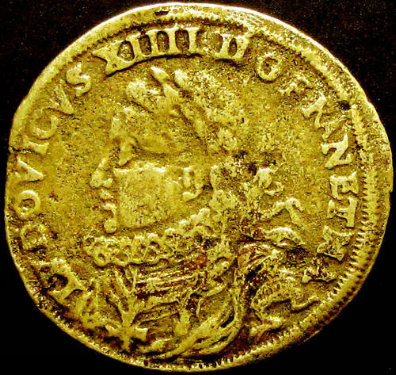
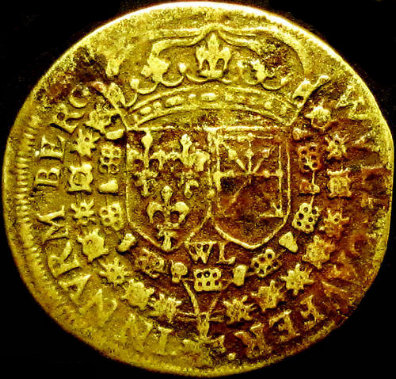
I do not know what this is or what value it has, it is 28mm and weighs 3.5 grams. Any information is appreciated. Thank you all in advance...

Need-Help-With-This-Coin-?--Token-?-|-Nuremberg-Jeton

Need-Help-With-This-Coin-?--Token-?-|-Nuremberg-Jeton

Identified - moved to Exonumia forum - Sap
Pillar of the Community
alganbagerap's Avatar
United Kingdom
2490 Posts
 Posted 05/31/2010  12:41 pm  Show Profile   Bookmark this reply Add alganbagerap to your friends list Get a Link to this Reply
The obverse is unfamiliar, but appears to be in the name of Louis XIV, king of France, late 17th C.
The reverse is almost certainly one of the known Nuremburg jeton patterns.
Edited by alganbagerap
05/31/2010 12:42 pm
Pillar of the Community
D's Avatar
Canada
899 Posts
 Posted 05/31/2010  1:20 pm  Show Profile   Bookmark this reply Add D to your friends list Get a Link to this Reply
Thank you alganbagerap...Now I have a good starting point I can follow up on..
Valued Member
Nicholas's Avatar
United States
56 Posts
 Posted 05/31/2010  3:15 pm  Show Profile   Bookmark this reply Add Nicholas to your friends list Get a Link to this Reply
Am I the only one that finds it odd that they used "XIIII" instead of "XIV" for 14?
Pillar of the Community
xshift's Avatar
United States
2669 Posts
 Posted 05/31/2010  3:22 pm  Show Profile   Bookmark this reply Add xshift to your friends list Get a Link to this Reply

Quote:
Am I the only one that finds it odd that they used "XIIII" instead of "XIV" for 14?


You'll find a lot of them did that - using IIII rather than IV. I don't think it made much difference back then, 4 was 4
Pillar of the Community
IBGolden's Avatar
Canada
598 Posts
 Posted 05/31/2010  7:00 pm  Show Profile   Bookmark this reply Add IBGolden to your friends list Get a Link to this Reply
... using IIII rather than IV, to represent 4, is also common on pocket watches(and oddly, some clocks) to avoid confusing VI (6) and IV (4) at a quick glance. Both of which are of course kinda close together and at the bottom of the face.
Pillar of the Community
alganbagerap's Avatar
United Kingdom
2490 Posts
 Posted 05/31/2010  7:06 pm  Show Profile   Bookmark this reply Add alganbagerap to your friends list Get a Link to this Reply
This is one version of the clock numbering story:
"There is a story that a famous clockmaker had constructed a clock for Louis XIV, king of France. The clockmaker had naturally used IV for four. When the clock was shown to the king, he remarked that IIII should have been used instead of IV. When it was explained to him that IV was correct, he still insisted, so that there was nothing to do but change the clock dial. This introduced the custom of using IIII for four. This is probably only a story, however, as IIII occurs long before the time of Louis XIV. And this same story is also told in connection with other monarchs. There is one reason why IIII is preferable to IV, and it may have caused the change. On the other side of the clock dial the VIII is the heaviest number, consisting of four heavy strokes and one light one, as it is usually made. It would destroy the symmetry to have the IV with only two heavy strokes on the other side. Thus IIII with four heavy strokes is much to be preferred. The change may therefore have been made for reasons of symmetry."

From Time & Timekeepers, W. I. Milham, The Macmillan Company, New York, 1947, p. 196:
Moderator
Learn More...
Sap's Avatar
Australia
16830 Posts
 Posted 06/01/2010  11:45 am  Show Profile   Bookmark this reply Add Sap to your friends list Get a Link to this Reply
The ancient Romans themselves were familiar with both the additive (IIII) and subtractive (IV) forms of their numerals, depending on the circumstances, though the additive was more common in everyday usage because it's more intuitively understood. On coins, the subtractive form was often used merely as a space-saving measure; IX takes up less space than VIIII. I even have a coin of Tiberius where, for reasons of space, IIX was used for "8" instead of VIII.
Don't say "infinitely" when you mean "very"; otherwise, you'll have no word left when you want to talk about something really infinite. - C. S. Lewis
  Previous TopicReplies: 7 / Views: 2,531Next Topic  

To participate in the forum you must log in or register.


Disclaimer: While a tremendous amount of effort goes into ensuring the accuracy of the information contained in this site, Coin Community assumes no liability for errors. Copyright 2005 - 2026 Coin Community Family- all rights reserved worldwide. Use of any images or content on this website without prior written permission of Coin Community or the original lender is strictly prohibited.
Contact Us  |  Advertise Here  |  Privacy Policy / Terms of Use

Coin Community Forum © 2005 - 2026 Coin Community Forums
It took 0.23 seconds to rattle this change. Forums
