









 Posted 06/08/2010 03:32 am


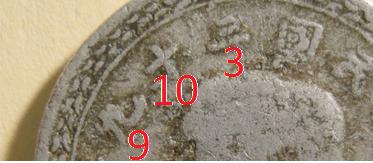
I admit I always get confused when reading "Chinese dates", which are found on coins of the Republic of China (both Old Mainland and Taiwan issues), Japan, Japanese-occupied China and some Korean coins. The confusion arises partly because I'm never sure whether the language is supposed to be read right to left, or left to right; some countries read one way, some the other, some change direction depending on how old the coin is. So, is your coin from "Year 39" or "Year 93"?
In this particular instance, the context helps; the coin was struck with only one date and can therefore be found in the catalogues quite easily. Besides, Year 93 of the Republic was 2004 and this coin doesn't look that modern. But for other coin types, it's not that simple.
It helps if you can remember that the symbol for "year" is always at the end of the date. This character, pronounced differently ("nian" in Chinese, "nyeon" in Korean and "nen" in Japanese) but always written the same, is the character at the far left of the date on your coin. That means the "9" is at the end of the date, so it must be Year 39.
In this particular instance, the context helps; the coin was struck with only one date and can therefore be found in the catalogues quite easily. Besides, Year 93 of the Republic was 2004 and this coin doesn't look that modern. But for other coin types, it's not that simple.
It helps if you can remember that the symbol for "year" is always at the end of the date. This character, pronounced differently ("nian" in Chinese, "nyeon" in Korean and "nen" in Japanese) but always written the same, is the character at the far left of the date on your coin. That means the "9" is at the end of the date, so it must be Year 39.
Don't say "infinitely" when you mean "very"; otherwise, you'll have no word left when you want to talk about something really infinite. - C. S. Lewis


