Mediaeval coins (500 to 1450 AD) aren't normally great works of art. Well, not the ones I can afford, anyway.

Most of the ones I have are pretty drab, dull and utilitarian - crude pictures (if there are any at all), chunky, hard-to-read letters, rarely if ever dated... mediaeval mint workers were definitely aiming for quantity over quality. To top it all off, they aren't covered in any readily available catalogue.
For me, this coin is one that stands out from the crowd. It's a silver asper from the
Empire of Trebizond, from the reign of the Grand Comnenus John II, who reigned 1280-1297. This coin is from the latter part of his reign (1285-1297):
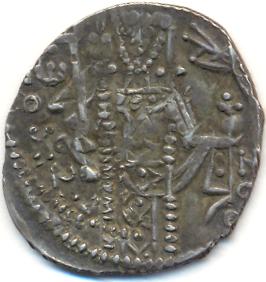 Obverse: Grand Comnenus John II standing facing in royal regalia, Hand of God reaching out to bless, inscription IW/O/KM N/O/C (John the Comnenus)
. "Grand Comnenus" was the title used by the Emperors of Trebizond, to distinguish themselves from the "other emperor" in Constantinople. "Comnenus" was the surname of the dynasty's founder. Poor Jon has been rendered in fairly typical late Byzantine "join-the-dots" style. I love the little "hand of god" to the right of the king's head; a common motif on coins from Christian countries of the period. It always looks to me as if the recipient is being "given the flick!"

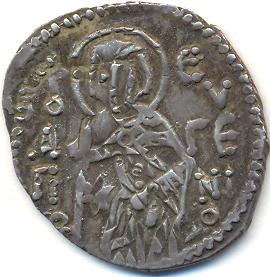 Reverse: haloed Saint Eugenius, patron saint of Trebizond, standing facing in simple robes, inscription O/A/GI/O E/V/GE/NI/O (the Saint Eugenius)
. The inscription on this coin (particularly this side) is a breeze to read, especially when you compare it to the chunky serifs favoured in Europe or the barely literate scribbles in coins of the Byzantine remnant. The lettering is mostly Greek, with a few Latin letters thown in. Eugenius seems to have been rendered with much more detail and care than the King on the other side.
Poor Trebizond always seems to "fall between the cracks" of the major reference works; the Byzantine catalogues seem to consider it a separate, secessionist state and normally don't list them (Trapeziuntine coins aren't listed in the Sear book of Byzantine). Books on European coins tend to skip it because technically it was in Asia (the north coast of Turkey). Crusader States books tend not to mention them, since the Crusaders didn't really have much to do with Trebizond.
I bought this coin back in 1999, and the only thing written on the 2x2 was "Byzantine-Trebizond aspen". Those were my pre-Internet days - no Wiki, no Google, no forums, not even a Byzantine book (I thought I was buying "my first Byzantine coin" when I bought this one!) - I had nothing but the University library, which had one book (really a compilation of scholarly articles) on the Empire of Trebizond. I had a great time trying to find out what I could about this coin, and the ruler and nation that issued it; my first really successful and rewarding numismatic research project.
Don't say "infinitely" when you mean "very"; otherwise, you'll have no word left when you want to talk about something really infinite. - C. S. Lewis









 Posted 08/02/2006 9:47 pm


