| Author |
 Replies: 18 / Views: 19,265 Replies: 18 / Views: 19,265 |
|
Pillar of the Community
United States
3640 Posts |
|
|
|
|
Valued Member
Israel
423 Posts |
Found this on the web. It seems to answer your questions 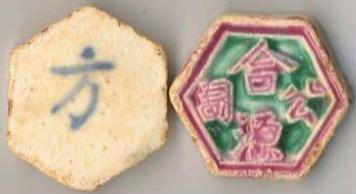 A hexagonal shaped token.On the green side are four embossed Chinese characters, hoh - yüan and kung - ssü, in pink with a white border which is the name of the issuer. In cobalt blue underglaze on the back is the character qian (coin), denoting it is worth one Thai salung coin (equal to one quarter baht). Source:British Museum The above are gambling token popularized during the Bangkok Dynasty (1782-1809). Most of these tokens were made from porcelain or ceramic. They were originally used by Chinese gambling houses in Bangkok. Due to the shortage of silver coins and diminishing use of the cowrie shell( also used as coin), these gambling tokens were found to be very useful and used in the daily life of the people until the 1870s. These porcelain token bore Chinese inscriptions naming the issuing house or wishing the users good fortune and pictorial designs mostly of Chinese origin. Very often, these gambling tokens were glazed with bright colors. |
|
Pillar of the Community
 United States
3640 Posts |
Hey Thanks.
Thats the one, obverse (a lot cleaner than mine)
Diff. reverse character but ?
Wonder what mine is ?
|
|
New Member
Philippines
11 Posts |
Hi,
you can easy clean this porcelain token... it's a 2 min job. Just take an old toothbrush and sop and start brushing/cleaning it. You will see it become same shiny like the other one posted here.
The token is just dirty because it came from an excavation site with lot of sticky mud. I clean my tokens the same way.
|
|
Forum Mom
 United States
5877 Posts |
Cleaning coins devalues them; is the same true for tokens? If so, I would not recommend cleaning this token.
|
|
Valued Member
United States
347 Posts |
Quote:
In cobalt blue underglaze on the back is the character qian (coin) Quote:
Diff. reverse character but ?
Wonder what mine is ? The character on the reverse of your token is indeed qian (eŒ¢) which means "coin" or "money". It's strange but the "reverse" of the token attributed to the British Museum is not qian (eŒ¢) but fang (æ-¹) which has a number of meanings including "square", "direction", etc. I don't believe the British Museum could make such a mistake so I'm guessing that the image and description actually comes from some other website and incorrectly makes the attribution to the British Museum. Gary |
|
Pillar of the Community
United States
3640 Posts |
Thanks for the info on the reverse.
Been a while since I posted this.
I still have it. Pretty cool I thought.
I just thought that the rev. on mine was different
than the one shown as it has two characters and not just one.
|
|
New Member
Philippines
11 Posts |
"...Cleaning coins devalues them; is the same true for tokens?...." Answer is Yes. But in this case it is lose dirt/mud from the excavation side. With water and sop you are not removing the "patina" from the porcelain token...you remove only the lose dirt/mud. Below the lose dirt/mud the porcelain coin still has his original "patina" and looks "dirty & used" but the lose dirt/mud from the excavation site is gone.
Chris
|
|
New Member
Philippines
11 Posts |
|
|
Pillar of the Community
United States
3640 Posts |
Quite the collection of different types there.
Yes, I found the one that matches mine (obv.)
Would still like to find out what the first character
means on the rev. of mine. Just curious.
For now anyway I think I will leave it in the flip
just as it is. A little dirty :)
|
|
Valued Member
United States
347 Posts |
Quote:
Would still like to find out what the first character
means on the rev. of mine. Just curious. There is only one Chinese character on the reverse side of your token. Quote:
The character on the reverse of your token is indeed qian (e΢) which means "coin" or "money". Gary |
|
Pillar of the Community
United States
3640 Posts |
? I guess mine is just bigger or something than the other one posted. Sure looks different in hand. Thanks anyway for all the help.  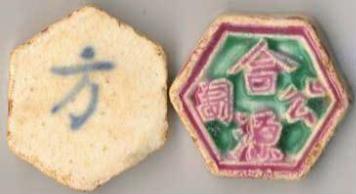 |
|
Valued Member
United States
347 Posts |
Quote:
I guess mine is just bigger or something than the other one posted. Sure looks different in hand. Thanks anyway for all the help. Apparently I'm not doing a very good job of communicating so let me try again. The obverses of the two tokens are the same. The reverses, however, are different. Both reverses have only one Chinese character. Your token only has one Chinese character. Maybe it looks like there are two characters to you but I assure you that it is all one character. The reverse on your token is qian (eŒ¢) which means "coin" or "money". The reverse of the other token is fang (æ-¹) which means "square", "direction", etc. This is the text that accompanied the other token: Quote:
A hexagonal shaped token.On the green side are four embossed Chinese characters, hoh - y�an and kung - ss�, in pink with a white border which is the name of the issuer. In cobalt blue underglaze on the back is the character qian (coin), denoting it is worth one Thai salung coin (equal to one quarter baht). Source:British Museum This description is correct for your token but is not correct for the other token. This text is not correct for the other token because the character on the reverse of the other token is not "qian (coin)". The character on the reverse of the other token is fang (æ-¹). Someone apparently copied the text from the British Museum website and added their own images. Unfortunately, they did not realize that the reverse side of their token was not the same as the reverse of the token on the British Museum website. I apologize for not doing a better job of explaining this in my earlier post but, hopefully, it is clearer now. Gary |
|
Pillar of the Community
United States
3640 Posts |
Gary Thanks. Not your fault in explaining. I was going by what exactly your quote stated about the other token. All cleared up now.  |
|
New Member
Philippines
11 Posts |
Hi Gary, you are 100% correct... and here the complete set is one picture  I hope it's not to too confusing... the next smaller nomination in the set (after qian and fang) is "pai" (the one on the right site) Chris |
|
Pillar of the Community
United States
3640 Posts |
Chris
Are those pics in accurate dimensions as to
the size of the tokens in relationship to their
denom.s ? I.E.: Larger token equals higher denom. etc.
Ron
|
| |
Replies: 18 / Views: 19,265 |









 Posted 08/10/2010 11:18 pm


