| Author |
 Replies: 30 / Views: 11,649 Replies: 30 / Views: 11,649 |
|
Valued Member
United States
469 Posts |
|
|
|
|
Pillar of the Community
United States
4846 Posts |
if you go to the Red Book, in the back it has a significant U.S. patterns section. in that section, there is the same exact design but 6 years later. maybe this was made but was never known? |
|
Valued Member
 United States
469 Posts |
I am aware of the US patterns but as you pointed out, this one is not listed. Could this a ONE of a kind? Boy would that be cool!
|
|
Pillar of the Community
United States
689 Posts |
That would be an amazing discovery! I'm excited to hear what others have to say about this one.
|
|
Pillar of the Community
3660 Posts |
I think that your very best bet for finding out for sure would be to send it to ANACS (yes ANACS rather than PCGS or NGC) for grading and attribution with a note of 'Attention: John Roberts'.
|
|
Valued Member
United States
314 Posts |
Southerngent - how does this coin play out with regards to weight, planchet diameter, etc with an original large cent?
|
|
Valued Member
United States
469 Posts |
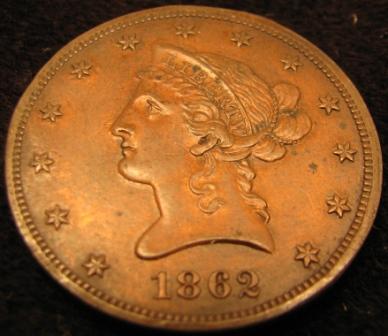
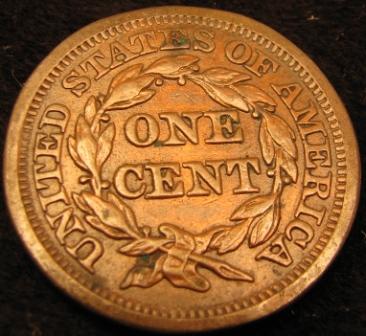
I was at a local coin show yesterday and had an opportunity to speak with a past president of the ANA who was doing free grading and some experts in early US copper. It turns out that this is a bit of an oddity. The obverse is that of a $10 gold piece and the back is of course a large cent. How or why the front was minted from a $10 gold is unknown. The item is a half of each which was put together from what the experts said, over 100 years ago.I am told that even though this is not a pattern as they first thought, it is still very collectible with a small group of collectors and they suggested that in the right auction, it could realize between $500 and $1500 or more. It was also suggested that I send it in to be slabbed. I will keep everyone posted as I am meeting with the experts Wednesday evening at a local coin club meeting to get more info. |
|
Pillar of the Community
United States
2589 Posts |
|
|
Valued Member
United States
314 Posts |
Sounds pretty cool, can't wait to hear what they have to say. I also wonder, is it a mule, or something put together outside the mint. STill curious about the weight and other specs. Great find!! As I drool across the page!!  |
|
Bedrock of the Community
United States
17884 Posts |
Interesting. It frankly looks too good to be your typical "put together" piece. The real question is going to depend on whether it is struck with genuine US dies or dies made up by a recent Chinese counterfeiter.
If the dies are real then it was probably made during the 1868 - 1870 period when a lot of fantasy restrikes and contrived rarities were coming out of the Mint with the knowledge and involvment of the officers.
|
|
Valued Member
United States
380 Posts |
Looks Chinese to me, but I have been wrong more than once... I hope the best for it as it would be an awesome discovery. Good luck!
|
|
Valued Member
United States
469 Posts |
It is actually 2 halves put together. There is a seam that was pointed out to me. Someone struck the $10 gold in copper to get the obverse. I will keep you all posted as I am eager to get the answers as well. It was really well done by whoever did it. I don't think the Chinese would have bothered to cut two in half to make one where they could have just used the 2 dies. It don't ring as right to me but who knows.
|
|
Valued Member
United States
380 Posts |
Listen to what you are saying.. There is a seam. minted coins were not struck one side then the other and then put together. This IMO (nothing more than my opinion) is not from the US mint. But if it is, it would be a dramatic and huge discovery, however I would not get too excited until you hear back from ANACS. I have seen Chinese Morgan Peace Obverse with Morgan reverse (but there was not seam). That seam bugs me.
|
|
Pillar of the Community
3660 Posts |
Quote:
it is still very collectible with a small group of collectors and they suggested that in the right auction, it could realize between $500 and $1500 or more. It was also suggested that I send it in to be slabbed. Quote:
It is actually 2 halves put together. There is a seam that was pointed out to me. Someone struck the $10 gold in copper to get the obverse. It was really well done by whoever did it. I don't think the Chinese would have bothered to cut two in half to make one where they could have just used the 2 dies. I agree, probably not Chinese....I also agree, the group of collectors who would pay $500-$1500 or more for such a thing must be INCREDIBLY small. (Try to find out who he is anyway). I would also be very interested in knowing which TPG would slab such a rarity. (It may require the assistance of one of the less popular TPGs). Edited by zeewool
08/24/2010 3:18 pm
|
|
Valued Member
United States
469 Posts |
OK, so I was at the local coin club meeting last night and a US large copper specialist looked the coin over and shared his thoughts with me. He does not think that my coin is 2 coins cut in half but does think it might be what he called an electro. That means that a mold was made of the sides of actual coins of probably wax due to the quality of the finish instead of the usual plaster to form the thin metal, in this case copper, to be clam-shelled together with some type of filler. If that is the case, he said it's the cleanest one he has ever seen. It leaves the question, why fake a cent when you have a $10 gold piece to make the mold from. This in gold with a lead center and the $10 gold back would be the way to go if you were making a counterfeit coin.
Then the conversation went back to the 1868 large cent pattern that was produced for no good reason where 7 examples exist. He thinks there could be the possibility of it being some sort of experimental coin or a pattern. So he is going to help me by looking through his books and connecting with some other specialists to see if he can help me solve this riddle.
Stay tuned!
|
|
Moderator
 United States
23522 Posts |
Quote:
Stay tuned! Yer darn right I am.  |
| |
Replies: 30 / Views: 11,649 |









 Posted 08/21/2010 9:06 pm





