| Author |
 Replies: 26 / Views: 3,753 Replies: 26 / Views: 3,753 |
|
Valued Member
United States
66 Posts |
I will add a new coin every day or two, to the first say post if that is fine. Some I know what they are pretty well. Some, not as much. This first is a Constantine's a.d. 307 to 337. (pretty sure) more coming from this family, which are vary similar, so I am hoping I do not cross up the photo's and names.   |
|
|
|
New Member
United States
30 Posts |
That's a awesome coin. I don't know anything about it but looks cool!
|
|
Moderator
 United States
23731 Posts |
Beautiful detail. Constantine I, Siscia mint RIC VII Siscia 235, circa 330-335 AD.
|
|
Valued Member
 United States
66 Posts |
Thanks Echi! and my fears were right, that I have sorting wrong on these photos. If that was Constantine 1, this could be the Constans then (?)   these pictures are not as clear, but this is the worst of the batch (picture quality wise) |
|
Moderator
United States
23731 Posts |
Beautiful detail and strike, where did you find these coins? This is Constans, Siscia mint, RIC VIII Siscia 88,circa 346-348 AD.
|
|
Valued Member
United States
66 Posts |
I will call them part of the F.W.W. Collection :) As the title states, I 'got to see them.'
As I understand they were bought about 20 years ago, by this collector, from a well known supplier, through a dealer. Plenty more to come.
|
|
Valued Member
United States
66 Posts |
and meant to add, I appreciate the full information on each, you are posting. thank you!
|
|
Valued Member
United States
66 Posts |
Ok, Constantine II, I think. The collection had about 12 of these Bronzes, Constantine the great, Constans and both I and II Constantines, which is part of the reason I think I lost track of names, to coins. Being the size of a dime, and all having roughly the same look and having a limited time to see and photograph them, was a challenge. (I could still be wrong about this one, but the next ones are much easier to keep straight, but I know less about them. Gloria Exercitas, or Glory to the Army.   Next up, Faustina the younger. |
|
Moderator
United States
23731 Posts |
Another nice coin, Constantine II, .ESIS., Siscia mint, circa 330-335 AD, Ric VII Siscia 236.
|
|
Valued Member
United States
66 Posts |
Well, sine that was so quick,  I will start in on the first of 2 Faustina's.   The largest coin in the lot This Bronze Sestertious (161-180 a.d.) (between the size of a quarter and a half dollar (?), if I remember correctly) but also, the poorest condition. |
|
Moderator
United States
23731 Posts |
Faustina II, RIC# 1668, Reverse: SALVTI AUGVSTAE with SC in the exergue.
|
|
Valued Member
United States
66 Posts |
Thank you again! Can you expand on what 'SC in the exergue' refers to, or what it means? and onto some silver. A Faustina Denarius.   (sorry that bit of the coin is blocked.) |
|
Moderator
United States
23731 Posts |
SC, means that the coin was approved and authorized by the Roman Senate. The exergue is located on the reverse at bottom of the coin, this is were the mint mark is placed.
Faustina II RIC# 677, Reverse: FECVNDITAS.
Edited by echizento
09/13/2010 12:44 pm
|
|
Valued Member
United States
66 Posts |
OK, thanks again for that definition. Here is probably the aesthetic favorite of the lot. (Maybe) Silver Tetradrachm, the Athenian Owl. 449-413 b.c. 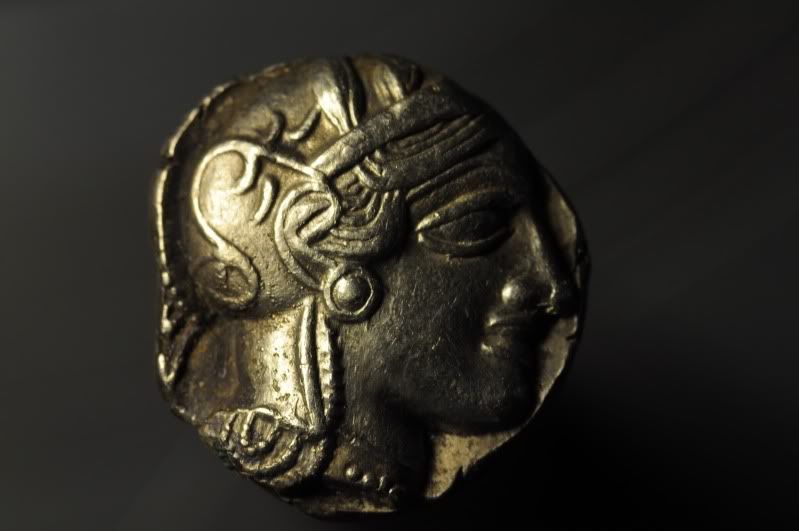 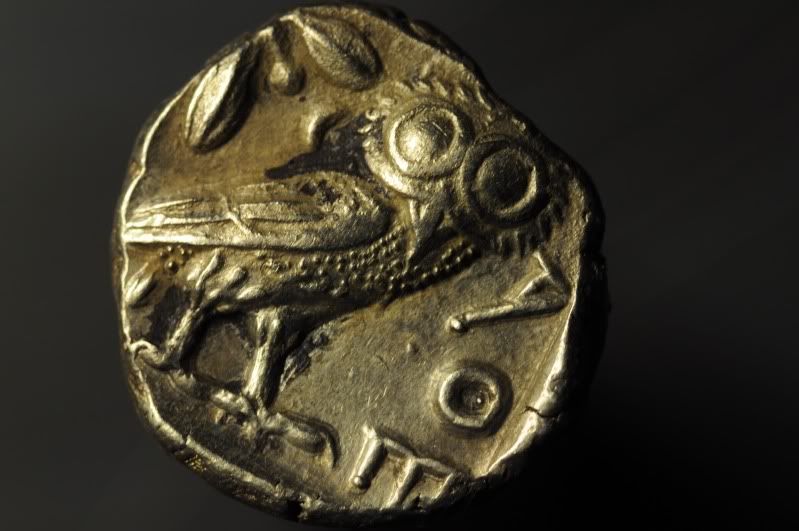 pictures are a little dark, but if I remember correctly, any brighter and the glare would come up to much. I may ask for another chance to photograph these sometime in the future. |
|
Moderator
United States
23731 Posts |
Nice coin, noting to add to the description.
|
|
Bedrock of the Community
United States
10045 Posts |
It's amazing to consider how Roman coins survived all those centuries in that condition.  Nice Tetradrachm too--it lacks the common cut marks, often right through the owl. |
| |
Replies: 26 / Views: 3,753 |









 Posted 09/09/2010 11:43 pm





