



Coin Community Family of Web Sites Join Thousands of Coin, Bullion, & Money Collectors
Royal Canadian Mint products, Canadian, Polish, American, and world coins and banknotes. Vancouvers #1 Coin and Paper Money Dealer Join Thousands of Coin, Bullion, & Money Collectors Coin, Banknote and Medal Collectors's Online Mall Specializing in Modern Numismatics 300,000 items to help build your collection! Shop for APMEX Bullion on eBay!


Username:
Password:
Save Password
Forgot your Password?


This page may contain links that result in small commissions to keep this free site up and running.

Welcome Guest! Registering and/or logging in will remove the anchor (bottom) ads. It's Free!

Henry II UK Bronze Seal Medal - What This Is?

To participate in the forum you must log in or register.
Author Previous TopicReplies: 5 / Views: 3,222Next Topic  
New Member
jaybirdsatx's Avatar
United States
3 Posts
 Posted 09/23/2010  6:21 pm Show Profile   Bookmark this topic Add jaybirdsatx to your friends list Get a Link to this Message Number of Subscribers
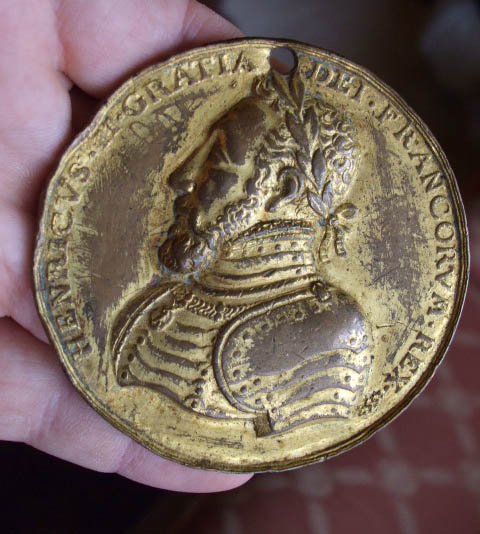
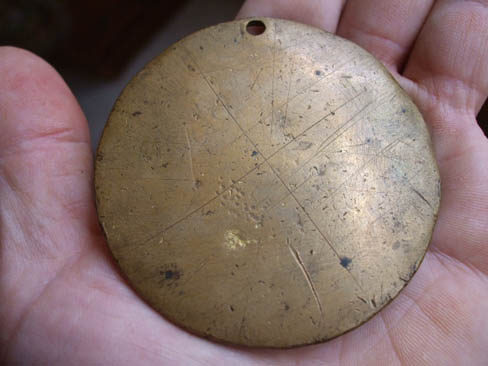
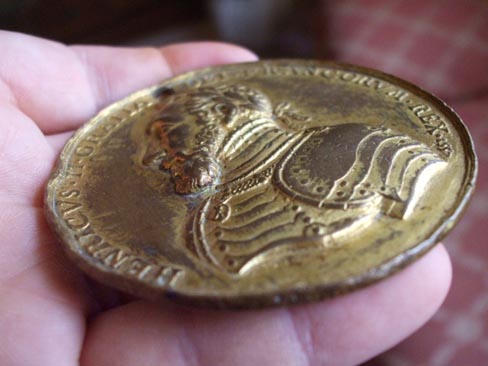
i recently purchased this medal that depicts the great seal of the realm of king henry II. it looks like it could be centuries old. could this be a 12thc period medal? it is made of gilt bronze. gilt is somewhat worn as you can see. at one point, someone holed it at the top edge. any ideas would be helpful.
thanks!
jon j

Henry-II-UK-Bronze-Seal-Medal---What-This-Is?

Henry-II-UK-Bronze-Seal-Medal---What-This-Is?

Henry-II-UK-Bronze-Seal-Medal---What-This-Is?
Moderator
Learn More...
Sap's Avatar
Australia
16826 Posts
 Posted 09/23/2010  8:00 pm  Show Profile   Bookmark this reply Add Sap to your friends list Get a Link to this Reply
That's not Henry II of England - "Francorvm rex" is latin for King of France. That's Henry II of France, who reigned 1547-1559.

This medal probably isn't that old, either. Gilt copper medals were most popular in the 1700s and 1800s.

Being uniface (with nothing on the back) I suspect it may have been made as a decoration to attach to something else, rather than as a standalone medal; perhaps for inserting into a book cover or mounting onto a piece of furniture. It may be part of a series of medals depicting French kings throughout history, made for such a purpose.
Don't say "infinitely" when you mean "very"; otherwise, you'll have no word left when you want to talk about something really infinite. - C. S. Lewis
New Member
jaybirdsatx's Avatar
United States
3 Posts
 Posted 09/24/2010  12:00 am  Show Profile   Bookmark this reply Add jaybirdsatx to your friends list Get a Link to this Reply
okay...that helps. I think this actually might be henry VI, who was this king of england and also the disputed king of france sometime in the 15thc. that makes more sense.
the medal is bronze...not copper. thank you for the opinion. i'll inquire with the british museum tomorrow.
Bedrock of the Community
sel_69l's Avatar
Australia
21786 Posts
 Posted 09/24/2010  03:29 am  Show Profile   Bookmark this reply Add sel_69l to your friends list Get a Link to this Reply
I agree with Sap for two reasons:

The legend is: HENRICVS . 11 . GRATIA DEI . FRANCORVM . M . REX

That makes it Henri the second.

The other reason is that the image of Henri certainly resembles that of other coins and medals of this king. ( ref. 'Coinage in France from the dark ages to Napoleon' by Nicholas Mayhew pp 119 & 120, and Plate 24).

There is obvious gilding on this piece.
New Member
jaybirdsatx's Avatar
United States
3 Posts
 Posted 09/24/2010  11:41 am  Show Profile   Bookmark this reply Add jaybirdsatx to your friends list Get a Link to this Reply
the british museum just told me that this is most certainly a 16thc french henri II medal.
mystery solved.
if anyone has anything else to offer, I would be interested.
thank you for the feedback!
Pillar of the Community
alganbagerap's Avatar
United Kingdom
2490 Posts
 Posted 09/24/2010  12:55 pm  Show Profile   Bookmark this reply Add alganbagerap to your friends list Get a Link to this Reply
I'm having a small problem with the wording:
Gratia Dei as opposed to Dei Gratia, the latter being by far the more accepted usage.
The first translates as Thanks to God, the second as By the Grace of God
The mediaevalists will probably jump all over me, but I've never seen this conformation used in any documentation of the time, and I've read over seven thousand from France, England, Italy Spain and Germany.
Edited by alganbagerap
09/24/2010 12:56 pm
  Previous TopicReplies: 5 / Views: 3,222Next Topic  

To participate in the forum you must log in or register.


Disclaimer: While a tremendous amount of effort goes into ensuring the accuracy of the information contained in this site, Coin Community assumes no liability for errors. Copyright 2005 - 2026 Coin Community Family- all rights reserved worldwide. Use of any images or content on this website without prior written permission of Coin Community or the original lender is strictly prohibited.
Contact Us  |  Advertise Here  |  Privacy Policy / Terms of Use

Coin Community Forum © 2005 - 2026 Coin Community Forums
It took 0.22 seconds to rattle this change. Forums