| Author |
 Replies: 47 / Views: 6,846 Replies: 47 / Views: 6,846 |
|
|
|
Valued Member
 Australia
222 Posts |
Hi ageka: Thanks for the picture. I wasn't aware that NGC graded coins adjectivally. Is this unusual? Thanks longnine009: This is getting very interesting. I didn't know that there was a distinction between different types of gradings. I think it is inappropriate to have two grading scales for coins. And Susanlynn9, do you mean if there were only two or three of a certain coin in existence, the actual grade of the coin would not really matter because of the coin's rarity? And therefore, the entire population is given the same grade if the coins sell for the same price in the marketplace? Hi sn31: I have a dealer friend who sends coins to PCGS for me along with his stuff. He charges me about AUD$35 nett per coin, and they come back three months later in slabs. I wouldn't be worried about not getting your coins back, as these grading companies have been around for years and are not run by crooks. Look forward to your comments. I am interested in knowing how TPG justify "upgrading" rare coins just because of price rises... |
|
Valued Member
United States
157 Posts |
quote:
Originally posted by Eric
I wasn't aware that NGC graded coins adjectivally. Is this unusual?
Generally, they don't for a typical submission. But if some dealer or home shopping show or whatever submits a huge number of mint state coins in bulk to be generically sold as "BU" or something like that, they will simply slab them as "Brilliant Uncirculated" which basically means "MS-60 or better." But if it were much better you wouldn't be seeing it in a generic holder, most likely. |
|
Pillar of the Community
Belgium
2078 Posts |
According to my friend gem uncirculated might mean anything between MS64 and MS70 which is not a surprise since the coin I showed probably went from the mint batchwise straight to NGC
Then I like the English term better
Choice Uncirculated ( and it is easy with a little training to decide this is true or not )
Or the French FDC fleur de coin ( no marks visible with the naked eye)
Why pay for a slab if chances are 99% that a coin straight from the mint to you will be MS64 plus ?
|
|
Pillar of the Community
United States
1247 Posts |
quote:
Originally posted by Eric
Hi
Thanks longnine009: This is getting very interesting. I didn't know that there was a distinction between different types of gradings. I think it is inappropriate to have two grading scales for coins.
Market factors have always existed even before it was "officical" A coin that graded a technical Unc. by Brown and Dunn standards in the 60's may have been stuck from worn dies which would make the coin appear worn even though it wasn't. That same coin stuck from early or mid-life dies would also be Unc. but it would get more money because it actually looked Unc or you could say the other got less money because it looked circulated. That's the down side of technical grading--no one really cares why a coin looks the way it does, they'll bid accordingly. The market factors in coins always existed but it was back when it really was a "market" back when people simply decided by looking at a coin what it was that they liked about it or disliked about it. Now TPGs decided what it is that we will like and how much. That's not a real market, that "marketing" commodification style. Edited by longnine009
08/14/2006 6:30 pm
|
|
Valued Member
Australia
222 Posts |
Hmm. ageka: In Australia, FDC, Gem UNC, and CHU are separate grades corresponding approximately to MS70, MS65-66, and MS64-65 respecitively. A coin in MS60 in Australia tends to grade around EF-aUNC, while a coin in AU50-58 grades anywhere between VF to aUNC. I have seen Aussie coins slabbed EF40 that would make only VG to Fine here. This is not "overgrading" as some anti-Numerical graders here in Australia call it. I believe it is partly because of the spread of the Numerical grades (there are more Numerical grades than there are Adjectival), and partly because of different grade definitions. longnine009: So, graders and slabs tend to commodify the market? I can believe that. What if someone proposed to you the argument that, while slabs don't allow you to buy sight unseen, they do give a sort of "ballpark", or rough estimate, of the grade of a coin, which is great on secondary markets (like ebay) populated by (mostly) well-meaning sellers who may or may not know anything about coins? And how would you reply to someone who said that slabs prevent dealers from arbitrarily upgrading their coins (which happens a lot in the Australian market)? (As an aside, I saw a big dealer here buy a handsome coin in aU for $6000, upgraded it to UNC, and sold it for $12000 all in the course of a month! This can't happen with slabbed coins unless the TPG company upgrades the coin.) |
|
Pillar of the Community
Belgium
2078 Posts |
Here in Europe every country has its own terminology and verbal grading especially France and Germany have different terminologies FDC which means Fleur de Coin which means Flower out of the die is supposed to be the most beautifull coin the die can produce In practice it is abused so much it starts at uncirculated I have read all european descriptions and come to the conclusion a real FDC has to be MS65 at least Choice uncirculated is meaningless to me because it will be used from AU58 up to MS63 in reality ; mostly by Britishers Gem uncirculated ; if my American photograder friend says it starts at MS64 I believe him ; to me it is meaningless also I selfgrade the coins and find that most sellers do not have the slightest idea what their coin really grade  |
|
Valued Member
Australia
222 Posts |
It looks like simply clarity of grades and their meanings is an advantage under the Sheldon Numertical Grading System... I will mention that in my article. Here are my very brief notes I've put together so far... tell us what you think and I will make revisions. =========== Notes: Adv of TPG: -Slabbed coins are genuine. -Slabbed coins provide a ball park estimate of the grade. More confidence buying from ebay. -Some protection against theft. Disadv of TPG: -Costly; -All the disadv of the Numerical System can go here. -Inconsistency in grading between and within grading companies. Adv of the Numerical System -Less confusing, less verbose. People can't make up new grades Choice, BU, Lustrous UNC, Practically UNC, etc. Disadv of the Numerical System -Can't qualify a coin by a single number: Must grade by wear alone, and then mention any imperfections or handsome lustre. Introduction of the qualifier "Nice". -No dual grades; -Coin in aEF sounds like its better than one in VF-35. Of course, more will be forthcoming, and I'll get all the nitty gritty detail of it too. :) |
|
Pillar of the Community
Belgium
2078 Posts |
Apart from the fact that TPG is not available in Europe I have a few problems First is price Second is grade ( I feel a big user will get better grades versus a one time submitter ; this is a purely commercial reflection since I seem to understand there were 107 TPG companies last year and not everybody understands only the top 3 may be usefull and number 4 of course wants to get to be nr 3 etc ) Last ; grade does not even start to explain eye appeal look at this MS62 NGC (unfortunately I lost the coin holder reference number ) No way I would buy a piece with so much slide 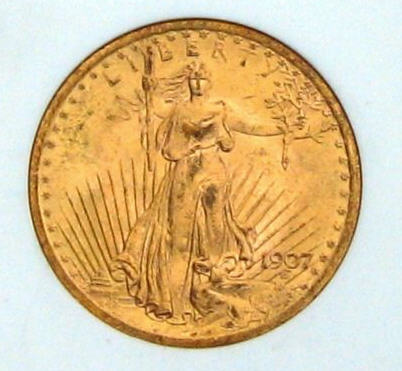 Edited by ageka
08/15/2006 09:12 am
|
|
Valued Member
Australia
222 Posts |
As an aside, is that what the surface friction (those dark patches on the high points of the design) are called: "slide"? I have always wondered what to call it. Maybe cabinet friction is a good term... :)
As for eye appeal: I agree with you. I have had quite a few slabbed coins, some even from the same batch of coins, and the difference between one MS-62 to the next is sometimes a lot.
As for whether big graders get better grades than little graders? I dunno. Is this true? Does that really happen? It's my understanding that graders don't know whose coins are whose and that the whole grading aspect is relatively anonymous...?
|
|
Valued Member
United States
411 Posts |
Wow. When I took the ANA grading correspondence course, the instructor said pretty much the opposite of what everyone here's saying. What I thought I understood him to say was that the more scarce an coin is, the harder it will be to get a fair grade. That way, the TPG's can control the market by limiting the number of 65's, for example, in their pops. I have also seen very old, rare coins being given more slack than not so rare coins. But when it comes to anything "scarce" as opposed to "rare," the higher grades are harder to come by. This also has corresponded to my experience with Peace dollars: 1921, '28, 34-S seem to have fixed populations, at least at PCGS. Which means you'd have to have an undeniably MS67 in order to get a 65 on many dates. Moreover, I've sent some common coins in that I got what I thought were generous grades. Hmm... puzzling evidence. |
|
Valued Member
Australia
222 Posts |
Yes, they have Relative Grading here in Australia too. What I mean by that is that if a particular series or date tend to have similar faults (weakness in strike, polished die marks, heavy bagging) then the coins are graded as though those faults don't exist. For those of you who collect Australin Jubilee sovereigns, you'll find that most of them are really bagmarked; this has not stopped dealers happily grading really baggy coins UNC. What is this ANA grading correspondence course, Stephen? How can one apply? |
|
Pillar of the Community
United States
751 Posts |
I don't think you should omit a discussion of PQ coins. As has been noted, not all 64's are of identical quality. Some just barely made the grade and are very close to 63, while others are just a hair (or hairline) away from 65. Coins near the top of their range are called Premium Quality (PQ). Of course, they are not designated as such on the slab. This is where people who think they are smarter (or better graders) than their peers come in to play. Many people will go to auctions or shows looking for these PQ coins. They may even pay a premium over nominal 64 prices for them. Then they crack the coin out of the slab and send it back to the TPG. If it doesn't come back 65, they may repeat several times. Given the inconsistency of the grading co., it will probably eventually come back as the higher grade. It is then sold as a 65 for a handsome profit. This is also done frequently with coins slabbed in a different era--a more conservative era. You buy a 63 in a 20-year-old slab and get it graded as a 65 under current standards. I might add that no one in his right mind is going to do the reverse--take a low 65 and have it regraded as a 64. Or have a coin graded at a liberal time regraded under newly tightened standards. Logically, given enough time all coins will eventually be slabbed and graded at their MAXIMUM CONCEIVABLE GRADE. I'll let you continue to draw conclusions about how you should regard and price a slabbed coin.... |
|
Pillar of the Community
United States
1247 Posts |
[quote] Originally posted by EricHmm. *longnine009: So, graders and slabs tend to commodify the market? I can believe that. What if someone proposed to you the argument that, while slabs don't allow you to buy sight unseen, they do give a sort of "ballpark", or rough estimate, of the grade of a coin, which is great on secondary markets (like ebay) populated by (mostly) well-meaning sellers who may or may not know anything about coins? **I would agree. But I would also say that we can do that much overselves. If it's better than MS60 but not as good as MS65 (a difference that you can actually see BTW) then call it MS63. Your odds of not being within the ballpark of two grades are only 33%. What are they doing that we can't do? *And how would you reply to someone who said that slabs prevent dealers from arbitrarily upgrading their coins (which happens a lot in the Australian market)? (As an aside, I saw a big dealer here buy a handsome coin in aU for $6000, upgraded it to UNC, and sold it for $12000 all in the course of a month! I would reply that it doesn't stop them. They still stand there smiling and saying "just look at that strike." "Oh that's nice but didn't they already factor that beautiful strike into the grade?" "Oh sure but they obviously undervalued the strike on this one...." Actually I would just walk away before it got that far. But what if someone really wanted the coin? How, with a net grade, does he prove to the seller that the totally awesome strike was already factored into the grade? You know it was a factor but you don't know how much and so can't disprove his claim that they undervalued the strike. You don't have a break down of how much weight was given to each factor in the grade. *This can't happen with slabbed coins unless the TPG company upgrades the coin.) **They "up-grade" coins all the time. Price=grade. Didn't they just "upgrade" a circulated 1804 Dollar last year or the year before? |
|
Valued Member
United States
394 Posts |
quote:
Originally posted by Eric
As an aside, is that what the surface friction (those dark patches on the high points of the design) are called: "slide"? I have always wondered what to call it. Maybe cabinet friction is a good term... :)
As for eye appeal: I agree with you. I have had quite a few slabbed coins, some even from the same batch of coins, and the difference between one MS-62 to the next is sometimes a lot.
As for whether big graders get better grades than little graders? I dunno. Is this true? Does that really happen? It's my understanding that graders don't know whose coins are whose and that the whole grading aspect is relatively anonymous...?
Not only was Ageka correct, I'll go a step further and claim that some of these (top 3-4) TPG allow coins that have had a coin conservation operation done to it. Can't prove it, but I have gotten a lot of slabbed coins and I just get the feeling the coin has been "cleaned" from some of the larger coin dealers, but like I asked one coin dealer at a show this week, does the fact that coins have been cleaned make any difference, and the reply was, "not if it is slabbed and certified". I did email one of the larger dealers and asked the question flat-out, but that is like spitting into the wind. I think if at least it is brought out by someone, it may help 20 or 30 years from now!!!! Berry |
|
Valued Member
United States
411 Posts |
Well, I have a number of coins that are undergraded by PCGS & NGC. My experience with a "Very Choice BU" 1928 Peace dollar that came back from PCGS as AU58, which I cracked out and sent to NGC, where it "won" a MS61 gives me pause when considering cracking out coins and sending them back in. I just have this feeling I'd risk it coming back as a lower grade. Which for a coin that scarce would be heartbreaking. I mean, if it's About or Almost uncirculated it can't be Mint State. So, unless NGC is overgrading AU coins, it all seems rather arbitrary to me. What about sending slabbed coins in for regrading? Has anyone had any success with that? |
| |
Replies: 47 / Views: 6,846 |








 First Page


 Posted 08/14/2006 10:17 am


