| Author |
 Replies: 5 / Views: 2,534 Replies: 5 / Views: 2,534 |
|
|
New Member
United Kingdom
26 Posts |
I recently found an old box belonging to my late father-in-law, containing studs and a few worthless coins. These included a large Canadian cent with Victoria obverse (c.1890-1901) and a reverse with the usual wreath, but NO INSCRIPTION. First thoughts were it has been erased (long ago) - there are old scratches - BUT there are traces of small letters, none clear enough to read, more of them and MUCH SMALLER than on Canadian cents. These are raised, so were on the die. INDIAN and Indian States 1/4 annas were identical in size and these have a similar (but not identical) reverse wreath border to Canadian of this period. The British Royal Mint made all of them, and it looks to me as though the punches used for the central reverse characters may have got mixed up, the mistake noticed, and erased on the die from which this was struck. In 1916 a few Australian halfpennies were struck by mistake with the obverse used on Indian 1/4 annas; so there is a precedent. The problem is the faintness of the reverse detail. 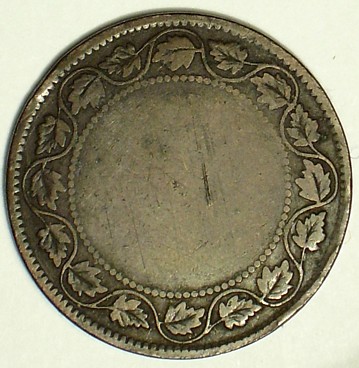 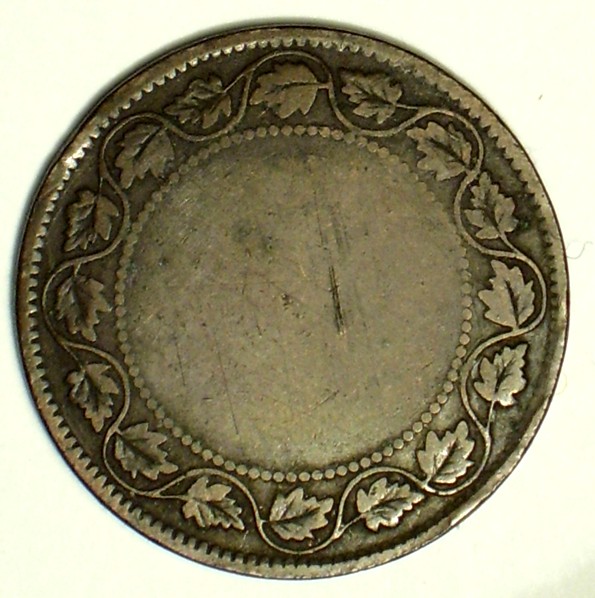 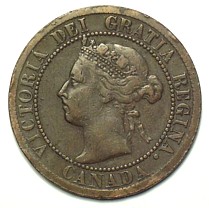 Edited by wossip
10/23/2010 11:04 am
|
|
|
|
Valued Member
United States
459 Posts |
Interesting coin.
Since it is a C4 obverse the date has to be between 1892 - 1901.
|
|
Bedrock of the Community
United States
10045 Posts |
From the photo, I can see a lot of abrasion marks on the blank reverse area.
Most likely, somebody was bored and wore away the design.
|
|
New Member
 United Kingdom
26 Posts |
Thanks for the replies.
The abrasion marks are partly raised, suggesting that they were on the actual die rather than on the coin itself, and that someone made a good job of erasing much of the central panel on the die.
But, more interestingly, there ARE letters in line, almost legible but very faint, in SMALLER characters than on the Canadian cent, and more numerous as well. That is how the INDIAN 1/4 annas of the same period appear; hence the possibility of an error punch, noticed by the Mint, but not fully corrected. Might an X-ray of the metal show them better? Many years ago, I took the unique 1889 British farthing to Scottish Aviation and they proved that the date was original by 'seeing' what had been impressed, INSIDE the metal. I may do similarly with my cent. (I am in Britain).
Edited by wossip
10/24/2010 04:59 am
|
|
Valued Member
Canada
153 Posts |
Although British India had a leaf and vine pattern on the reverse of the 1/4 Anna coins, it was not the same design. The Canadian Large Cent for 1890-1901 (of which your coin is one) had 16 leaves .. the India coin has less and looked different. I lean toward someone removing it, as others have suggested .. it was only a one-piece die, so just the center couldn't have been removed. On your photo of the Reverse, how was it acclimated/aligned for the photo? ... medal, coinage, something inbetween?
|
|
New Member
United Kingdom
26 Posts |
Sorry. I don't think I made my thoughts clear.
Indian 1/4 annas had, I believe, a wreath of lotus leaves and flowers, not the Canadian maple leaves. What I was trying to suggest is that the central panels containing the inscription and date would be imposed by a punch on to the die, already engraved with the appropriate wreath; but that, by mistake, in the case of my coin, someone had punched the INDIAN inscription on to a Canadian reverse die - and, before striking commenced, had tried to erase the central panel details, leaving faint traces of these details.
Alignment cannot be determined.
|
| |
Replies: 5 / Views: 2,534 |
|







 Posted 10/23/2010 1:35 pm





