











 Posted 11/17/2010 06:53 am


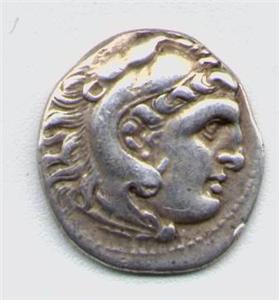
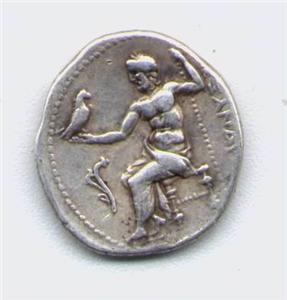
There is enough of the legend to tell that it is indeed a coin of Alexander (the Greek letters ...XANDR... are clearly readable). However, not only were there several kings of this time period named "Alexander", coins in the name of Alexander the Great himself were struck for about 200 years after he died. Dating them is tricky.
However, one rule of thumb is that during Alexander's lifetime, the depiction of the seated Zeus on the reverse changed sightly: early coins depict Zeus's legs side by side, while later coins depict him with legs crossed. Your coin has crossed legs, so it's either late lifetime or a posthumous issue.
All ancient coins have been cleaned at some point, because all ancient coins that are around today were dug up sometime in the past 500 years. So "cleaning" isn't as bad as it is on modern coins. Coins can be "overcleaned", but from those pics I wouldn't say that yours was.
Collectors of modern coins sometimes get surprised when they see ancient coins that are off-centre, double-struck or with other "mint errors". This is normal, given the way coins were made back then - by a guy with a big hammer using hand-carved dies. Such "errors" are common in ancient and mediaeval coins. It's the well-struck, fully centred coins that are scarce and collect a premium.
However, one rule of thumb is that during Alexander's lifetime, the depiction of the seated Zeus on the reverse changed sightly: early coins depict Zeus's legs side by side, while later coins depict him with legs crossed. Your coin has crossed legs, so it's either late lifetime or a posthumous issue.
Quote:
Is it cleaned to look so bright?
Is it cleaned to look so bright?
All ancient coins have been cleaned at some point, because all ancient coins that are around today were dug up sometime in the past 500 years. So "cleaning" isn't as bad as it is on modern coins. Coins can be "overcleaned", but from those pics I wouldn't say that yours was.
Quote:
I would think it was a bad (hammer) strike...
I would think it was a bad (hammer) strike...
Collectors of modern coins sometimes get surprised when they see ancient coins that are off-centre, double-struck or with other "mint errors". This is normal, given the way coins were made back then - by a guy with a big hammer using hand-carved dies. Such "errors" are common in ancient and mediaeval coins. It's the well-struck, fully centred coins that are scarce and collect a premium.
Don't say "infinitely" when you mean "very"; otherwise, you'll have no word left when you want to talk about something really infinite. - C. S. Lewis


