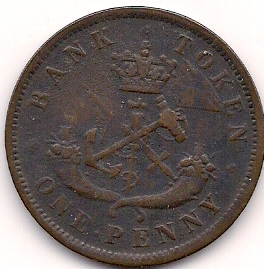
In the United Province (an early political union of what we now call Ontario and Quebec) there were no official government coinage issue until 1858, when the first coins in the name of "Canada" were struck. Prior to this the larger banks were granted government authority to issue tokens. These "bank tokens" are generally regarded as an official part of the Canadian series and are listed in the Krause catalogue of world coins.
Note that these are denominated in "pence", not "cents". They would have circulated alongside British pounds- shillings-and-pence coinage which would have been legal tender in Canada at the time, though coins from America and the other Canadian colonies would have circulated as well.
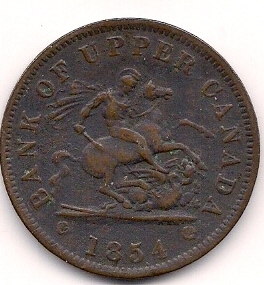
Up to 1849, the capital city was Montreal and most of the token issues were struck in Lower Canada (Quebec) but following a series of riots, the capital was moved to Toronto. The Lower Canada banks had their token-issuing status revoked (though it was briefly restored to one bank there after a coinage shortage in 1852) and the Bank of Upper Canada was granted a monopoly on token-issuing instead. Halfpenny and penny tokens were struck with dates 1850, 1852, 1854 and 1857. The token-issuing rights were withdrawn when Canadian coinage began in 1858.
In 1866, the Bank of Upper Canada went bust, collapsing under the weight of too many poorly secured loans. A year later when the bank's vaults were cleared out, eleven tons of tokens were recovered and sold for scrap. It's suspected that many of the higher-grade examples of these tokens that survive today had been souvenired by the scrap metal traders before they reached the melting pot. The bank's headquarters were bought by the Christian Brothers and turned into a school; the
building still stands in Toronto today.
There is a slightly scarcer variety in the 1854 dated penny token, the "crosslets 4", where the crossbeam of the numeral "4" has a crosslet at its tip. I don't think yours is that variety, but a closeup pic of the date area could confirm this.
Don't say "infinitely" when you mean "very"; otherwise, you'll have no word left when you want to talk about something really infinite. - C. S. Lewis







 Posted 11/23/2010 11:46 pm





