| Author |
 Replies: 10 / Views: 1,742 Replies: 10 / Views: 1,742 |
|
|
New Member
United States
42 Posts |
I found these three ancient coins at the coin shop I work at. Can anyone ID them for me, please? Thank you! There's a dime in the pic with them for size comparision. Also, any idea what they're worth/where I can find out? 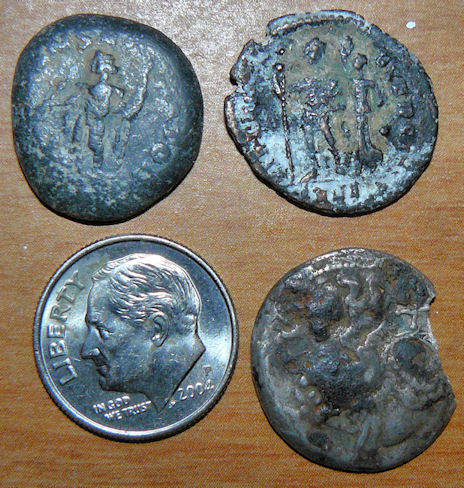 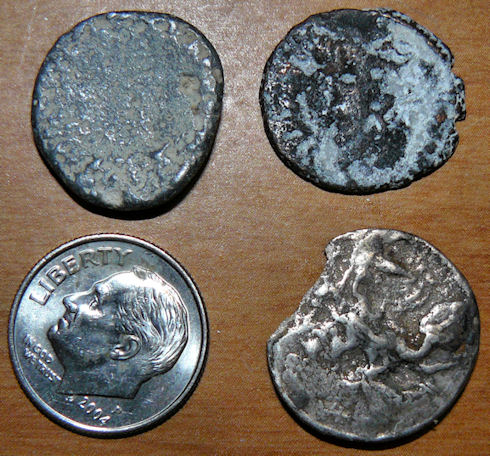 |
|
|
|
Valued Member
Canada
268 Posts |
Tough call in that there is little detail. Possible late Roman AE3 and AE4.
|
|
Moderator
 Australia
17005 Posts |
Top left: it looks Greek in style, though there are a couple of odd things about it: the standing figure is typically a reverse design, so the other side should feature a portrait, in high relief; I'm not seeing any trace of that at all. Second, there's a clear letter "S" above the figure's head; Greek has no letter shaped like "S". I'd assume it's some kind of late Greek/early Roman provincial.
Top right: a late Roman bronze from the 300's AD, in quite poor condition with a nasty case of verdigris. Reverse GLORIA EXERCIT (Glory of the Army), but I can't read the mintmark and the obverse is too far gone for me to guess an emperor.
Bottom right: Interesting. Were it not for the fortuitous exposure of the letter "X" (top pic, at about 2 o'clock) I'd have no clue, but the "X" gives this away as a Roman Republic silver denarius. I have no idea what the lizard-tree-starfish thing on the other side is, but on the side with the "X" is a portrait of Roma - you can just see her nose, lips and chin at about 8 o'clock.
Don't say "infinitely" when you mean "very"; otherwise, you'll have no word left when you want to talk about something really infinite. - C. S. Lewis
|
|
New Member
Greece
14 Posts |
Concerning the denarius I have (foolishly?) convinced myself that this is what we are looking at (approximately):    To be truthfull, I can even read "ROMA" under the horses... The coin we are discussing has, in my opinion, at some point in its career been in contact with extreme heat. Maybe it was a funeral offering and was burn with the deceased? |
|
New Member
 United States
42 Posts |
Thanks for the ID on the clipped/burnt(?) one. If memory serves, "denarius" is equivalent to 1 cent, right? Can you tell me the year (or range of years) the coin was made? Any idea of it's worth (in mint condition or otherwise)? How about on the other two?
|
|
New Member
United States
42 Posts |
The top left one apparently didn't photograph very well. I can read the letters "ONS" and possibly follwed by an M to the left and at the top of the figure in teh top poicture. Toteh right of the figure, it looks like it might be "KATOD" (not 100% sure about the first and last letters - teh first could be an I and a C stuck/worn together). Before the O in the "ONS" there appears to be a G or a C. Hope that helps!
|
|
Moderator
Australia
17005 Posts |
Quote:
If memory serves, "denarius" is equivalent to 1 cent, right? No, if anything, the denarius was equivalent to the "dollar", and a denarius of the Republic period would have been worth much more than a modern dollar is to us today. In the days of the Republic, a denarius would have been a day's pay for a soldier or highly skilled worker. There were originally 10 asses to a denarius - "denarius" literally translates to "of ten" or perhaps more loosely as "tenner". The "X" I mentioned earlier was the mark of value, the Roman number "10". The coin was later retariffed to be worth 16 asses, but the name and mark of value were retained. It's impossible to give a specific date range without seeing the (now lost) details on the reverse. Coins of this same general design were used from the introduction of the denarius in 211 BC down to about 100 BC. I don't know how much an unidentifiable, damaged denarius would be worth. In VF condition, denarii of the period typically catalogue in the $80 to $100 range, but this poor thing probably wouldn't be worth more than $20 or $30. Still more than bullion value, but not too much more. The Late Roman Bronze is likewise too badly damaged to be worth more than a couple of dollars. Some extra cleaning might help, but that verdigris makes me think vital details have been corroded away. If we can get an ID on the "Greek" one it might be worth more, but until then, it too will have to go in the "Unidentified ancient bronzes - $5 each" box. Don't say "infinitely" when you mean "very"; otherwise, you'll have no word left when you want to talk about something really infinite. - C. S. Lewis
|
|
New Member
United States
42 Posts |
Thanks. Can you tell me the names of the other two coins?
|
|
Moderator
Australia
17005 Posts |
I don't know what to call the "Greek" one because I don't know what it is. And I don't know what to call the Late Roman one because nobody knows what these coins were actually called; the word "follis" is often applied t them, thought here is scant evidence the Romans themselves used for these particular coins. The only word used for these particular coins in ancient literature was "nummus", which simply means "coin".
In both the Greek and Roman series, the conventions for coins we don't know the names of are to use numbers. In the Greek and Roman Provincial series, the convention is to use the letters "AE" (short for "aes", the Latin word for bronze) and the diameter in millimetres. This, if your coin is 16mm diameter, it would be called an "AE16".
In the Late Roman series, slightly different (though confusingly similar) symbols apply: AE1 are very large bronzes, AE2 are medium-sized bronzes, AE3 are small ones and AE4 are tiny. This one would fall in the AE3 range.
Don't say "infinitely" when you mean "very"; otherwise, you'll have no word left when you want to talk about something really infinite. - C. S. Lewis
|
|
New Member
United States
42 Posts |
Thought I'd redo the photos of the one remaining unkown ancient. Let me know if this makes a difference at all. Thanks for all your help! 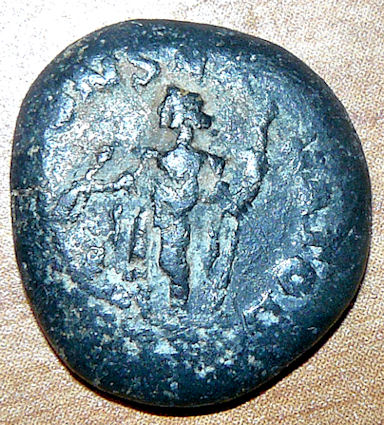 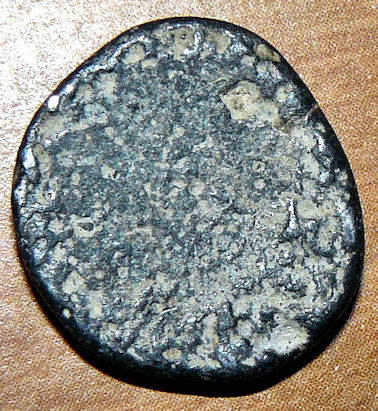 |
|
New Member
United States
42 Posts |
By the way, the coin is about 3 mm thick at its thickest point.
|
| |
Replies: 10 / Views: 1,742 |
|










 Posted 11/25/2010 6:40 pm


