









 Posted 12/04/2010 06:02 am


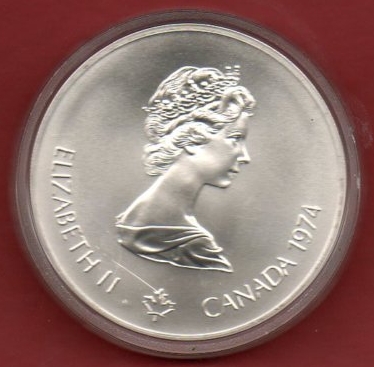
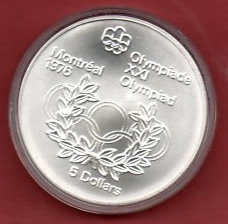
And in case it's not obvious from nikola's post: yes, it is an official Canadian coin, struck by the Royal Canadian Mint. They predate the introduction of bullion maple leaves by 15 years.
Montreal '76 was the first of the really big "coin Olympics" - previous Olympic Games all had either no coins made at all, or just one circulating commemorative. This coin is part of a massive set of 14 $5 coins, 14 $10 coins and one $100 gold coin, issued from 1973 up to 1976. The Canadian Olympic Committee had high hopes for these coins, but overall they were a commercial flop, especially the silver ones - mintages were simply way too high. Earlier coins are slightly more common than later ones, because many people that started buying them in 1973 couldn't be bothered finishing them. They've never been worth much more than bullion, though like all Olympic coins they usually have a price spike every four years at Olympics time.
The happiest Olympic Coin owners were the ones that sold them at the height of the 1979/80 Hunt Brothers silver boom; many were probably melted down at the time. Then in the 1990s when silver fell below Can$6.92 an ounce (which is the face value equivalent price), many more of these coins would have been cashed in at the bank, who would have then sent them back to the Mint... for melting down.
And yours is the Unc version, not a proof. Proofs have mirrored fields, Uncs have frosted.
Web references: These guys are selling them. This one on WorldCoinGallery is a proof.
Montreal '76 was the first of the really big "coin Olympics" - previous Olympic Games all had either no coins made at all, or just one circulating commemorative. This coin is part of a massive set of 14 $5 coins, 14 $10 coins and one $100 gold coin, issued from 1973 up to 1976. The Canadian Olympic Committee had high hopes for these coins, but overall they were a commercial flop, especially the silver ones - mintages were simply way too high. Earlier coins are slightly more common than later ones, because many people that started buying them in 1973 couldn't be bothered finishing them. They've never been worth much more than bullion, though like all Olympic coins they usually have a price spike every four years at Olympics time.
The happiest Olympic Coin owners were the ones that sold them at the height of the 1979/80 Hunt Brothers silver boom; many were probably melted down at the time. Then in the 1990s when silver fell below Can$6.92 an ounce (which is the face value equivalent price), many more of these coins would have been cashed in at the bank, who would have then sent them back to the Mint... for melting down.
And yours is the Unc version, not a proof. Proofs have mirrored fields, Uncs have frosted.
Web references: These guys are selling them. This one on WorldCoinGallery is a proof.
Don't say "infinitely" when you mean "very"; otherwise, you'll have no word left when you want to talk about something really infinite. - C. S. Lewis


