











 Posted 12/12/2010 01:43 am


Because they wished to help support the Australian economy. 
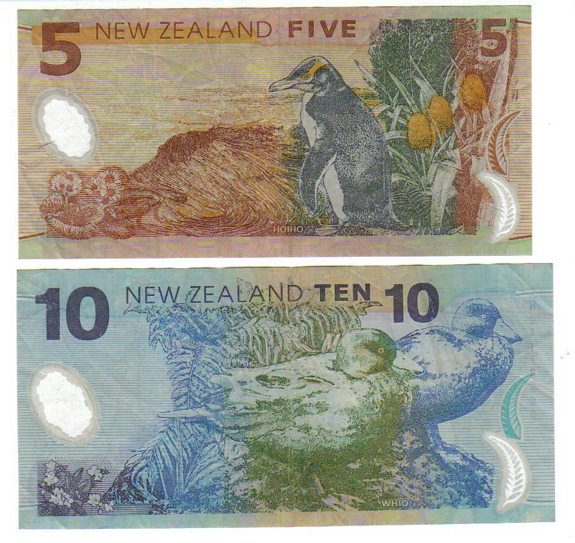
Polymer note technology was invented and patented by CSIRO, the Australian government research arm. Australia has been making polymer notes like these since 1988, and since the mid-1990's all our "paper money" has been plastic. New Zealand is just one of Australia's neighbours to be persuaded into adopting the substance for circulation notes, but anyone using this technology has to get their notes printed in Australia.
Polymer notes have several advantages, besides the longevity mentioned by svslav, though this is less of a factor in New Zealand than it is in tropical countries like Papua New Guinea and Brunei, where the climate makes paper notes degrade even faster.
Polymer notes are also harder to counterfeit - to make a passable replica, you need something more sophisticated than a colour printer.
Polymer notes have a few drawbacks, too. They tend not to "stay flat" like paper - if you put a crease in them, they stay creased and don't want to straighten out again; this makes handling and counting bulk amounts of notes more problematic. And while they're harder to cut or tear, the plastic is more brittle than polymer, especially after prolonged exposure to sunlight, so once a cut or tear starts it tends to propagate further and faster through it.
Polymer note technology was invented and patented by CSIRO, the Australian government research arm. Australia has been making polymer notes like these since 1988, and since the mid-1990's all our "paper money" has been plastic. New Zealand is just one of Australia's neighbours to be persuaded into adopting the substance for circulation notes, but anyone using this technology has to get their notes printed in Australia.
Polymer notes have several advantages, besides the longevity mentioned by svslav, though this is less of a factor in New Zealand than it is in tropical countries like Papua New Guinea and Brunei, where the climate makes paper notes degrade even faster.
Polymer notes are also harder to counterfeit - to make a passable replica, you need something more sophisticated than a colour printer.
Polymer notes have a few drawbacks, too. They tend not to "stay flat" like paper - if you put a crease in them, they stay creased and don't want to straighten out again; this makes handling and counting bulk amounts of notes more problematic. And while they're harder to cut or tear, the plastic is more brittle than polymer, especially after prolonged exposure to sunlight, so once a cut or tear starts it tends to propagate further and faster through it.
Don't say "infinitely" when you mean "very"; otherwise, you'll have no word left when you want to talk about something really infinite. - C. S. Lewis


 is made in Holland


