| Author |
 Replies: 13 / Views: 1,318 Replies: 13 / Views: 1,318 |
|
|
Valued Member
United States
223 Posts |
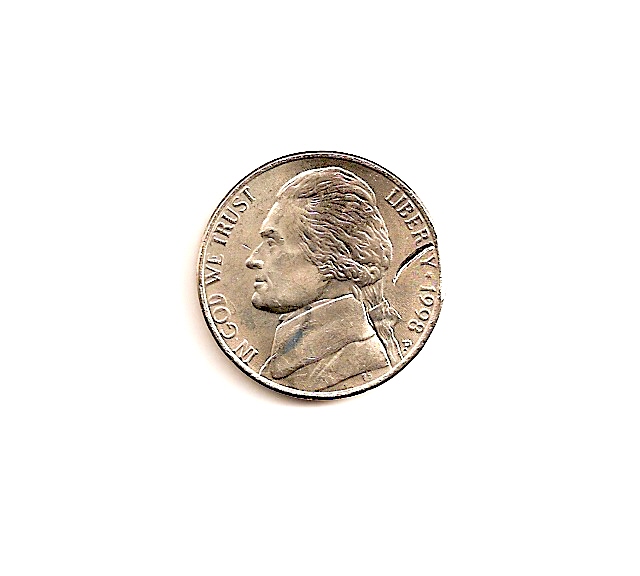
At first I thought this was one giant gouge in the coin. Upon closer inspection there is also a partial clip on the right side. Did this clip fall on the planchet and get pressed into the coin? What happen to the clipped piece? Did it adhere to the die and make more of these gouged nickels? Image:  1998.jpg 1998.jpg66.66 KB |
|
|
|
Pillar of the Community
United States
5362 Posts |
stmpcol - technically a "clip" is produced in the blanking step when a coin blank is cut out of the strip of coin metal. It happens when the circles (of the blank cutters) slightly overlap and the cutter produces less than a full disc of metal. The little "pieces" are not actually missing - they are a part of the blank that was cut out earlier.
Now as to what you might have here.
After the metal is blanked it is "UPSET" in an upsetting mill which thickens the edge - turning the blank into a "planchet". A small piece of the edge can be removed at this step but it would be unlikely to remain with the planchet it came from.
Then the planchet is cleaned and softened for coining. The pressure of the strike hardens the coin again. This usually is the point at which debris (small metal fragments) get caught and removed.
But little chips of metal can be created at several different points in the coining process right up to the strike itself. The damage to the planchet which happens in the press and feeder mechanisms is far more likely to leave the small chip of metal on or close to the coin to be struck. If for example the planchet was not exactly centered in the coining chamber the force of the rising collar die could (I suppose) clip off a tiny chip of metal. The coin could then fall into the coining chamber in time to be struck with the metal chip on the surface of the planchet. This would place the coin in two different categories. The incomplete planchet is one error and the strike through the chip of metal is a second. Matching the chip of metal to the small area of damage would make this a rather scarce double error.
|
|
Valued Member
 United States
223 Posts |
Swamperbob, thanks. According to my 12" ruler, using 16ths It fits. But who is the GOD of the Coin World that says your right? Does this have to be sent off to a grading company and at fifty $ a coin is it worth it since as now I have no intention of selling any of my coins? |
|
Pillar of the Community
United States
5362 Posts |
stmpcol - I would not sumbit it because the final value would absolutely be less than the cost to slab it. However, you should be able to determine the charater of the gouge by looking at it with a binocular microscope at 30X or higher.
Think of the mechanics of how the depression could have been made. I see about only three possibilities to create that gouge.
1. It is a gouge or scratch caused by a glancing blow with a harder object made after the strike. This will have lines along the gouge (scratch) in the direction of the cut. These parallel scratches (if they are present) mean that the cut is simple post strike damage. There should also be some very slight metal displacement at the edges of the cut which would raise the perimeter of the gouge above the fields. If you have a high resolution microscope you will see that as you focus on the cut itself. If the edge of the cut comes into focus BEFORE the field does - it is HIGHER and it is post strike damage. If the edge of the cut is precisely even with the field and if there are no long scratches along the axis of the scratch - move to possibility two.
2. The gouge could possibly be the result of an impact perpendicular to the coin surface by a hard object like a puncheon. This would not produce scratches along the axis of the gouge. This would result in scratch lines perpendicular to the coin surface and should produce a small amount of damage on the opposite side of the coin - a flattening of the surface. I doubt anyone has a puncheon made in this shape - but I thought I would examine all possibilities no matter how remote. Move onto number three.
3. The gouge represents the impression of a piece of metal that was on the planchet at the time the coin was struck. Now this could be the chip that was cut from the edge of this planchet or it could be any other extraneous hunk of metal that falls into the coining chamber. This is called a "strike through". They are more valuable when the foreign object remains in place, but they are of minimal value when only the "impression" of the foreign object remains. The features of a legitimate strike through are a DEAD LEVEL surface with no distortions whatsoever within the field. If a chunk of metal was resting on the coin surface it will be pressed into the surface by the force of the strike - no upwhelling of metal around the perimeter of the object is possible. Also, because there is no motion between the chip of metal and the coin surface, there will be NO SCRATCHES within the gouge.
So I believe you should be able to place your coin into one of the three categories above.
Once you can be absolutely sure you are dealing with an impression of a "strike through" - you have a legitimate mint error and not post strike damage. A coin struck through an abnormal object is classified as a Class III-K error. The variety struck through a planchet fragment (whether of this coin or another) is listed as a III-K-7 and has a value of $1 up. I would personally find it very interesting and of perhaps $5 in value, if you could match the missing piece of the coin with the impression.
|
|
Pillar of the Community
United States
5362 Posts |
For anyone following this thread - Frank sent the coin in question to me for inspection. Here is the letter I sent to him today.
The 1998 Jefferson arrived safely. It is beyond almost all doubt a "Struck Through Rim Burr" where the piece of metal has largely dislodged from the original surface. This is a class III-K-8 error according to the PDS classification system.
I say "probably" only because of the presence of a pair of very oddly positioned marks on the edge of this coin. I will cover that later.
My review shows all of the features of a "Strike Through" - the distortions of the depression, the lack of evidence of tooling or an impact, absence of flow lines within the "hole" and the size and shape of the "hole" itself all conform to other similar coins I have examined. There is actually a smaller second shard of metal that was retained and can be seen between the "hole" and the edge of the coin. That second strike though involves a very tiny sliver of metal possibly a piece of the edge of the larger burr that was cut from the rim. This feature I only noted when I rotated the coin under high magnification. The second burr was thicker than a human hair but not by too much. This second sliver runs through the letter Y in LIBERTY and is not a "cut in" post-strike feature. I also noted that above the R in LIBERTY the burr remained attached to the planchet and that there is a small piece of the burr still remaining. The missing part of the sliver appears to have been broken away at the point above the R near the edge. This may have happened in the ejection process or at any point before you found it.
The edge of the coin where the burr originated has been sheared perpendicularly to the coin face and is fully consistent with the planchet being damaged by the edge of the rising collar die just before the planchet became fully centered in the coining chamber.
Above I noted the presence of two oddly positioned rim "nicks". They are located at about 180 degrees apart and in a plane that bisects the burr. There is a slight (only slight) possibility that these two contact marks - one round and one resembling a knife edge cut could be traces of a device used to hold (or clamp) the coin rigidly in place while being tooled. That said, I was initially very suspicious, BUT after a full microscopic examination, my opinion is that this is actual striking damage and NOT AN ELABORATE HOAX. I believe the marks on the rim can be assigned to miscellaneous post strike damage caused by the coin dropping into the coin hopper.
At times, error collectors have been known to manufacture clever forgeries to fool authenticators. If that is the case here - I would love to meet the party or parties responsible because they have essentially produced a PERFECT example of a Non-Retained Struck Through Rim Burr.
The coin has a value estimated at $1 to $2 over the value of the coin itself. It is considered a rarity level 3-5 which is defined as Scarce to Rare From 100,000 to 100 pieces. For the particulars on the PDS classification system and values attached see - Krause Publications "2007 North American Coin Prices" by David C. Harper, Editor, pages 117 and 131.
|
|
Bedrock of the Community
United States
14454 Posts |
quote:
Originally posted by stmpcol
But who is the GOD of the Coin World that says your right?
I dont quite understand this statement but if it was meant the way I took it I find the statement very offending and I think it was in poor tatse to ask someone for their opinion then when they give it to you you make a comment like that about their personal knowledge |
|
Pillar of the Community
United States
5362 Posts |
Bryan1315 - I was not offended by the comment because as I understood it - it was a general inquiry into "who decides". It was more of a general comment about the confusion that often exists when more that one "expert" weighs in on a coin. I think it is just an indication of the frustration that all of us feel at one time or another when we get into areas where we are not comfortable.
Thanks you for the supportive comment however. We all need to treat each other as well as possible because life is all too short.
|
|
Valued Member
United States
223 Posts |
Thanks swamperbob, once for the interpretation of the coin and again for interpretting the sentence the way I meant it. Honestly Bryan I,m enjoying this forum to mucn to want to offend anyone on it.
|
|
Bedrock of the Community
United States
14454 Posts |
Like I said I wasn't sure about the comment and wasn't sure how it was meant to be taken, that is why I said if it was meant the way I was reading it that the comments that followed is how I felt. I am sorry if I misunderstood but I wasn't coming down on anyone just trying to state my opinion if the statement was meant in a harsh way, the way I was reading it
|
|
Pillar of the Community
United States
954 Posts |
From the pic I would have thought it was post mint damage. It looks like a gouge, but I didn't notice the clip until just now. It was very interesting to hear the "verdict".  |
|
Pillar of the Community
United States
5362 Posts |
stmpcol - just thought you should see another example of a Struck through (RETAINED) Rim Burr. When your coin came up I did a search on ebay and found this one. I decided to bid on it on a lark. It falls in the identical class as the nickel and shows that this kind of an error has happened for a long time. http://cgi.ebay.com/ws/eBayISAPI.dl...190031185196The auction presents an anomaly associated with some "errors". Notice the final bid price. Even with shipping the price I paid is UNDER what I would consider the actual retail of this coin without the error. The coin is NOT DAMAGED - the damage to the planchet happened BEFORE the strike. The coin surfaces are very nice in person. I think the problem here is that most bidders looked at this as a "damaged" coin and they didn't bid.
|
|
Valued Member
United States
223 Posts |
I also would have just seen a damaged coin. But the more I visit this forum the more I'm learning. Is the reverse really rotated that much or did the seller turn it some to hopefully get a better price?
|
|
Pillar of the Community
United States
5362 Posts |
stmpcol - apparently most bidders had the same opinion - which was great for me.  The coin is NOT rotated. Whenever I bid on ebay I NEVER make assumptions (or I try not to). If I would be willing to adjust my bid to include a feature not 100% certain from the scans I ask questions. Better same than sorry.   
|
|
Pillar of the Community
Czech Republic
803 Posts |
Nice error, stmpcol! And as always, I have greatly enjoyed swamperbob's response in it's detail and educational value.
~Roman
|
| |
Replies: 13 / Views: 1,318 |
|










 1998.jpg

 Posted 09/07/2006 6:57 pm


