| Author |
 Replies: 23 / Views: 3,483 Replies: 23 / Views: 3,483 |
|
Valued Member
Canada
59 Posts |
Hello everyone and Happy New Year!
Can someone shed some light as to why the J76800001A - J96000000A run in this block printed at FW in December 1992 is so scarce? I have looked it up in the most recent Collector's Guide by Robert Azpiazu (where it is listed at $45) and have also looked it up in the BEP reports, and I can see no reason why it would be worth more than any other note in the same block, especially since 19 million+ notes were printed in this run. Any thoughts or ideas would be greatly appreciated.
|
|
|
|
Valued Member
Guatemala
357 Posts |
This is just an idea, and I don't have any knowledge to back it up, but is it possible this run was printed for 'foreign' use, perhaps in Liberia, which was dual currencied at that point in time? Or Panama, which has been dollarized since 1904. El Salvador and Ecuador went to the dollar in 2000 and 2001, as I recall, so they would be too late.
|
|
Valued Member
 Canada
59 Posts |
That's a very interesting idea JM, I never thought of that and I wonder if printing currency for "international" use is actually something the US Treasury did. I know that in the pre-Euro days the US dollar was the de facto currency in many Eastern European countries, and was the only accepted form of payment for large purchases. I remember visiting Russia in 2001, and many ATMs would dispense cash in Roubles or in US$s.
Anyone else have any thoughts on the reason behind the scarcity of this particular run?
|
|
Valued Member
United States
176 Posts |
sounds like a typo to me. my book says $4.50
|
|
Valued Member
Guatemala
357 Posts |
Peiper,
They still do it. They ship pallets of new bills to Iraq and Afghanistan. I'm sure any dollarized country or territory can trade their old bills in and get new ones fairly easily too. I do know that you see a lot more Dallas/F.W. bills in circulation in Central America, than you do in the U.S.. I always figured Panama and El Salvador got their currency from Dallas/F.W..
|
|
Pillar of the Community
United States
1397 Posts |
Quote:
my book says $4.50 Thats called inflation, they just move the decimal point over by one every so often... |
|
Pillar of the Community
3660 Posts |
I have heard on many occasions about these "runs".... some are considered small runs, some are not..... just what is a "run"? I am not familiar with the terminology.
|
|
Valued Member
Guatemala
357 Posts |
Zee,
I've always been understood a run to be any print order to produce any size order of a single product. It's the same basic concept as a first edition or second edition, etc. of a book.
The way I visualize it, it's like your local daily newspaper. That newspaper has a daily circulation of X copies. But, each day, it might have multiple editions. Each individual edition would be a 'run'.
|
|
Pillar of the Community
3660 Posts |
Thanks JM.... so basically, it all just a bunch of hype, and is totally meaningless? What is the difference between a low run and a normal run? Anything? What I mean is this: a district like San Francisco might have over two billion notes printed for a particular series..... what would cause a premium for any of those two billion notes based on a particular run? I can understand low serial numbers, but I have read stuff about a note holding a premium based on it being of a low run..... If I fill a jar with grains of sand every day for three months, and then dump the jar daily into a big pile, (but on a couple of those days I only filled the jar halfway), does this make those particular grains of sand that were in the half filled jar more special?
|
|
Valued Member
Guatemala
357 Posts |
A low run just means fewer examples are printed. For example, an emergency issue of a currency.
Normally, I'll agree, the distinction of a run is meaningless, unless there is an anomaly associated with that run. Emergency issue, an error specific to a run, or something of that magnitude.
|
|
Pillar of the Community
3660 Posts |
I see.... Thanks very much JM.... I am learning little bits here and there about what these modern FRN actually mean to the collector.
|
|
Valued Member
Guatemala
357 Posts |
Sometimes it gets rather silly. I've seen Mexican provisional banknotes sold, where the seller seeks a premium based upon a low serial number, for example 07533. Well, a knowledgeable collector could easily determine that only 8400 bills were printed, so 07533 is not, in fact, a low serial number.
Edited by JMerrick
02/20/2011 10:30 am
|
|
Pillar of the Community
3660 Posts |
Yes, I see what you mean..... or, another way that folks might look at it is that they are all low serial numbers...  I have a 1914 red seal FRN $20 Atlanta.....# F26959A.... some people might think that is somewhat of a low number, but if you realize that there were only 160,000 notes printed, the low factor dissipates quickly enough. Here is another 1914 red seal FRN from Altanta..... $5 low # ? Depends on low you look at it...... 520,000 notes printed for that district. 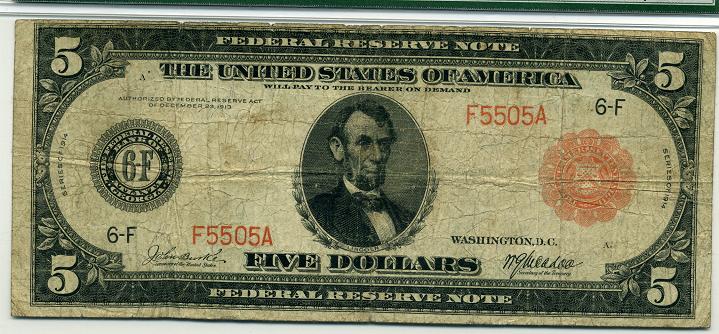 Consider the fact that prior to the new SOI press capabilities of 50 note sheets being fed, the COPE-PAK held a capacity of 40,000 half sheets, (640,000 notes) at one time..... so, to generate an entire block of serial numbers, the COPE-PAK would have to print/cut/package to its full capacity 150 times..... employing 12 presses though, this could be accomplished rather quickly at either print facility. |
|
Valued Member
Guatemala
357 Posts |
Well... I'm going to lapse into my 'opinion' here. I wouldn't consider the $5 FRN to be a low S/N, personally. If 520K bills were printed, I would want to see a leading 0, and the A suffix. So, my definition of a low S/N would be F0999A or lower. Then again, I'm a bit more of a 'snob' in that regard than the average collector.
Now, you can find yourself in a situation with modern notes, where a small segment of an FRB's allocation is dedicated to a specific 'run'. For example, the defense department could call the BEP, and say "We need 4 pallets of $100 bills" in Iraq. Since that amount is actually large enough to print a run, the BEP could assign a special block of S/N's to the job. Then BEP could look at the number of bills ordered by the different FRB's, and say a certain district was a little low in their orders, they would assign that 'run' to that district. So, if Cleveland, hypothetically, wasn't ordering as many $100 bills as the other districts average, the bills would be assigned to Cleveland, and BEP would deliver 4 skids of $100 bills from the Cleveland district to the Dept. of Defense.
|
|
Pillar of the Community
3660 Posts |
Quote:
I'm a bit more of a 'snob' in that regard than the average collector. As am I, nothing wrong with that either, as I see it.... Sorry for fading in and out JM.... I am trying to watch one of my favorite movies ("Morocco" with my favorite actress... Marlene Dietrich). Good example with the Iraq analogy.... It happens far more frequently than most folks can imagine. |
|
Valued Member
Guatemala
357 Posts |
Another thing to consider is 'terminology.
A lot of people don't understand the process fully, and use the wrong terminology.
A series is just that. All items mandated to be released at one time, bearing certain distinguishing characteristics. For example, a series number, signatures, etc.
A job is the overall mandate to produce a theoretically unique subset under that series, for example "We project we're going to need 52,000,000 $100 bills in the Boston District during the lifespan of this series"
A run is the smallest subset. It's the actual items produced without changing any variables. To use a very simple example here, If I put a sheet of paper in a photocopy machine, and press 250 copies, my maximum 'run' will be 250 copies. But, if I run out of paper, or toner at 95 copies, I actually have two 'runs' in my 'job'.
So, in theory, a 'run' begins when you fill the ink drum, load the paper and mount the plates. Anytime one of those variables is altered for any reason, your 'run' is over.
|
| |
Replies: 23 / Views: 3,483 |










 Posted 01/07/2011 4:20 pm


