| Author |
 Replies: 18 / Views: 3,826 Replies: 18 / Views: 3,826 |
|
Pillar of the Community
United States
5910 Posts |
|
|
|
|
Valued Member
Guatemala
357 Posts |
He professes he's not a grader, but he talks about metal flow diagnostics?
|
|
Bedrock of the Community
United States
12437 Posts |
I have seem some curved clips look a little funky and this one does not look too abnormal. It is definitely genuine though.
|
|
Pillar of the Community
United States
4008 Posts |
Strange looking Blakesley's effect. Never seen one ribbed looking like that before.
|
|
Pillar of the Community
 United States
5910 Posts |
Check out the rest of the other coins he has for sale, quite a bit of clipped coins.
Some of those raise a flag for me. I just need to see better pictures to make sure if its genuine.
|
|
Pillar of the Community
United States
2761 Posts |
It could be a corner clip (aka assay clip), but doesn't it don't like the damage opposite the clip like it could have been held when it was 'clipped'?
|
|
Valued Member
United States
499 Posts |
Its a curved clip. the angle is due to the metal flowing into the "B" of LIBERTY instead of outward with the rest of the metal. the ribbing on the blakesley effect is due to the edge of the coin flowing over where the rim is missing.
Richard
|
|
Pillar of the Community
3660 Posts |
I don't know the first thing about Mercury dimes or planchet clips... but I do know a bit about other things.... this is indeed a curved clip.... the B in LIBERTY has very little (if anything) to do with anything..... it is a minor device (not unlike the corresponding lettering on the reverse) which does not absorb much metal displacement. The reason that the clip looks as it does is due to the proximity of Liberty's cap, which is the most major device on the coin, (coupled with no corresponding device on the reverse), and as such, draws the lion's share of metal displacement. The effect displayed exactly 180 degrees opposite the clip is due to the upsetting of the rim.... while being upset, the planchet inherently was out of kilter in rotation in the upsetting machine, and the rim did not form on that area, because of lack of opposing pressure from the clip.... (imagine rolling the coin...same thing)..... the trailing away of the rim is mirrored in both locations. 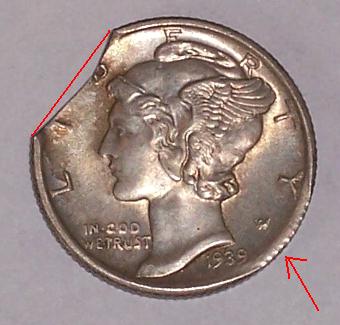 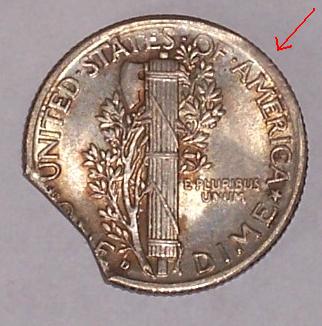 Edited by zeewool
01/08/2011 10:21 am
|
|
Pillar of the Community
United States
5910 Posts |
Thanks all who responded.
I still have a lot to learn about making of error coins.
|
|
Pillar of the Community
United States
2761 Posts |
It is interesting that the seller has such a high number of clips.
|
|
Moderator
 United States
23522 Posts |
Quote:
Strange looking Blakesley's effect. Never seen one ribbed looking like that before. The Blakesley Effect doesn't always manifest itself the same way every time - sometimes the upsetter gets it more "right" than others, sometimes it doesn't show up at all. This coin's opposite edge was strong enough to contact the collar with enough force to acquire reeding, and I think the clip might have allowed the planchet to tilt a little in the moments when the dies weren't at maximum travel, allowing some of the reeding to be impressed over the edge of the rim. Quote:
It is interesting that the seller has such a high number of clips. Clips are not all that rare. Some sellers - this is not the only one - tend to gravitate towards them with their purchases for resale. Not every coin has die cracks, but most of mine seem to.  |
|
Pillar of the Community
United States
4008 Posts |
Thanks SuperDave, that makes sense.
I wonder if someone sold off an incomplete planchet type set?
|
|
Pillar of the Community
3660 Posts |
Quote:
The Blakesley Effect doesn't always manifest itself the same way every time - sometimes the upsetter gets it more "right" than others, sometimes it doesn't show up at all. Would this not be determinant on the size of the clip? |
|
Moderator
United States
23522 Posts |
Quote:
Would this not be determinant on the size of the clip? You would think so. It doesn't always seem to be true. I suspect the specific orientation of the coin, relative to the clip, when it initially enters the upsetting mill can have a bearing on what comes out. |
|
Pillar of the Community
3660 Posts |
Now that is interesting... Thanks Dave.
|
|
Pillar of the Community
United States
5910 Posts |
I am not really clear as to how this came to be (meaning the process)?
I was thinking of bidding for it and keep it to study/references, but I want to have the expert here to clarify that its genuine.
Thanks Dave and zeewool!
|
| |
Replies: 18 / Views: 3,826 |




 Posted 01/07/2011 11:23 pm





