| Author |
 Replies: 11 / Views: 13,767 Replies: 11 / Views: 13,767 |
|
|
New Member
United States
7 Posts |
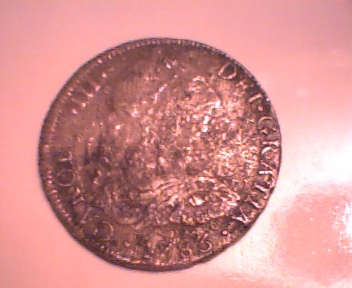
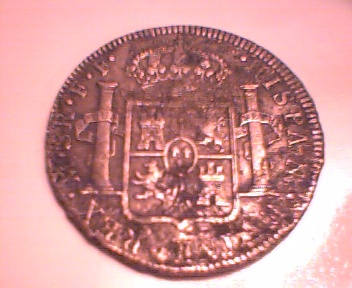
I have a Carolus III pillar dollar dated 1783 in fair condition. On the front is " CAROLUS*III*DEL*GRATIA*1783 " and on the back is " *HISPAN*ET*IND*REX*M*8R*F*F* " I'll try to get a pic up in the next couple days. Does anyone have an estimate of what it might be worth?
|
|
|
|
New Member
 United States
7 Posts |
Also, the edge of the coin has alternating squares and circles...
|
|
New Member
United States
7 Posts |
|
|
Moderator
 Australia
16991 Posts |
For the 1783 FF, The Krause world coin catalogue gives a value of US$25 in Very Good grade, the lowest grade listed. The catalogue is a bit old now, and the current price may be higher owing to the increase in silver price; badly worn or pitted ones may be worth not much more than bullion value.
Note that these Spanish dollars have been widely counterfeited, both at the time they were issued (to pass as a dollar in trade) and right up to today (to fool collectors). The squares-and-circles edge is "normal" for this type, but some of the better forgeries do a passable imitation of this as well. Swamperbob is the forum member to ask about authenticity of Spanish dollars, but he'd need to see a nice clear pic.
Don't say "infinitely" when you mean "very"; otherwise, you'll have no word left when you want to talk about something really infinite. - C. S. Lewis
|
|
New Member
United States
7 Posts |
Sorry the picture quality is bad, but here are a couple pics... (See the difference in the two coins outer edge) Image:  Sep13$01.jpg Sep13$01.jpg42.97 KB Image: Sep13$02.jpg49.26 KB |
|
Pillar of the Community
United States
5362 Posts |
Epiphanick - the 1783 Mo FF is perhaps one of most difficult coins of the entire 8R series to diagnose from just a scan. The reason is because thousands of originals were salvaged from a shipwreck (the "El Cazador") and they all look like yours. Couple that with the fact that there are even LARGER numbers of fakes of the same date made in every type of metal possible and you may see the problem. For this date, even Specific Gravity or XRF is not accurate. Some of the forgeries were made in silver (some were made from actual salvaged silver) so the assay even with an XRF can be correct. That is one reason why there are disputes about this date among "experts".
I may have related this story on another thread, but it is worth going through again. A few months ago (perhaps a bit longer) a coin dealer friend showed me two essentially identical 1783 Mo FF 8R coins that looked like yours. He had received them from a client who wanted to get them graded. But the dealer was suspicious and asked me to review them. I examined the coins and discovered that both were edged incorrectly. The circle and rectangle design had only ONE overlap. All original coins made at Mexico City were edged with a two flat bar die milling machine. This machine ALWAYS produces PAIRS of overlaps. Since the single overlap is a guarantee that the coins were not real I gave him my opinion - definitely forgeries. No doubt whatsoever. They were silver and they were approximately the correct weight given the level of damage.
But the owner of the coins still wanted them graded so the dealer sent them with NO DESCRIPTION other than Date, mint, assayer, denomination and country to ANACS. Both coins came back encapsulated as "Damaged" and they added the name of the shipwreck "El Cazidor" to the description - even though no such claim was made as to origin on the submission forms.
So I called and spoke personally to the grader who did the two coins. He admitted that on such "low value" items they spend very little time and he further admitted he did NOT check the rim design for TWO overlaps.
So, what you have in this case are two silver fakes encapsulated as originals because there is essentially no difference in actual value. Until they are cracked out - these two will never be discovered because the edge is hidden by the slab.
|
|
New Member
United States
7 Posts |
An interesting fact I discovered today-I was reading about the El Cazador and learned that most of the coins minted in 1783 were discovered by a fishing boat (www.elcazador.com) in August of 1993... The weird thing is that if found the coin I own somewhere around 1993 in the dirt in Mississippi (where I live) when I was seven years old.
|
|
Forum Kid
Kuwait
1523 Posts |
Intersting.... Or plain co-incidence,  It has a chance og being genuine. All I can say is Bob Knows best! TKC! |
|
Pillar of the Community
United States
5362 Posts |
Epiphanick - do you remember exactly where you found the coin? Was it at the beach where a storm could have blown it?
|
|
New Member
United States
7 Posts |
nope, I found it in the dirt in a friends carport/shed in east-central Mississippi. I'm thinking that maybe someone maybe dropped it...
|
|
New Member
United States
7 Posts |
well if it were real swamper, what kinda value would you give it?
|
|
Pillar of the Community
United States
5362 Posts |
Based on the appearance, I would say its coin value alone (no shipwreck attribution) is about $10 or so, but a real coin attributed to the El Cazador is a minimum of $25 to 30 - even in poor shape.
|
| |
Replies: 11 / Views: 13,767 |
|










 Posted 09/11/2006 9:38 pm


 Sep13$01.jpg
 Sep13$02.jpg


