| Author |
 Replies: 49 / Views: 18,541 Replies: 49 / Views: 18,541 |
|
|
|
Pillar of the Community
United States
1397 Posts |
A lot of people use services like photobucket to upload and display pictures or if you know someone with web space they could host a picture for you.
*Edited to add*
Also don't handle that note more than needed. If you don't have it in some kind of holder (like a Mylar sleeve, or top loading rigid holder) do so now!
Edited by Nickelman
01/28/2011 08:45 am
|
|
Valued Member
 United States
240 Posts |
I just purchased a sleeve for it where it will remain. I will try photo bucket and see if I have better luck. Thanks
|
|
Bedrock of the Community
United States
14454 Posts |
spring423 If you would like me to upload the pictures for you I will send you an email you can just respond to my email to you and attach the unedited pictures in the original size and I will resize them and post them so they will be larger on the forum if you would like.
Edit: I have sent you an email, if its not in your inbox you may need to look in your spam folder (that is where the emails from the forum seems to go on some servers)
|
|
Valued Member
United States
240 Posts |
Bryan1315 That would be great as I have not had any success uploading larger pictures Thanks
|
|
Bedrock of the Community
United States
14454 Posts |
Here are the pictures cropped and hopefully bigger   |
|
Valued Member
United States
268 Posts |
I was wondering something. I dont know how the sheets are cut at the BEP. I was looking at a regular 1 dollar note and the distance of the bottom of the district number which is 11 in this note and a regular note seem to be the same. Do they use some kind of scaning device to cut the sheets that corespond to these numbers.  |
|
Pillar of the Community
United States
1397 Posts |
Those sure look like red/blue fibers to me. 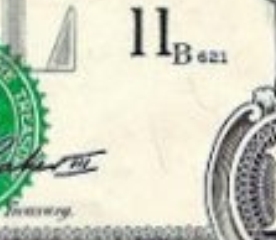 |
|
Pillar of the Community
United States
1397 Posts |
Quote:
I was looking at a regular 1 dollar note and the distance of the bottom of the district number which is 11 in this note and a regular note seem to be the same. Do they use some kind of scanning device to cut the sheets that correspond to these numbers. In my uneducated less than expert opinion (and I welcome someone to correct me)... I would have to say no to that. I will now attempt my character assassination unimpeded. Some notes have normal faces with shifted overprints, some have shifted faces with normal overprints (like this one above). I suspect the cutting has to do with the sheet itself and the error has to do with which of the 3 prints went wrong. Print 1 is the back of the note Print 2 is the face Print 3 is the overprinting of the seals on the face What I truly have a hard time with is how (in this case) both the back and front could be off and the 3rd print be correct. It seems to me there would have to be 2 errors at work here. A sheet twice printed misaligned and then once correctly. If both sides were printed correctly and then the overprint was wrong, when the sheet was finally cut (as you theorize) there couldn't possibly be the correct number of correctly sized notes. There would have to be "scraps" left over that should have been notes. Take the two error notes posted in this thread so far. The first (by spring423) has the front printed almost level, but the reverse printed at an angle. Then notice on the one I posted that only the face has part of a second note on it. I suspect both these examples help to state my case that more than one error had to take place for this note to happen. It's not so simple as saying it is a "cutting error". If that were so why are both sides not the same? Also I can't help but think how sheets are not cut individually. I believe one hundred are cut at a time, so your theory about a "scanning device to cut the sheets that correspond to these numbers" would only be reading the top sheet, any sheet under that is at its mercy. As I said I welcome input.  Edited by Nickelman
01/29/2011 02:13 am
|
|
Pillar of the Community
United States
1285 Posts |
Spring423, this is a nice error note "worthy of grading". It is not often you see "shifted face on both front and back". Also this error falls between moderate to major. You will only find out during grading IF it is considered a "major" error.
IF "major" the prices would be considerably higher.
|
|
Valued Member
United States
240 Posts |
Thanks everyone for the info concerning this note. I do plan on having it graded. Any suggestions as to who I should send it to. Looked online and found numerous company's that do grading. Just want one that has a good reputation. Thank You
|
|
Pillar of the Community
3660 Posts |
No Johnny, no scanners are involved in the cutting of the notes (logical thought though)..... In reality, (and here is where most folks get confused), the sequence of events is not as you might think.
The notes are printed on sheets of paper in the total of 32 notes per sheet (4 horizontally by 8 vertically).
First, the backs of the notes are printed on a Giorgi printing press, next the faces are printed on either the same or another identical Giorgi printing press.
Next, the notes sheets are cut in half (vertically) into half size sheets of 2 horizontally by 8 vertically.
.....................................................................
These half sheets are then hand stacked into stacks of 10,000 sheets and are fed into the COPE-PAK machines.... The COPE-PAK holds four stacks of half sheets (or 640,000 notes).
Since we are talking about sheets here, I will limit the explanation to half of the COPE-PAK's normal operating level (320,000 notes).
Once these two half sheet stacks enter the COPE-PAK, the process is purely mechanical (with an impressive array of computer controlled trouble sensors that can sense over 700 mechanical errors and shut the machine down automatically when a fault is detected).
The first thing that happens in the COPE-PAK is that blowers individually separate the half sheets..... The half sheets are then moved into position for the addition of the overprint (serial and district identifiers) by suction.
This is where your error occurred spring.... suction moved your sheet not far enough to align with the overprint cylinders..... Grippers then moved that half sheet (by mechanical action) to a predetermined distance (on top of the stack that will grow to 100 half sheets).
Next, (after the half sheets are machine stacked into stacks of 100 sheets), they are cut both vertically and horizontally into stacks of 100 individual notes.
After that, these stacks of 100 individual notes are automatically banded.
These banded stacks of 100 notes then proceed to a revolving carousel that collects ten banded stacks and then bands and shrink wraps those ten 100 note stacks together..... four of these (now 1000 note packs) are then collected and shrink wrapped together into a 4000 note pack called a brick.
It is important to remember that there are two very distinct machines that create these notes, the Giorgi press that prints the backs and the faces....... and then the COPE-PAK that applies the overprint and cuts and packages the notes for shipment.
Yes spring, your note is genuine, caused by the simple action of insufficient suction (which was probably due to insufficient separation of the half sheets by the blower), and finally correct action of the grippers.... It is a very neat error to look at, but the effect is lessened when you consider the actual cause.... I think that I would hold onto it though (if I were you), as you just don't see such things that often.
Edited by zeewool
01/29/2011 12:17 pm
|
|
Valued Member
United States
240 Posts |
Ok thanks, so basically it is a very common error. Appreciate the info
|
|
Pillar of the Community
United States
4008 Posts |
I don't think I'd be so quick as to call it a common error. Maybe the cutting sequence described by zeewool might be *common*, but I don't think the alignment of the printing is.
|
|
Pillar of the Community
3660 Posts |
Don't give it a second thought Scoob..... it is called reverse psychology. Quote:
I think that I would hold onto it though (if I were you), as you just don't see such things that often. How that was interpreted to mean that it "basically it is a very common error." is beyond me..... Whatever the motive is, I neither know or care.... I am not into playing games today. The fact of the matter Scoob, is that the cutting on a COPE-PAK note is directly dependent on the placement of the overprint..... the grabbers grab the sheet and place it onto the stack at a predetermined distance from where the grabber picked up the sheet. (If the grabber's normal post overprint pickup position requires 13 inches of travel to the stack, but this particular sheet was overprinted at a location 13 1/2 inches from the stack, the grabber will still only move that sheet 13 inches to the stack, and the sheet will be 1/2 inch out of alignment with the rest of the stack, and will be cut 1/2 inch off from the other sheets). Slight variances in sheet position are common, but dramatic misplacements such as this one are quite uncommon. |
|
Valued Member
United States
268 Posts |
Well Thanks for the information Zeewool.
|
| |
Replies: 49 / Views: 18,541 |







 First Page


 Posted 01/28/2011 09:47 am





