| Author |
 Replies: 12 / Views: 2,215 Replies: 12 / Views: 2,215 |
|
|
Valued Member
United States
101 Posts |
Hi, So what we have today to get some input on.... get it slabbed? grade? value? Switzerland 1863B 2 Francs - weighs out at correct 10 grams,field is highly reflective, proof like. standard catalog world coin mintage listed 500,000 for standard issue. f - 180 vf - 350 xf - 1000 unc - 2500 bu - 3750 they also list out a 1863B specimen, what is a specimen coin? looking forward to your opinion, take care 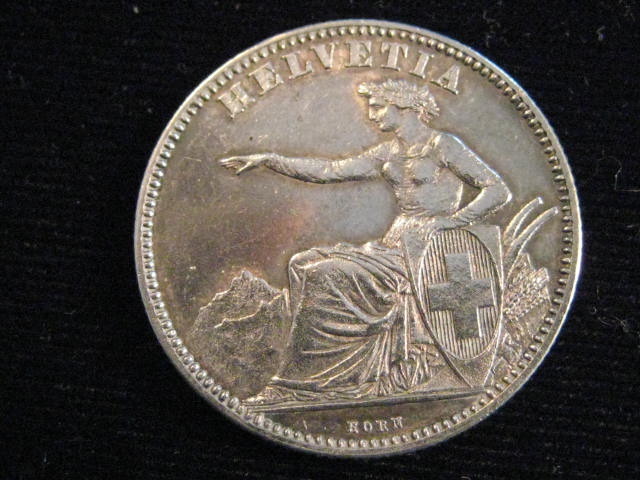 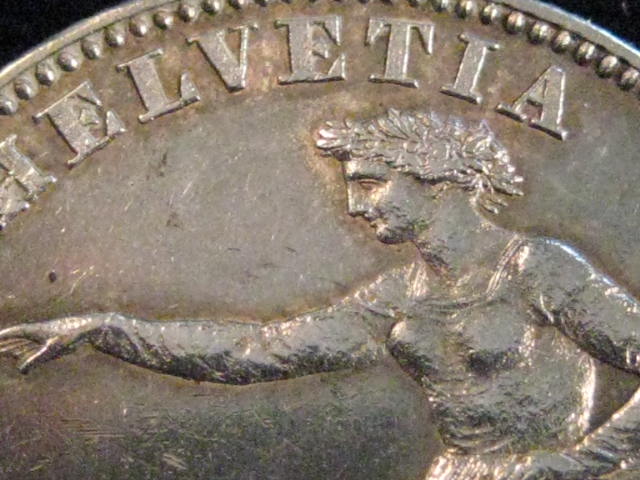 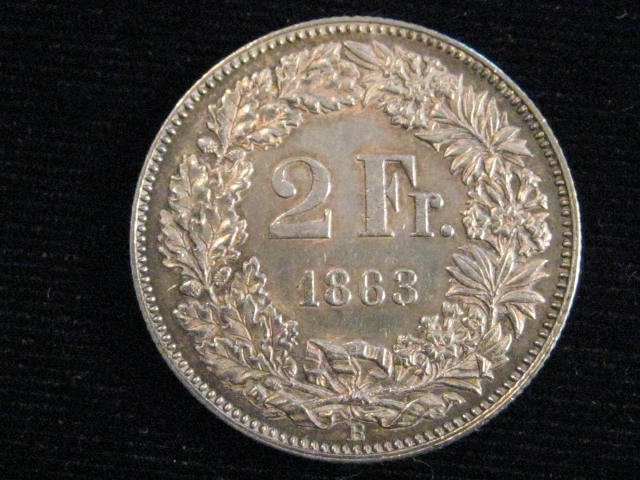 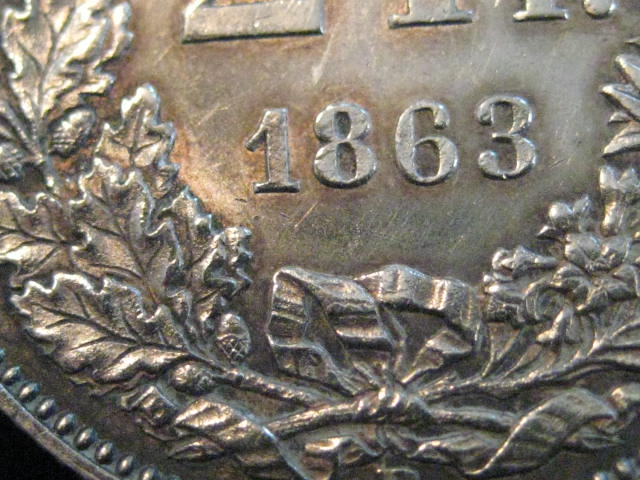 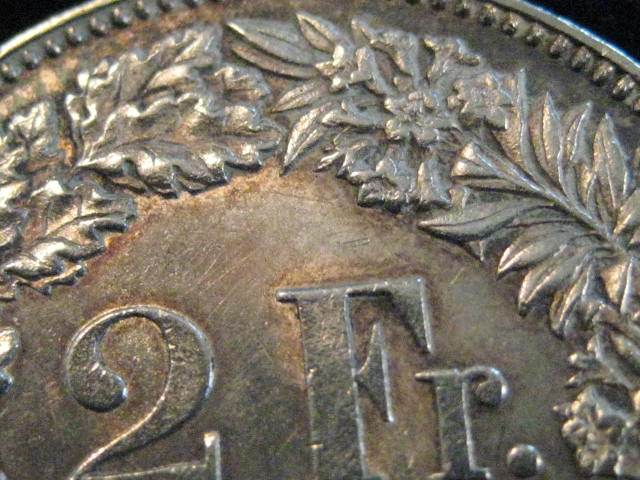 |
|
|
|
Valued Member
 United States
101 Posts |
any ideas, input or opinions?
|
|
Bedrock of the Community
Australia
21789 Posts |
I have a copy of
Munzenkatalog.ch Swiss Coin Catalog 2009 edition 190 pages. Coins of Switzerland and Liechtenstein.
This coin has a catalogue value of 3,500 Swiss Francs in choice Uncirculated. I would guess about MS63.
The Swiss really go for their own coins in top condition, which this coin obviously is. Most probably, it would bring less in the U.S. market. Try to keep it if you can. If you need the money, negotiate with:
Munzen und Medaillen (numismatic auctioneers) in Switzerland.
If you went Bowers and Marena or Heritage, I think they would on - sell it to Switzerland anyway.
Edited by sel_69l
01/29/2011 12:23 am
|
|
Pillar of the Community
United States
3098 Posts |
Wow nice piece! Older Swiss coins, especially in the higher grades really command high prices.
As for the specimen coin, I remember that on older Swiss specimens, they would have the word "Essai" (French for trial) although not necessarily proof.
|
|
Valued Member
United States
101 Posts |
thankyou for your input, now I guess it decision time.....
it is a beautiful coin
|
|
Pillar of the Community
United States
5362 Posts |
I don't want to be a wet blanket on the discussion, but there seems to be high point wear and far to many bag marks for this to be MS. I would say a nice EF or low AU provided the coloration is not from chemical cleaning. The coloration in and around HELVETICA shows a color transition that looks like deep toning or dirt was removed. To me that is a serious caution.
I also am aware of well made forgeries of this coin so be careful and examine the reeding. Swiss dies were very well made and the apparatus used meant few die oddities. Die cracks chips and breaks are rare in the Swiss issues - SO ARE EDGE ANOMALIES. Make sure the reeds are uniform and well spaced - NO SPLIT REEDS.
I would also love to see pictures of the edge and of the rim area at the bottom of the side near the mountain. That edge seems a bit wide and would contain any evidence of improper surfacing or filing.
It is a nice - rare coin BUT only if it is REAL. Do not be blinded by wishful thinking. Before you spend your money make sure it is not on a forgery.
|
|
Valued Member
United States
101 Posts |
well lets see if this coin is a fake or not, I like a good challenge. hope for the best though. I have included some new close up photos. thankyou for your input swamperbob, so if you or anyone else notices something wrong or right with this coin would be greatly appreciated. there is a die chip(?) to the left of "Korn" grey material in between the reeding areas? take care 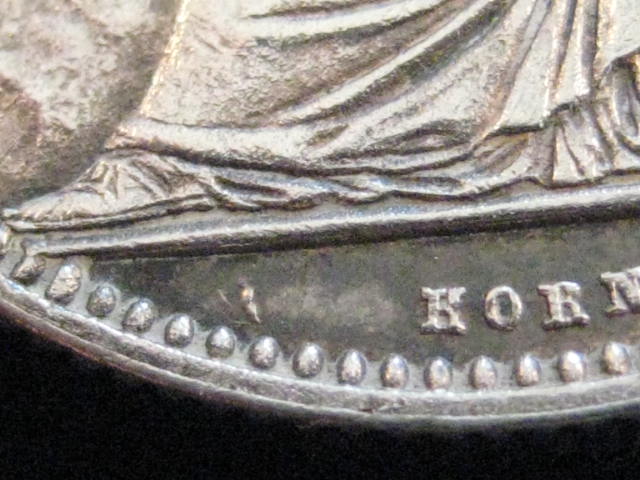 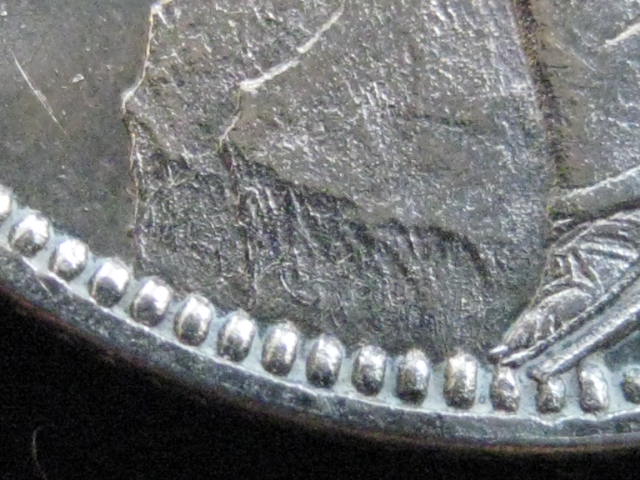 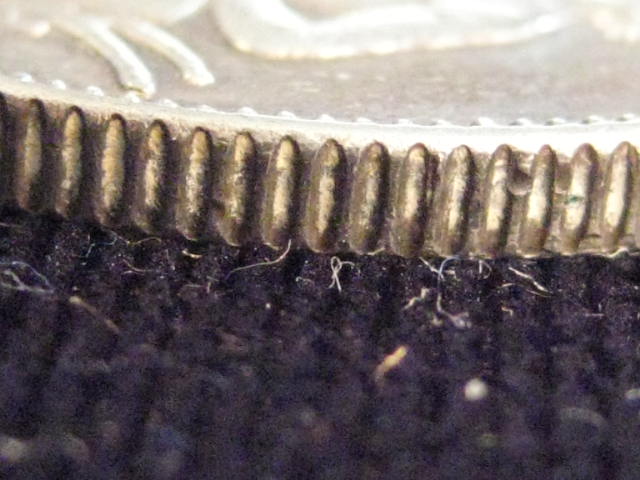 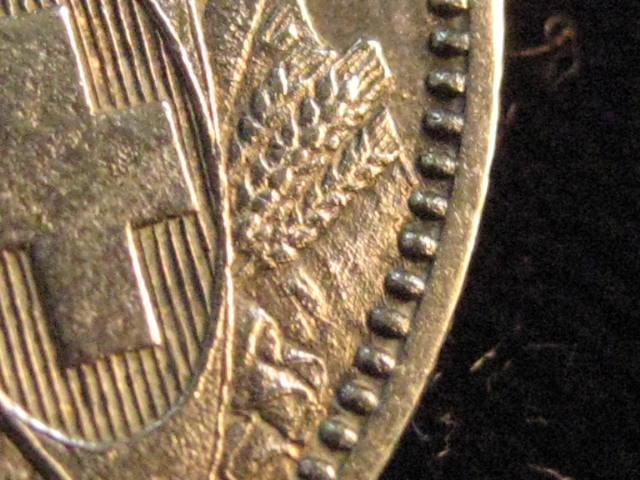 |
|
Pillar of the Community
United States
5362 Posts |
The enlarged pictures are very good and they capture some of what I was looking for.
I was able to check this coin against some other Swiss coins made in 1874 BUT NOT an 1863 - NOT a KM 10A. So there could be a modification in the apparatus which might account for what I observe. But I am concerned.
Based on my examinations and comparisons - the coin design itself looks real as far as the die work and surfacing goes. It is either real or a near perfect replica. There are some odd field lumps here and there (like the one pointed out) but I noticed similar features on 2F coins from 1874. This coin also matches a typical rim including dentils and there are no apparent grinding marks. The collar/die seam seems a bit wider than on the 1874 but die sizes may have been changed a few thousandths.
BUT the reeding is NOT the same. Perhaps the 1863 collar used a different shape reed so I stand to learn something here as well. All the examples of early Swiss silver I happen to have at home now all use a virtually square sided, square based, STRAIGHT BOTTOM reed. This coin has a reed that appears to be wider and possibly deeper at the center than at either edge. The bottom of the reed may in fact be straight but the height to the top of the reed seems to be greatest at center. The reed has an overall ovoid shape in the pictures. This shape in turn indicates the presence of a BULGE in the collar at the center-line or a bulge in the planchet at the center-line so that the collar was not completely filled with metal during the strike.
Obviously a collar that bulges at the center is IMPOSSIBLE based on the mechanics needed. It would cause the coin to stick and not eject if the reeds changed depth. But a bulging planchet is possible if the pressure was not adequate to totally fill the collar die. However, for the bulge to survive the coining chamber pressures the strike could NOT BE AS STRONG as I see here. The die faces certainly look like a 99% full strike to me and in addition the collar to die transition seam noted above is well defined - indicating a filled collar.
Counterfeit copies, on the other hand, often display reeds that are stronger and deeper at the centers of the coin because of the way the edge seams are removed and the reeding is applied. When a ring die is used to add reeding to a cast coin, the bottom of the reed is GOOD but the tops of the reed are NOT. This is especially pronounced near the edges of the coin. So a fine grinding often takes place to reduce or eliminate the appearance of problems (split tail reeds and tops). If the coin is carefully ground and then polished with jeweler's rouge the traces of the grinding can be eliminated. However, the process often leaves traces of the rouge itself which clings as a residue in the fine details.
I add these facts together with the white "powdery" deposits I see here and I get suspicious of polishing being done to remove traces of edging problems arising from a casting.
I can not be sure of course and I stand to be corrected but I am concerned that something is wrong here.
On another earlier topic, I also was able to confirm wear on the peaks of the mountain which is obvious enough to down grade the coin below MS level.
This coin is a candidate for CERTIFICATION but only by one of the Big Two. I would not buy this coin raw - it is too risky not to spend the extra money to have it certified. At least that way you have a third party guarantee of value.
|
|
Valued Member
United States
101 Posts |
Thankyou swamperbob for your time and expertise to examine the photos, your knowledge of coins is fantastic. It sounds like my next step will be to have the coin sent for certification. You mentioned to send it out to "One of the Big Two" TPG, so hence my lack of knowledge will show. I will assume you mean PCGS and ? the white deposits at the reeds, jewelers rouge?, does concern me alot. again thankyou, I guess now its a matter of waiting while I have it sent out. take care. |
|
Bedrock of the Community
Australia
21789 Posts |
I notice that the width of the tops of the ridges of the reeding varies quite significantly.
|
|
Pillar of the Community
United States
1231 Posts |
PCGS and NGC would be the top 2 TPG's to send world coins to. |
|
Pillar of the Community
United States
5362 Posts |
Yes I meant PCGS and NGC - ANACS is a possibility but I have seen some counterfeits in ANACS holders.
|
|
Valued Member
United States
365 Posts |
I concur with S-Bob on his point about wear, and would add that the shininess of the fields is the result of wiping. The hairlines in the fields would likely earn a details grade from NGC and PCGS. ANACS would give you a number grade and then identify however they view the highly likely cleaning job done to this otherwise awesome coin. Well-worth slabbing, in my view, b/c even with a 'cleaning' designation certification will bolster it's market value (and probably put your mind at ease).
-SCS
|
| |
Replies: 12 / Views: 2,215 |
|








 Posted 01/29/2011 12:19 am


