| Author |
 Replies: 52 / Views: 14,399 Replies: 52 / Views: 14,399 |
|
|
|
Bedrock of the Community
United States
20753 Posts |
For one thing IF what is on those coins is PVC don't really worry about it. PVC is a stable substance in normal temperatures. If heated it will leave a PVC residue on your coins but the temperature required it substantial. Next if it is a greenish substance on your coins it is more than likely Copper Carbonate, not PVC. If it is a dark green and you live in an area or the coin was in an area where the air may be contaminated with Sulfur Oxide or Sulfur Dioxide, the substance on your coin may be H2SO3 or H2SO4. (the previous numbers should have been lower cased) for scientigfic notations. Nail polish in the US is basically a form of laquer. Therefore the nail polish remover is a Laquer thinner, not a form of Acetone. Also, as someone noted Acetone and water. However, Acetone will not mix with water. Try it. Do not use AMMONIA for anything you don't have to. The fumes may be harmful to your lungs and the people here that recommend it will not pay for your doctor bills nor come to visit you in the hospital. If you feel you must remove the residue on those coins, yes Acetone is OK to use and you can get it at places like Walmart, Kmart, etc. It is in the paint aisle. You don't need an expensive highly purified form since you must rince the coins when done with distilled water and blow dry with a hair dryer. Always be carefull using any chemicals you are not familiar with and remember that people on the internet that tell you to experiment will not pay for your medical expenses. |
|
Pillar of the Community
 United States
2177 Posts |
Thanks for your concern just carl. I did this with the amnonia outside, wearing gloves, and a mask, AND I held my breath. I didn't inhale any fumes. I learned a lesson about these fumes years ago. I tried the amnonia on this nickel and the pvc is gone. I tried it on a penny just for the heck of it. I did the baking soda on a 1982 penny, a 1965 quarter and on a silver clad 1/2 dollar just to see any results. The penny is nice and shiny but now has colored tones. The quarter got some tarnish, and the 1/2 dollar got REALLY tarnished. I wasn't expecting anything. This was fun.  I'll try some other solution another time.  |
|
Pillar of the Community
Belgium
2078 Posts |
@ just carl
pvc is very brittle and stiff
In the old days they put in plenty of plasticizer as an internal lubricant like they put into wall to wall carpetting and linoleum
The plasticiser will ooze out over time and causes the deposit or attack on your coins
The plasticiser maybe an phthalate compound but whatever it is acetone wll get rid of it
I only have seen ammonia as one of the many cures for silver
The danger will depend on the concentration
Outside the labo I never used ammonia NH4OH
Edited by ageka
09/19/2006 08:09 am
|
|
Pillar of the Community
Belgium
2078 Posts |
|
|
Valued Member
United States
394 Posts |
quote:
Originally posted by thingee
Thanks for your concern just carl. I did this with the amnonia outside, wearing gloves, and a mask, AND I held my breath. I didn't inhale any fumes. I learned a lesson about these fumes years ago. I tried the amnonia on this nickel and the pvc is gone. I tried it on a penny just for the heck of it. I did the baking soda on a 1982 penny, a 1965 quarter and on a silver clad 1/2 dollar just to see any results. The penny is nice and shiny but now has colored tones. The quarter got some tarnish, and the 1/2 dollar got REALLY tarnished. I wasn't expecting anything. This was fun. I'll try some other solution another time.
Good precautions to take thingee, if you used normal household ammonia, you should have no trouble, but always use in an open area. My memory is not as it used to be, but anything over 2% or 4% ammonia solution can be deadly in an enclosed area, so your safety precautions are to be commended, good work thingee. If you start using mixing various solutions, be careful as you could mix up batch of deadly gases. Know what you are doing and the ramifications before you do it. As a last point of interest, any mask used for ammonia should have a charcoal filter to filter "gas fumes" since an ordinary paper filter will not work. Berry |
|
Pillar of the Community
United States
2177 Posts |
quote:
Originally posted by BERRY4402
quote:
Originally posted by thingee
Thanks for your concern just carl. I did this with the amnonia outside, wearing gloves, and a mask, AND I held my breath. I didn't inhale any fumes. I learned a lesson about these fumes years ago. I tried the amnonia on this nickel and the pvc is gone. I tried it on a penny just for the heck of it. I did the baking soda on a 1982 penny, a 1965 quarter and on a silver clad 1/2 dollar just to see any results. The penny is nice and shiny but now has colored tones. The quarter got some tarnish, and the 1/2 dollar got REALLY tarnished. I wasn't expecting anything. This was fun. I'll try some other solution another time.
Good precautions to take thingee, if you used normal household ammonia, you should have no trouble, but always use in an open area. My memory is not as it used to be, but anything over 2% or 4% ammonia solution can be deadly in an enclosed area, so your safety precautions are to be commended, good work thingee. If you start using mixing various solutions, be careful as you could mix up batch of deadly gases. Know what you are doing and the ramifications before you do it. As a last point of interest, any mask used for ammonia should have a charcoal filter to filter "gas fumes" since an ordinary paper filter will not work.
Berry
When I said I had learned the hard way about amnonia I had also learned about mixing solutions with it. I was house cleaning several years ago and mixed amnomia with other solutions (thank god I was outside when doing this esp since others were in the house) I noticed the fumes and also that I was having trouble breathing. I quickly dumped this solution into a grated gutter. I found I could hardly breath and was wheezing like a fire alarm. I ended up in the ER and was told by the doctors and nurses that I had been very close to meeting my maker. I also spent the night there for observation. So, believe me, I've LEARNED my lesson. And hope others will pay attention and use caution when using such chemicals and solutions. Use these solution only outside, use gloves, wear a mask such as recommended in the post. Hold your breath when you can. Don't let children near such solutions. Don't have anyone around when you are using these chemicals unless they too use such precaution. These fumes can be DEADLY! By the way, the half dollar I used with the baking soda was an insignificant Kennedy.  Edited by thingee
09/19/2006 11:36 am
|
|
Forum Dad
 United States
24228 Posts |
Bleach and ammonia mixed together generates chlorine gas at a significant rate which will kill you quick in a confined area.
|
|
Pillar of the Community
United States
2284 Posts |
Acetone is available in hardwares but I've been told that this is not very pure and will have contaminants. Usually I'll just soak things in this acetone and rinse them off in 91% pure isopropyl alcohol. This is available at any drug store. On circulated coins they'll look better afterward if you rub a little body oil onto them after cleaning. Don't ever do this with proofs or unc coins.
Hydrogen peroxide will dissolve or loosen protein based dirts. This is not normally a large constituent part of the dirt on a coin so it won't be any more effective than water. A few coins with globs on them might be more easily cleaned with peroxide though. This can also be bought at the drugstore.
Time don't fly, it bounds and leaps.
|
|
Pillar of the Community
United States
2284 Posts |
Oh, and I would avoid using amonia and nail polish remover. Most of the removers have small amounts of oil and fragrances added to them. They probably won't hurt the coin if you rinse it off but why take a chance?
Time don't fly, it bounds and leaps.
|
|
Pillar of the Community
United States
1841 Posts |
quote:
Anyone ever try or know if hydrogen peroxide is any good for cleaning off coins? Mainly just dirt or other junk.
Hydrogen peroxide is a very unstable molecule that is also a very powerful oxidizing agent. In high concentrations it is corrosive. While inorganic chemistry is not my specialty, I would assume you could do a lot of irreversible damage to your coins with hydrogen peroxide. |
|
Moderator
United States
23522 Posts |
I would beg to differ with the previous comment about mixing acetone and water; they are eminently miscible. In fact, acetone is sometimes used as a drying agent for its ability to intermix with water and evaporate quickly, leaving no spotting behind. Furthermore, unless you're using distilled water, you might be better off not even rinsing a dip in pure acetone, because the water is more likely to leave something behind than the acetone is.
Having said that, you should rinse any short acetone dips because whatever the acetone removed remains in suspension. You could end up redepositing the plasticizer right back onto the coin. Done best, an acetone dip is a staged uperation, with multiple dips into clean acetone each time.
|
|
Pillar of the Community
Belgium
2078 Posts |
Sometimes acetone will leave a bluish shine upon drying on gold proofs Then I use window cleaner spray ( you know the kind you clean windows without leaving streaks )That is a soap with a surface tension reducers and an evaporator After that I use distilled water This will remove all the grease (acetone) and all traces of impurity I pay only 2 dollar a liter for pure acetone so that is no problem whatsoever  |
|
Pillar of the Community
Belgium
2078 Posts |
Ok the word I was looking for was surfactant This coin was freed from fingerprints and blue shine that way Image:  50 000 Won 1987 K.jpg 50 000 Won 1987 K.jpg47.61 KB 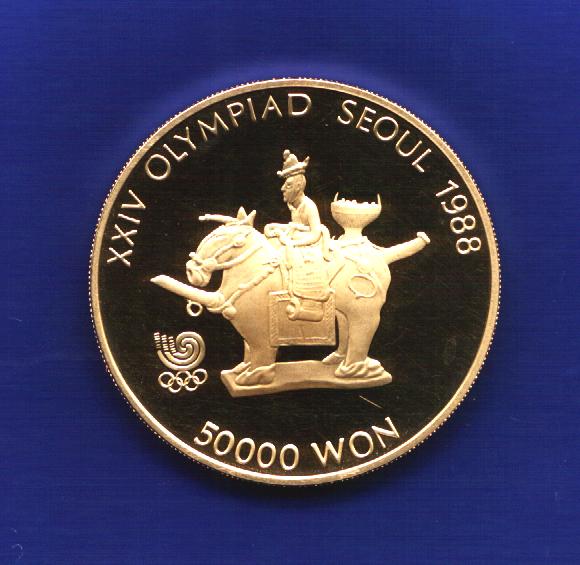 |
|
Bedrock of the Community
United States
20753 Posts |
quote:
Originally posted by ageka
Sometimes acetone will leave a bluish shine upon drying on gold proofs
Then I use window cleaner spray ( you know the kind you clean windows without leaving streaks )That is a soap with a surface tension reducers and an evaporator
After that I use distilled water
This will remove all the grease (acetone) and all traces of impurity
I pay only 2 dollar a liter for pure acetone so that is no problem whatsoever
Great idea. I would not use the window cleaner though. Just a good rince in distilled water and blow dry with a hair dryer. And yes I do stand corrected. Acetone and water do mix. both are covalent and mix rather well. I'm getting old and forgetful. Also, most modern nail polish removers are a form of Acetone and water with numerous Dimethyl com;ounds added. Some also contain glycerin and a gelatin to soften nails so this would absolutely make this substance non usable for cleaning a coin. Regarless of what you use always wear safety glasses, do it in a well ventilated area or outdoors, keep a garden hose handy, wear hospital type plastic gloves and don't breath any gases released from your experiments. |
|
Pillar of the Community
Belgium
2078 Posts |
They say familiarity breeds contempt I still remember the faces of the lab people when as a 24 year old Univ chem engineer I walked into their labo with half a litre of pure acrylonitrile in a plastic vessel with an ill fitting top wanting a glc impurity analysis The acrylo running over my bare hands I am only afraid of pure chlorine gas, pure H2S gas and explosions Though I will treat fuming nitric acid and liquid nitrogen with all repect due I never tried it but I suppose putting a coin in pure liquid nitrogen probably would clean anything off  I saw a warning movie in which they put a piece of meat into the liquid and then shattered it with a slight tap of an hammer |
| |
Replies: 52 / Views: 14,399 |








 First Page
 Previous Page


 Posted 09/18/2006 8:31 pm


