| Author |
 Replies: 13 / Views: 2,262 Replies: 13 / Views: 2,262 |
|
|
Pillar of the Community
United States
604 Posts |
Can some tell me how to clean REALLY CRUSTY COINS LIKE SUPER CRUSTY Roman coins Any help will be taken graciously and happily heres a bannana  |
|
|
|
Forum Mom
 United States
5877 Posts |
The safest method to start with would be a good, long soak in olive oil. Unfortunately, by "long" I mean it could take a year for it to soften up the crust sufficiently to safely remove it from the coins. I'm sure you will get more replies from collectors of ancients. I just know that mine have been soaking for a little over 18 months and are still pretty crusty.  |
|
Pillar of the Community
Canada
1152 Posts |
wow that is a long long time. By the way, (I will also post this in the buy section), would anyone happen to have some really crusty/verdegris covered coins they would sell to me for a MODERATE price? I would like to test out some cleaning methods.
Andrew
|
|
Pillar of the Community
Australia
1360 Posts |
quote:
Originally posted by pattiewhack
By the way, (I will also post this in the buy section), would anyone happen to have some really crusty/verdigris covered coins they would sell to me for a MODERATE price?
Hi Andrew, My mum has an enormous tin of pennies which I have been too scared to look at as I am pretty sure they are in appalling shape! I will go through them and see if I can find any bad ones for you, I'm afraid it's not a guarantee, they might actually be not too bad. But if I find any awful ones, they are all yours. Think of it as a reward for giving me such a terrific prize. Though kind of an unfair reward, you give me nice coins, I give you verdigris? Pretty horrible of me, really. Snooba  |
|
Pillar of the Community
Canada
1152 Posts |
|
|
Valued Member
Australia
205 Posts |
Hello Buffaloboy,
Susan's method is the safest and best advised course of action. You may use distilled (deionised) water as an alternative to olive oil. I prefer to do so because the coins get oily and a nusiance to handle. The disadvantage is that the water must be changed pretty regularly.
Some of the coins will inevitably resist cleaning no matter how long you soak them for. For these, you might consider other options, perhaps careful electrolysis combined with normal mechanical cleaning.
Peter
|
|
Pillar of the Community
United States
4589 Posts |
quote:
Originally posted by greekandromancoins
Hello Buffaloboy,
Susan's method is the safest and best advised course of action. You may use distilled (deionised) water as an alternative to olive oil. I prefer to do so because the coins get oily and a nusiance to handle. The disadvantage is that the water must be changed pretty regularly.
Some of the coins will inevitably resist cleaning no matter how long you soak them for. For these, you might consider other options, perhaps careful electrolysis combined with normal mechanical cleaning.
Peter
I have tried both and I think they work but after a long time the advantage to the distilled water is you do not need to clean with anything after to remove the oil, also distilled water is cheaper . the better Grade olive oil you use is said to have an Impact I have used extra extra virgin olive oil but it is expensive. |
|
Pillar of the Community
Australia
1360 Posts |
|
|
New Member
Germany
12 Posts |
where can I get pictures of the coins you are talking about?
|
|
Valued Member
Australia
205 Posts |
Hi Will, Here is an example of the types of coins we are talking about. The typical uncleaned coins are evenly covered in layers of dirt. In addition to dirt, crusty coins can becovered in all sorts of things e.g. cement-hard dirt, rocks, crystals... you name it! Peter Image Insert: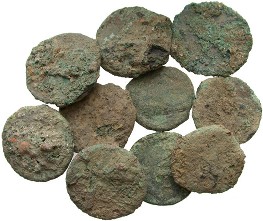 Edited by greekandromancoins
09/24/2006 3:49 pm
|
|
Valued Member
Canada
96 Posts |
Buffulo..can you post a picture of your crusty coins ?...did you see any metal or are they all coververed with hardened soil/dirt...etc.
Greek...i tried recently few coins(in the same condition of those in the picture above) in a ultra sound cleaner that I bought. And this thing seems to work well on thick greek coins. Dirt starts to break off little by little. The vibration that this machine gives off loosen the dirt then you start to seen them fall. But you have to keep your eyes on your coins because it's powerfull enough to pry of some patinas specially on roman imperial coins.
Now I have dipped few uncleaned coins in olive oil first to wetten the dirt a bit...then I'm gonna drop them in the machine then see how they go. I think that would help the ultra sound cleaner pry off the dirt much easier....I'm gonna wait and see :)
|
|
Valued Member
Australia
205 Posts |
Hi Pat,
What kind /model of ultrasound cleaner do you use? I haven't heard anyone that's had much luck with the cheap jewelry cleaning types and don't know anyone that has had access to an industrial one. I've always been interested in trying this.
Thanks,
Peter
|
|
Valued Member
Canada
96 Posts |
Sorry greek...i just red your post. Now why didn't I get notified that someone replied ?..hmmm...anyways here's the one I got from The Source : http://www.thesourcecc.com/estore/S...er&pagenum=0It's a shop here that ressambles somewhat Radio Shack. Ti'll now I tried several things like dipping coins in olive oil first for few days before dropping them in the cleaner....but that didn't do much thing...then cleaning solutions...also didn't loosen the dirt before their bath in the ultra sound cleaner. The best cleaned coins were those that I didn't add nothing..only tap water which you fill the stainless steel tank of the cleaner with..tbefore dropping the coin/coins in...on the stainless steel. Because the cleaner comes with plastic seperator that goes in in between the tank and your coins. But I found that the seperator is no good for cleaning ancient coins because the dirt is too tough.It's better without it. So for now the best thing is not to add anything....just water...then you drop your coin. Then you hit the start button which is a 3 minute timer. So several cycles are needed before you see some results. But with each cycle you'll notice pieces of soil(that is hundreds or thousands of years old)that are stuck on the coin start vibrating..then little by little they come off. But you have to do some tests first with different types of coins to learn what work best with this machine. Regads, Patrick Edited by pat44
10/10/2006 7:14 pm
|
|
Pillar of the Community
Australia
1360 Posts |
|
| |
Replies: 13 / Views: 2,262 |
|










 Posted 09/20/2006 7:00 pm


