| Author |
 Replies: 29 / Views: 3,638 Replies: 29 / Views: 3,638 |
|
|
|
Bedrock of the Community
United States
20753 Posts |
Quote:
Have you heard of him?
Might be a sort of popular name in the Numismatic world. Maybe. If you have a Red Book turn to the inside cover and right under the title and R.S.Yeoman, someone stuck the name of Q.David Bowers. HHMMMM. Similar name?   |
|
Valued Member
 United States
155 Posts |
Quote:Might be a sort of popular name in the Numismatic world. Maybe. If you have a Red Book turn to the inside cover and right under the title and R.S.Yeoman, someone stuck the name of Q.David Bowers. HHMMMM. Similar name . That would be an amazing coincidence.... Below are some more interesting pages    |
|
Moderator
 United States
195742 Posts |
|
|
Bedrock of the Community
Canada
10743 Posts |
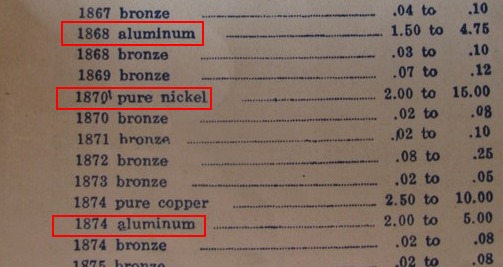
Yeah.. I was wondering the same thing... aluminum?..pure nickel?  |
|
Moderator
United States
195742 Posts |
That 1874 appears to be 100 years before its time.
|
|
Valued Member
United States
155 Posts |
|
|
Bedrock of the Community
United States
12437 Posts |
All of the aluminum, copper, and nickel listings are for patterns.
|
|
Moderator
United States
195742 Posts |
Quote:
All of the aluminum, copper, and nickel listings are for patterns. That was my first thought, but there is no mention of them in the Red Book (not that I expected it, but many patterns are discussed throughout). I am hoping someone will chime in with the details.  |
|
Valued Member
United States
155 Posts |
1868 1C One Cent, Judd-612, Pollock-677, Low R.7
Struck from the regular proof dies for the 1868 Indian cent, in aluminum with a plain edge. Judd notes that two pairs of proof dies were used. One might infer from the use of two pairs of proof dies that a considerable number were struck, but they are nonetheless today rated Low R.7. In addition, aluminum was still quite a precious metal at the time(s) these pieces were produced--regardless of exactly when that was. Improved processes for isolating elemental aluminum from its alloys resulted in increased availability of the metal only in the late 1880s. Per Judd: "One of the reverse dies also used to make restrikes of regular Proof 1864 With L cents (per Richard E. Snow); this die is not known to have been used to strike regular issue 1868 Proof cents, but was widely used from 1869 to 1871 (per Snow). This, plus the use of two die pairs, would seem to indicate that aluminum cents were struck on at least two different occasions." At least some of these were included in complete 16-piece proof sets from the cent through double eagle. The Garrett Collection had a complete set; the earliest recorded offering of a complete aluminum proof set is in the William Fewsmith sale of 1870, lot 1381, conducted by Mason and Company.
Edited by WheatBackBill
02/22/2011 4:18 pm
|
|
New Member
United States
2 Posts |
You might get a couple grand for it . Stack's auction might be your best bet. First printing of the RedBook, 1947 gets over a grand in VF condition. I googled Stack's 1935 catalogue and there is some guy looking to buy early Stack's catalogues. I have a Stacks book from 1959....somewhere. Had it since I was 5 years old. |
|
Valued Member
United States
155 Posts |
Quote:You might get a couple grand for it . Stack's auction might be your best bet. First printing of the RedBook, 1947 gets over a grand in VF condition. I googled Stack's 1935 catalogue and there is some guy looking to buy early Stack's catalogues. I have a Stacks book from 1959....somewhere. Had it since I was 5 years old. I have googled everything possible and have not been able to find any info anywhere |
|
New Member
United States
2 Posts |
1935 stack's publications sought...I searched using "BING"
|
|
Valued Member
United States
155 Posts |
So any guesses to the value?
|
|
Valued Member
United States
155 Posts |
I think I will bring it along with me to my local coin dealer this week.
Will let you know.
WBB
|
| |
Replies: 29 / Views: 3,638 |








 First Page


 Posted 02/22/2011 09:55 am