| Author |
 Replies: 6 / Views: 2,075 Replies: 6 / Views: 2,075 |
|
|
Pillar of the Community
United States
3229 Posts |
I have an untributed bronze ae3 that I think is a Licinius I. Following is a desription.
Obverse: "IM......ICIN.ICINIVSP.AVG"; Radiate right facing bust
Reverse: Left field - "IOVI CON.", Rt. Field -- "ERVATO.." w/ Jupiter standing left, Victory globe on right; Long scepter vertical in left
Flanked by eagle with wreath (Rt.) and captive at feet (Left); a "x" over "III" is over the captive
Wild winds had a coin very like this coin in every way except the letters where in better condition (above I have only included the letters that are easy to make out) & the mint on my coin is SMNA.
Do you think that I have the coin identified corectly? Do you know the mint, "SMNA"? New to all this but having a great time. Thanks:) TJ
|
|
|
|
Moderator
 Australia
17006 Posts |
It is indeed Licinius I. Your specific type is not actually listed on Wildwinds, though there are several similar types. Here's one that's similar, except it's Licinius II who reigned at the same time. The XIII is a denomination mark - if you look at the third I, it should actually be bent in half, making the number 12½ rather than 13. The denomination is "12½ somethings" - scholars disagree on what the "somethings" were. Roman mintmarks can be a confusing mixture of letters and symbols. "SM" is often found at the beginning of mintmarks, especialy in the eastern half of the empire, and stand for sacra moneta - "sacred money of". "N" in this case is the actual mintmark-letter, and stands for the city of Nikomedia. "A" is the officina mark. Technically, it's not a Latin "A", but the Greek letter alpha, which was sometimes written slightly differently to the Latin "A" during this period. Roman mints were not a single large structure within a city, like a modern mint is today. Rather, they were a collection of smaller workshops scattered throughout the city - Antioch is recorded as having up to fifteen such workshops operating simultaneously, but most cities had four or less. The "officina" or branch was the particular workshop within the city that particular coin was struck. Officina Alpha was the first branch. Don't say "infinitely" when you mean "very"; otherwise, you'll have no word left when you want to talk about something really infinite. - C. S. Lewis
|
|
Pillar of the Community
 United States
3229 Posts |
Thank you for the confirmation that it is Licinius I, and the great mint information! I haven't found any mint information with the detail you have kindly offered. This coin stuff is really fun. Thanks again. TJ
PS: On second look my coin does have a bent third I. Do you have any more information on the "12 1/2 somethings" that the scholars debate about?
|
|
Moderator
Australia
17006 Posts |
For most of the history of the Empire before the currency reforms of Diocletian, the "money of account" - the currency unit everyone counted their wealth in - was not the denarius but the sestertius, worth a quarter of a denarius. By 298 AD when the coinage reforms began, the sestertius had not been seen in circulation for a generation and the denarius had shrunk to a tiny copper coin struck only for ceremonial purposes. The general consensus is that with the currency reforms, the money of account formally changed to the denarius. The Edict of Diocletian is a document, written in 301 AD and preserved in stone in numerous places throughout the empire, which lists the official maximum prices for all sorts of things; these prices are given in denarii. The coins bearing "12½" all date from about the same time, so it is reasonable to assume that those coins are valued at 12½ denarii. But there is no actual evidence, and some suggest that it's actually 12½ "radiates" - the "radiate" being a small copper coin worth 2 denarii, which would make the "12½" coins actually 25 denarii denomination. Others argue the "12½" might not be a denomination at all, but a mark of intended silver fineness or some other meaning. More more detail about the Edict, see this summary page. Don't say "infinitely" when you mean "very"; otherwise, you'll have no word left when you want to talk about something really infinite. - C. S. Lewis
|
|
Bedrock of the Community
Australia
21792 Posts |
The Edict of Diocletian makes interesting reading. Thanks for that, Sap.
Where did you get that reference from?
I will not look at the total value of my Roman coins in 'dc', because they were not all issued in 301, but is tempting. It would be a highly inaccurate exercise to try to revalue all of my Roman coins to equate to the Edict of Diocletian.
|
|
Pillar of the Community
United Kingdom
2838 Posts |
Here is one of mine that sounds very similar to the OPs but was produced in one of the other mint workshops. 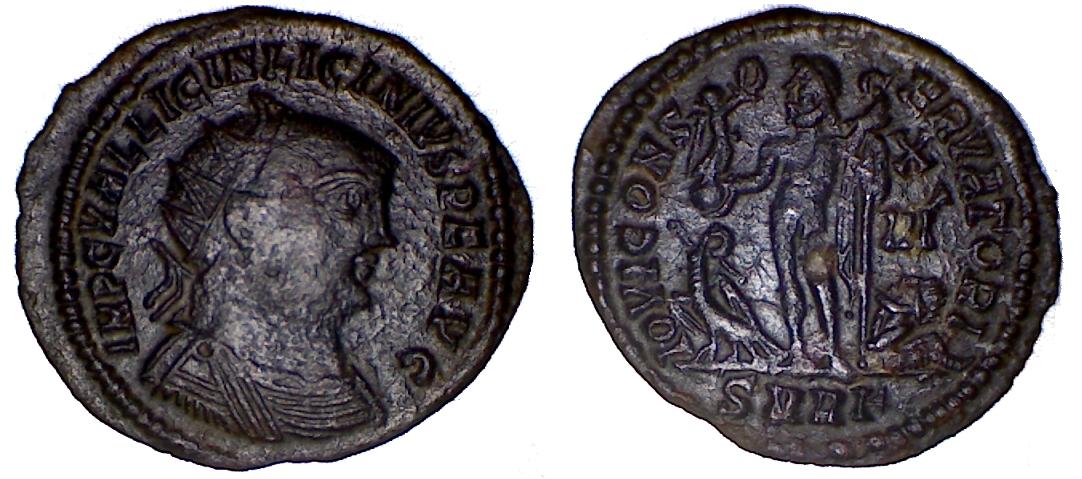 Obv - IMP C VAL LICIN LICINIVS P F AVG Rev - IOVI CONSERVATORI (X/IIμ) MM - SMNGamma" Nicomedia 321-324 RIC VII Nicomedia 44 As Sap has stated SMNA is Nicomedia - your coin has the same RIC No as mine and also shares the same mint dates of 321-324. There are a lot of 'M's, 'N's and 'H's in the mintmarks of these coins and due to the narrow stamps it can get difficult to pin them down fully. The final 'bent' 'I' is often referred to as the Greek letter Mu. Edited by bobbyhelmet
03/03/2011 12:14 am
|
|
Pillar of the Community
United States
3229 Posts |
Sap. Thanks a lot! You are very helpfull  |
| |
Replies: 6 / Views: 2,075 |
|









 Posted 02/23/2011 10:57 pm


