| Author |
 Replies: 14 / Views: 5,469 Replies: 14 / Views: 5,469 |
|
|
New Member
United States
34 Posts |
Anybody know what this coin is about and it's value? 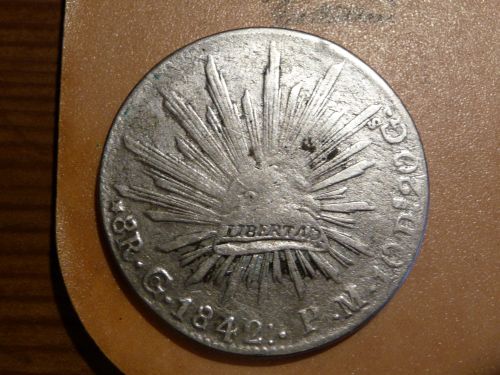 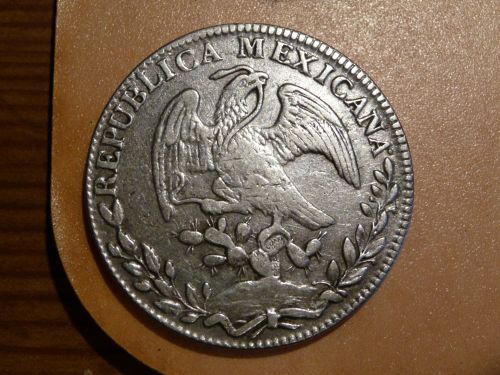 Edited by gdlovgren
02/27/2011 7:24 pm
|
|
|
|
Valued Member
United States
426 Posts |
Hello gdlovgren, You have a 1842 Mexican 8 Reales coin also known as a "cap & rays" or "Resplandor". Your particular piece was minted in the city of Guanajuato hence the Go mintmark. The assayer's initials are P.M. for Patrick Murphy. It has some wear and it looks like it might have been cleaned some time in the past but it is still a nice coin and these early dates sell well on ebay. This year and mint is listed as common but there is a scarce variety that has a overassayer of PM/J that one should watch out for. The normal mint and date coin is worth somewhere in the $35 - $45 dollar range. I would like to add that there seems to be something interesting on your coin if you look at the assayer's initials there is something going on with the M but I can't tell if its the overassayer or something elese. A clearer focused picture of the assayer's initials would be helpful, if it is the scarce overassayer variety than it would be worth considerably more. There are a few more regulars that collect this series of coins here on the forum including swamperbob who has a lot of knowledge on these coins, hopefully they will stop by and give us their opinions. ***Fun Fact*** Prior to 1857 these were legal tender in the U.S. and were used in many areas of the country. Edited by RealPeso
02/27/2011 6:18 pm
|
|
New Member
 United States
34 Posts |
Here is as close as I can get to the assayer's initials. The M does look a little odd. But I don't know really what to look for. 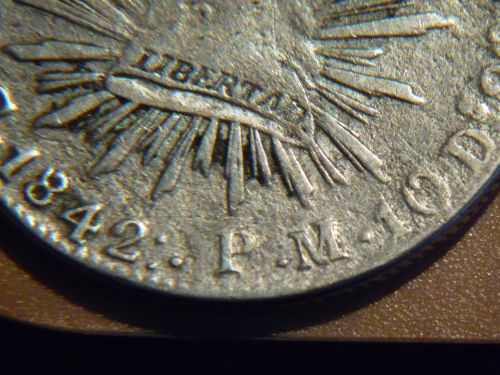 |
|
Valued Member
United States
425 Posts |
The close-up pic shows alot of wear/damage in that area! Is there any chance this could be a fake/counterfeit?cast copy?
Or maybe a sea-salvage coin?
***Fun Fact***
Prior to 1857 these were legal tender in the U.S. and were used in many areas of the country.
Very True RealPeso! About 10 years ago a coin very much like this one was found,(MO mint dated 1851), at Fort Union, New Mexico. Many of the fort pay records showed that about half the coins payed out to soldiers were Mexican Reales.
|
|
New Member
United States
34 Posts |
It does look like it has been eroded on one side and it looks like it has been cleaned thoroughly at some time. It's part of a collection that has been passed down from my grandfather, and he's been gone for quite some time.
|
|
Valued Member
United States
426 Posts |
Hi oden!hey again gdlovgrenQuote:
The close-up pic shows alot of wear/damage in that area! Is there any chance this could be a fake/counterfeit?cast copy?
Or maybe a sea-salvage coin? Speaking of which, I forgot to mention that your coin should weigh 27.1 grams or very close to be a legitimate 8R, if you have a digital scale or jewelry scale it would be a good idea to weigh it. Im still leaning towards this coin being real but your'e right oden, the surface does look a little off it almost reminds me of the early year Zacatecas 8R's that had planchet porosity but I don't think the guanajuato issues had this problem. The sea-salvage look makes sense, I also thought maybe it had been buried at some time but were definitely going to wait and see what swamperbob says since he is very familiar with the counterfeits. About that P.M. Thanks for the pic gdlovgren, It is very interesting to say the least but I can't quite make a definite call on it, I would also like to wait and see what the others have to say, I don't know whether it might just be a over punch, over assayer or if I am just seeing something that isn't there but it almost looks like something was behind that M. You might want to update the title of the thread to 1842 just for the sake of accuracy.
|
|
New Member
United States
34 Posts |
It weighs a touch over 27 grams. I don't think its counterfeit.
|
|
Pillar of the Community
United States
5362 Posts |
gdlovgren You present an interesting case. The coin is clearly worn with eroded surfaces yet a weight of OVER 27 grams is not possible for a real 8R of this date.
So we need to examine the facts - with what accuracy did you weigh the coin? Is the scale a a gram 1/10th or 1/100th gram scale? I would expect the coin to weigh about 26.7 grams given the loss of metal that appears to be associated with this coin.
Have you examined the edge? The coin should have an engrailed edge all running in one direction with two overlaps in the design 180 degrees apart. If possible a picture of the edge at BOTH overlaps would be interesting. Make sure you show enough of one face of the coin to position the edge.
Based on my measurements taken from your picture - the die is not likely to be the over assayer die. It would mean that there were two entirely different dies with the same over assayer - possible but I am not certain this is the case.
|
|
New Member
United States
34 Posts |
I have a fairly simple hanging scale that goes from 0 to 100 grams. Upon re-weighing, it seems to be about 26 and a half grams. Here is a picture of the edge. 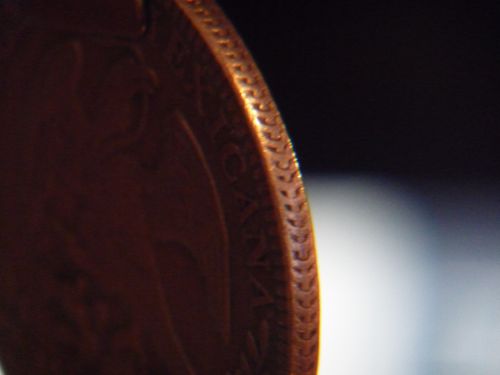 |
|
Pillar of the Community
United States
5362 Posts |
Well, that is much better and the edge itself looks REAL.
|
|
Pillar of the Community
United States
1801 Posts |
Nice 8 Reales, it looks real to me as well but I would guess it is a land burial coin, it does not look quite like a sea salvage coin.
|
|
Valued Member
United States
425 Posts |
OK, after seeing the edge and the new weight, I also say "Real". But how is it that the edge and the reverse have stayed so nice when the Obverse side has suffered so much damage?
On the edge design there should be two over laps....... are they directly across from one another?
|
|
Pillar of the Community
United States
5362 Posts |
I would suspect that the coin lay cap down on a reactive surface for some period of time. Like the album toning seen on coins from the old blue whitman books - the erosion here looks like a contact type.
I have received a copper penny US 1802 that was found on top of a wooden door frame. It exhibits corrosion on ONE side - the contact side only.
Silver is less reactive than copper but I suspect something similar happened to this coin. It was later cleaned to remove the corrosion products.
|
|
Pillar of the Community
United States
1801 Posts |
Or possibly the coin was found along with another coin or more laying on top of it. The two exposed sides (bottom of the bottom coin and top of the top coin) would show much more advanced deterioration than the sides that lay protected by the other coin. I have seen pillar dollars off the 1733 wrecks off the Florida Keys that were found in stacks and the center coins have minimal corrosion beyond the edges and the outside two surfaces were beyond recognition. I have several 1733 MoMX coins that came from a clump found by diver Stefan Sykora that are really nice for sea salvage, they were in the middle of the clump and protected once the concretion built up all over the outside of the clump.
|
|
Pillar of the Community
United States
5362 Posts |
That would be a possibility if the coin had evidence of edge corrosion. But I really don't see any.
Since the uneffected sides are the edge and one face, I was thinking how do you do that in practice. That is why I postulated a single face as being the contact surface for erosion. If this coin was stacked in a corrosive environment what protected the edge? So the environment itself must not have been corrosive. Only the one face was exposed to some corrosive force.
What it was is anyone's guess. But I also noticed dark corrosion products between the rays. Could this be rust? Perhaps a test of the material would reveal what caused the corrosion.
|
| |
Replies: 14 / Views: 5,469 |
|







 Posted 02/27/2011 5:27 pm





