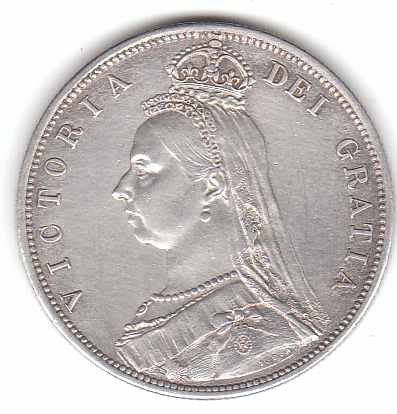
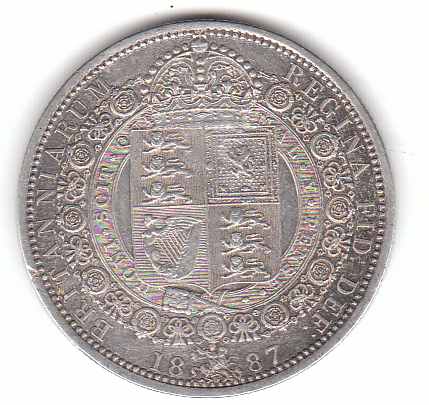
To answer the OP's question: yes, they did make a proof set in 1887, but no, I don't think yours is one. Ordinary circulation British coins from the late 1800s are extremely sharp and detailed; in high grades they look exceptionally nice.
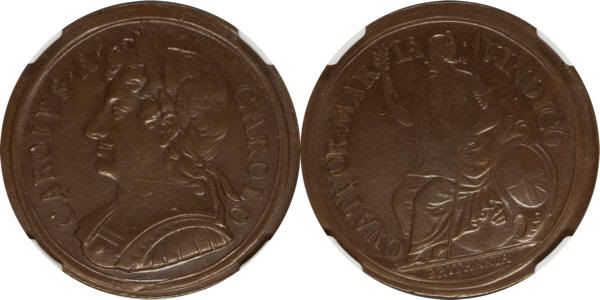
As for the more general question: I would define a "proof" as "a coin made especially for collectors or as presentation pieces, often resembling ordinary circulating coins but struck from specially prepared dies on a specially prepared planchet". The trouble is, by this definition the coins in the "mint sets" from most countries would also be classifiable as "proofs". Most of the distinctive features of modern proof coins (highly polished dies, a clear "cameo effect", being struck twice) were not employed on the earliest "proofs", which in the English series date right back to the introduction of machine-struck coinage, with silver coins from the Cromwell Protectorate struck as proofs in gold.
In certain coinage series, the typical quality of normal circulation coins is very poor. In these series, "presentation pieces" which bear many characteristics of "proofiness" are easy to spot. The "Royal Coinage" of the Spanish-colonial mints and the "Nazarana rupees" of mediaeval India are two that come to mind.
Since, by my definition of "proof", you need them to be struck for collectors or as presentation pieces, it's virtually impossible to consider proof coins existing before coin collecting became popular. While we have isolated instances of coin collecting in the ancient historical records in the West, this didn't really happen until Petrarch wrote about it at the beginning of the Renaissance (1304-74). In the East, particularly in China, coin collecting goes back further and one could readily acknowledge the extremely scarce
silver and gold cash coins of the Tang Dynasty (circa 650-900 AD) as being "the world's first proof coins", since they clearly were not intended to be functional parts of the economy.
If there were coin collectors earlier than that, we have no record of it. And if proof coins were specially made for them (or for presentation purposes) way back then, we can't tell the difference between them and ordinary coins now. The only possible exceptions are the "contorniates" and other large "medallions" in ancient times, but though they were most likely made as presentation pieces, functionally they were more akin to medals than to proof coins.
Don't say "infinitely" when you mean "very"; otherwise, you'll have no word left when you want to talk about something really infinite. - C. S. Lewis












 Posted 03/17/2011 06:22 am