| Author |
 Replies: 16 / Views: 3,837 Replies: 16 / Views: 3,837 |
|
Pillar of the Community
United States
2168 Posts |
Someone was asking about what the * means in the serial number and I can't seem to recall. For some reason I thought it had to do with skips in the numbers but I'm not sure. Thanks for any input!
|
|
|
|
Bedrock of the Community
United States
14454 Posts |
the star means its a replacement note, in that the one with that serial number without the star had an error and that one was printed with the star on the end to replace the note that the BEP saw an error on. Until 1980 a star is used to represent the 100 millionth note since the serial numbering machinery only has eight digits from what I have read
|
|
Pillar of the Community
3660 Posts |
I really hope that you are joking Bryan.... if you are not, you seriously need to throw whatever it is that you are reading in the trash..... The star in the serial number (replacing the prefix letter on some types of notes, and replacing the suffix letter on other types of notes) designates a replacement note, and the serial number of the star note will not correlate to the note that it is replacing (star notes have been used in this fashion since 1910).
The 100 millionth note was signified by a new prefix letter (A99999999A to B00000001A)... the next 10 millionth note would be C00000001A, and so on.... this is no longer the case though as the newer notes (and newer notes are not my forte', so I could be mistaken about this part)are only numbered as high as 96000000 (with the exception of notes sold by the BEP as sheets).
|
|
Bedrock of the Community
United States
14454 Posts |
actually this is information I am almost positive I have gotten from here since I never even messed with notes until I came here. The 100 millionth note thing I think I may have read somewhere else, I will look for it later on. I am still no note expert as I only look for serial numbers and star notes and just keep the ones I think are interesting so I do not have any books on them and just gather information as I read what is posted here Edit: Just looked, here is one website with the same information http://www.daggarjon.com/Explain_Star_Notes_US.phpQuote:Star notes also are used to replace the 100 millionth note instead of a note with the serial 00 000 000 as printed. We know of at least one instance where, through error, the note with a serial of A00 000 000A escaped replacement in the Bureau and was shown at the ANA convention in Boston MA, in 1973 by John Morrissey. Also on that site it does say the serial number does not have to match the "bad" note Quote:
No attempt is made to replace any defective note with the same serial number star note. If this 100 millionth information is wrong there seems to be quite a few people spreading it around including an article in Coin World stating the same thing |
|
Pillar of the Community
United States
1285 Posts |
Bryan, The info on that site is a mix of old and new which is misleading and wrong as it relates to star notes. I am surprised no one has contacted the owner of the website. http://www.uspapermoney.info/Above link is good source to stay "current". |
|
Pillar of the Community
3660 Posts |
Thanks for weighing in Ceylon, (I knew that if I refuted the info given there on my own, I would appear to be nothing more than argumentative). The first star notes were indeed Vernon/McClung black eagles, and this was done at a time when there was no suffix letter on the serial number, so that also is a first... the problem with all of these specific names and dates and range of first star serial numbers is (that at the time) star notes actually were printed after the normal notes, and the serial number on the star note was exactly the same serial number as that on the note that it replaced with the exception of the star prefix and letter suffix, and these star notes were printed individually when an error in the normal run was discovered..... the normal notes were printed in numerical order and had no zeros preceding the normal numbers... (single digit numbers preceded two digit serial numbers), etc, etc..... seven digit serial numbers would have been down the road in the production of the series... The first stars did not have seven digit serials, and they were not printed in a run of 100 (I guarantee it). There are approximately 30 examples of these notes known today, here is mine (six digit serial). 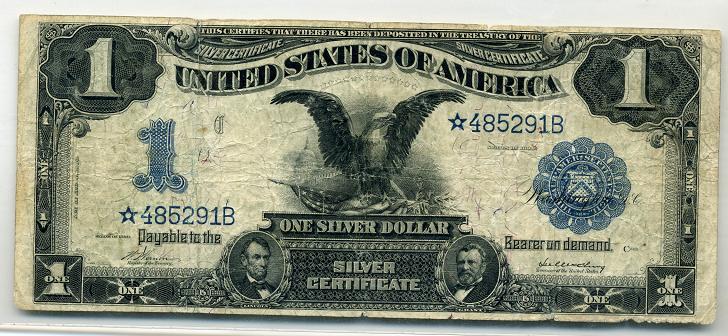 Here is another for sale: http://cgi.ebay.com/FR-229-1899-STA...em35b111c13fQuote:
Star notes also are used to replace the 100 millionth note instead of a
note with the serial 00 000 000 as printed. Okay Bryan, that is understandable.... I misinterpreted what you mentioned earlier.... Nevertheless, a star note is a replacement note despite the reason for replacement.... A note with a serial number containing eight zeros would be considered an error note as this number is not recognized as a normal run number..... This crosses the line into trivia in my opinion though as I was speaking in the broad sense of what the general public and collecting world considers the purpose of a star note..... since we are here in the land of trivia though, allow me to illustrate a caveat to the notion of "replacement".... Quite a while after the series 1969 $1 notes had all been printed and dispersed, 13,000 sheets of second printing notes were discovered at the BEP.... what to do with them....? The decision was made to print serial numbers and disperse them..... the serial numbers started at C05120000* and went up..... 416,000 notes... they were all stars, and they replaced nothing. The BEP, and the private companies in New York that printed U.S. currency have changed the way they do things many times in the past 140+ years.... lumping all star notes into one basket and saying "this is the way they were all created" is folly. Edited by zeewool
04/02/2011 09:54 am
|
|
Pillar of the Community
3660 Posts |
Now here is another thing that I have considered (without any basis in fact), but merely pondering the possibilities...... Today, most star notes are printed prior to the regular runs of notes so that they will be readily available as needed..... but what happens to all of these hundreds of thousands of notes when they are not needed? We are told that they are destroyed.... we are told lots of stuff by our government.... It would not surprise me one bit to learn that rather than being destroyed, they wind up in a foreign country as payment or aid for this, that, or the other thing.
|
|
Pillar of the Community
United States
1812 Posts |
Zeewool's photo reminds me of when I used to collect large size notes back in the 80's...
If memory serves, replacement notes received a hollow star, and a solid star was NOT a replacement note...
|
|
Pillar of the Community
United States
1397 Posts |
Don't quote me but I was thinking a solid star was used up to the mid 50's or so and then it changed to the hollow star.
|
|
Bedrock of the Community
United States
14454 Posts |
Quote:
The first star notes were indeed Vernon/McClung black eagles, and this was done at a time when there was no suffix letter on the serial number, so that also is a first... the problem with all of these specific names and dates and range of first star serial numbers is (that at the time)star notes actually were printed after the normal notes, and the serial number on the star note was exactly the same serial number as that on the note that it replaced with the exception of the star prefix and letter suffix so all of my information was correct, just a little dated then correct? I knew I had read that information here somewhere at some time I just didn't know it applied at one time and not another, Now I know. I am definitely in no position to argue any facts when it comes to US Notes of any era and most of what I say is what I have read from others and was accepted as truth at the time and try to pass on that information when asked |
|
Valued Member
Canada
59 Posts |
Since we are talking about star notes, I have a question: when defective notes are replaced by star notes, does the star note district have to match the district the defective notes came from? In other words if a series of notes from the Boston (A) district are replaced, will the star notes also be from the Boston district, or can they be, say, from the Cleveland (D) district? Always been curious about this, and this seemed like a good time to ask. Thanks!
|
|
Pillar of the Community
3660 Posts |
Yeah Bryan, your info was correct.... I just misunderstood at first, and was unaware of the 100 millionth thing, but it does make sense.... The time frame in which this would be true was a relatively narrow one though.
You are partially correct Broken-Coin.....Large size notes with a solid star are not replacement notes..... Large size notes with a hollow star are replacement notes.... Small size notes with either solid or hollow stars are replacement notes.... early notes 1928, 1929, 1934 used a solid star..... later notes 1935 to current, used a hollow star.
That is the way it is supposed to work peiper..... the district of the error note is meant to be replaced by a star note of the same district.... each Federal Reserve Bank operates as an individual company, and the banknotes are controlled at both dispersal and redemption by denomination and district letter or number.
|
|
Pillar of the Community
United States
1361 Posts |
However, from what I've heard, it doesn't matter what district a star note is for when it's used.. They just use whatever districts they have on hand..
For example, in series 2003A $2 bills, only Atlanta (F) stars were printed, but they were likely used for any district. I've also heard of how Series 1995 stars (F) were used in the early runs of Series 2003 $2 bills (I-A block)..
I hope this answers your question..
(Zeewool's gonna kill me :P lol)
|
|
Pillar of the Community
United States
1285 Posts |
Quote:
However, from what I've heard, it doesn't matter what district a star note is for when it's used.. They just use whatever districts they have on hand..
That is correct and the current SOP. Also short run stars replace large run stars when there is an issue with the large run stars. |
|
Pillar of the Community
3660 Posts |
I cannot allow myself to be dragged into the world of green seal FRNs.... I really do not know or care much at all about them..... Ceylon would be your best bet as someone to listen to in that area.
This lack of transparency concerning to which district a star note is actually issued is interesting though.... A person would naturally ask "why?" Is this a form of money laundering at the national level? Is this to save on the cost of destruction of perfectly good money? Are checks and balances so acute as to keep debits and credits on track for each of the district banks? Why even bother with district numbers and letters? Are they just a means of insuring that the numeric possibilities of serial number plurality will not be reached (which could be done through series change)?
If this is current SOP, and I will take your word for it that it is, it is news to me, and is a departure from the procedures that the FED was originally set to follow.
Yes, I too have heard of many seemingly haphazard uses of star notes.... this causes me to think that error replacement is not their only intended use today, and that star notes hold a higher degree of importance and stature in the collecting world than at the BEP.
I shall stick to banknotes of the 1861-1929 era, and leave the green seals to those who are interested in them.
|
|
Pillar of the Community
United States
1285 Posts |
Quote:
A person would naturally ask "why?" I have privately posed this question to numerous folks in the currency arena who know more about this than me. Simple answer given to me is that "the BEP does what it wants" - this is fact. Interestingly I have heard / read Dept of Treasury has told the BEP that they are not happy with some of the things BEP does and for lack of better term "stop it". So who knows what happens in the future. Quote:
If this is current SOP, and I will take your word for it This was done to save money / cost of production as it is rather time consuming to match stars by district. Also you do not need to take my word rather look at the star runs VS regular production runs meaning not all districts have stars printed for a particular series. Also stars can cross series year  (mix and match). This too is fact. |
| |
Replies: 16 / Views: 3,837 |










 Posted 04/01/2011 8:35 pm


