| Author |
 Replies: 33 / Views: 8,541 Replies: 33 / Views: 8,541 |
|
|
|
Pillar of the Community
3660 Posts |
I don't have any thoughts on the scratches, but the dots I do.... consider that these dots are all over the place, sometimes in the fields, sometimes in the devices, the denticles, etc.... that in itself would be enough for me to disregard any notion of 'testing'..... to me the 'smoking gun' is in '21-D vam-3..... how could any tool produce a circular depression on a device drop off? I fully endorse the notion of gas bubbles caused by inferior die steel.... these dies were made in the wake of WWI ("the BIG one" to some of you old geezers), and could well have been forged from remnants from the USS South Carolina.
|
|
Moderator
 United States
23522 Posts |
Yours is another plausible explanation, but there are (to me) weaknesses in it which equal the "hardness test" weaknesses.
If it were a hardness test, I could imagine a jig with a single cylinder of very hard steel, driven downwards by a spring of known tension. The depth of the impression it created on the die would indicate the relative hardness of the die steel. This might be a recommended practice, if you were in fact using steel from the South Carolina in your dies.
The '21-D VAM-3 is actually a rather nice example to throw out for discussion. I'm thinking the location of the "dot" was a rather poor choice, or a rather sharp one - if the die were weak at the intersection of the field and device, the die would not have much life before age caused the delineation to fuzz out.
Now, I'm forced to ask this based on my inferior knowledge of metallurgy: 1921-D VAM3 and its' sub-VAMs are not exactly rare on the ground. I've personally been through a number of VAM-3A's in progressive stages.
All have the "dot."
Would a bubble in the die have the strength to last through a relatively large number of strikings, including a progression of that huge wing break, while remaining perfectly circular with sharply-defined shoulders? Remember, these "dots" are very sharp, as sharply-shouldered and defined as any deliberate device.
|
|
Pillar of the Community
3660 Posts |
I'm probably not going to be around long enough to even think about that Dave.
Edited by zeewool
04/04/2011 10:26 pm
|
|
Valued Member
United States
220 Posts |
SD, wouldn't your question apply to no matter what caused the incuse impression in the die?
|
|
Pillar of the Community
 United States
1285 Posts |
Dave, this is the best I can do on the pic of the lip and you can somewhat see it. Hope this is what you are looking for (circular) As per the scratch around the N - The visible scratch is the one highlighted. I am looking at it 16X. There are other faint scratches on the reverse at numerous spots. I did not want to get into them as they are not as prominent as the one near the N and are NOT as long and OR NOT straight. Question -- If a coin like this went through circulation would the die scratches (rev) and the die crack on the obverse (running through the hair) wear off / rub off / become smooth / non visible over time from circulation? 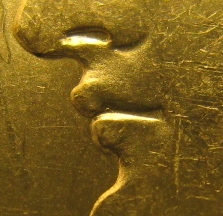 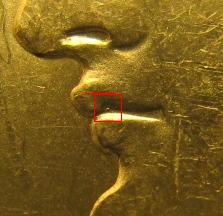 Edited by Ceylon62
04/04/2011 9:45 pm
|
|
Pillar of the Community
3660 Posts |
It is my belief that the mint did not possess an actual steel mill (where it could take a steel plate from the starboard bulkhead, liquefy it, and remold it into a die), but rather acquired its stock from out of house (from somewhere like the steel mills of Pittsburgh).... I might further imagine that the mint might make requisition of a specific grade of steel (density) for the purpose of fabricating coin dies, but had little control over what was available or what it actually received.... (keep in mind, I am only daydreaming about everything I say here).
In my effort to further denounce the notion of a hardness test:
Whether the dot were a cause of spring loaded jig, or hammer and punch, I doubt that striking the vam-3 die in such a location could occur without slippage into the device or at least breakage of the drop off ledge.
If the intent of this test was to determine die hardness, I would think that it would be done after the die was hardened rather than before (when such an event could occur without risking stress fissures in the die surface).
If such a test were to be performed at a predetermined exertion of force (like the jig), I might think that care would have been taken to consistently strike either in the field or in the device, but not haphazardly, sometimes in a device, sometimes in the field, sometimes in the denticle.... (the anticipated goal is lost on me).... Cracks are caused in the die surface because the surface and edges of the die are the areas most subject to being brittle from annealing.... intentionally damaging this surface for the purpose of a test of immeasurable determination is beyond my scope of comprehension.
The small surface area of the dots (relative to the larger surface areas of devices, including mm) leads me to believe that wear (the possibility of round over of the drop off ledge) would be minimized as the load of the press strike would be spread out (over rather than into) the dot by the sheer expanse of its neighboring field or device.... I further might think that a dot in a device would weather the storm of striking better than one in the field because (relatively), the field is the initial impact zone, while the device collects planchet displacement at a lesser degree of compression, especially in an area between two opposing devices.
It seems logical to me that the devices in a die might already be a tad denser than the field anyway (from compression of hubbing), so the inconsistency of dots in the devices, dots in the field would negate any noteworthy conclusions as to the hardness of the overall die.
I have attempted to transfer my thoughts on why hardness testing is not the culprit.... and while I cannot detect any obvious flaws in my best guess notion of gas bubbles, I would very much like to hear what your best guess might be VfM (if you have even given this any thought of course).
|
|
Valued Member
United States
220 Posts |
ZW, no, I have never really given this much thought actually, since I consider the issue somewhat irrelevant to attribution. If you have not guessed, I am not so much into the actual minting process. OOOHHH, imagine the horror of such a statement!! That being said, I do think I have a fundamental understanding of it all.
So back to the issue at hand. I can find plausibility in both the hardness test and bubble theories. Personally, I would go with the bubble theory. But I also think the real story is yet to be told, hence my continuous search on E-Bay for the DeLorean.
I mentioned above that I consider the cause of the dots irrelevant to attribution. Whatever the cause, it is clear it was in the die. Thus, either the dot is there, or it is not there. It is merely die poop to me to assist in the attribution in my world.
Dots are curious, they are widespread in the 1921 series, and a mystery to try to solve, and as such, intriguing to some. But for attribution purposes, the cause is irrelevant.
|
|
Pillar of the Community
3660 Posts |
Sorry Ceylon, I really didn't mean to run over you like that.... it looks to me like chip is a chip rather than a dot. 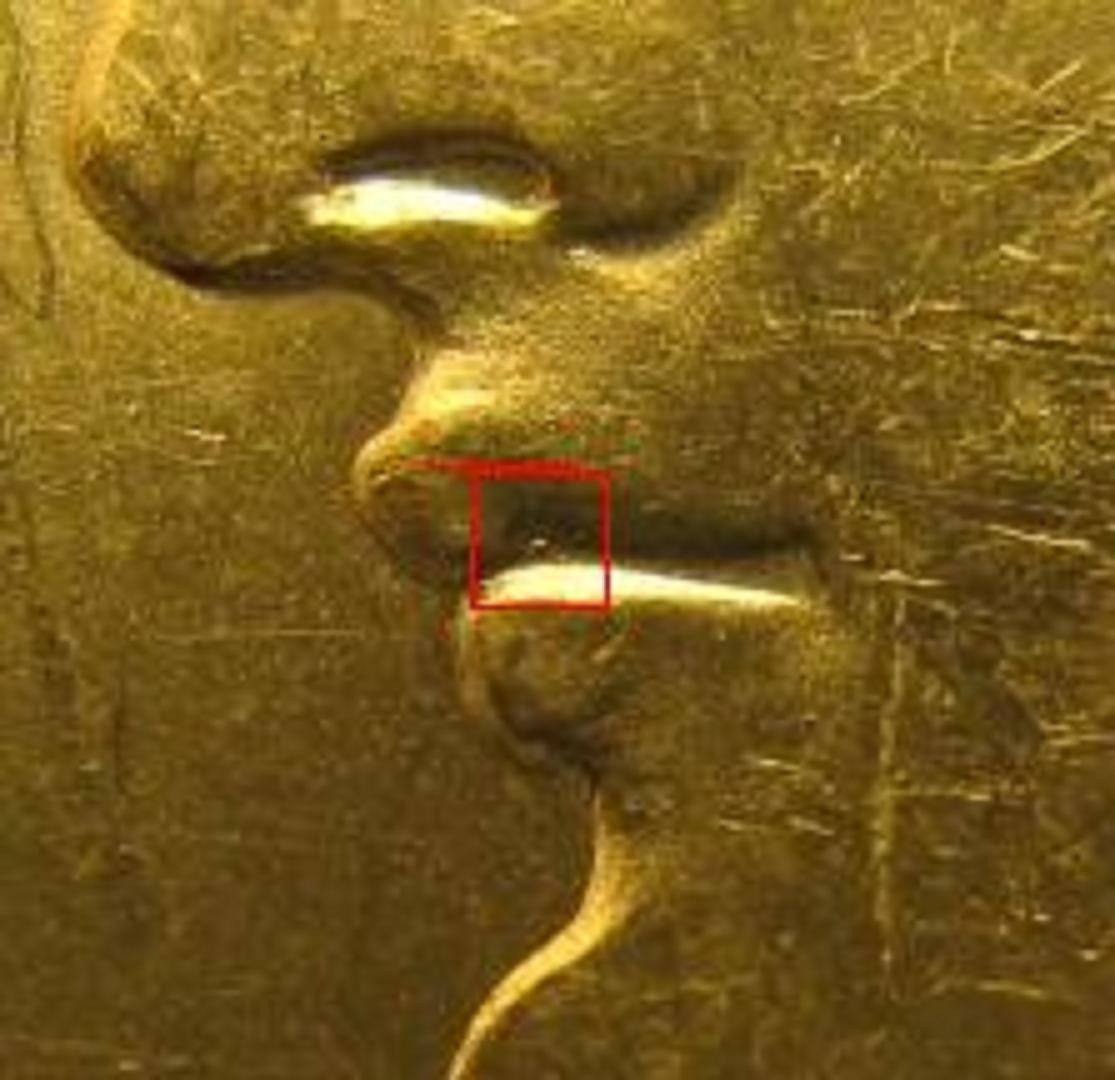 |
|
Pillar of the Community
3660 Posts |
Thanks for the reply VfM.... I can certainly understand the reluctance of so many folks to engage in the obvious futility of such speculation, but personally, I cannot resist it....  I am intrigued by the DeLorean... I had thought that it was an eccentric failure of an automobile.... is there more to it than that? Edited by zeewool
04/04/2011 11:00 pm
|
|
Moderator
United States
23522 Posts |
Quote:
If you have not guessed, I am not so much into the actual minting process. OOOHHH, imagine the horror of such a statement! Bite your tongue, VfM.  Ceylon62, I gotta rack my brain (and VAMworld) to figure out which 1921 I'm thinking of with the dot between the lips. The location of your chip/dot is in the precise place I remember, but it's not mentioned in the 1DM description. I've asked for advice over there regarding it. I am quite torn about the "dots." The argument against hardness testing - aside zeewool's very strong point that nobody in their right mind would put one at the junction between field and device - is that I feel the "sweet spot" for getting a proper strike on the die is very small indeed. Springs do not exert equal tension throughout their compression range, and a mechanical linkage similar to that which actually strikes the coin (the only linkage I can imagine capable of exerting enough force) would exhibit a similar "sweet spot." I think that the difficulty of jigging up such a tester, and the variance between individual dies, would defeat the ability to trust the test results. On the other hand, zeewool's theory of die bubbles is argued against by the known (in Mint State coins) cylindrical shape of the "dot." There is a known, flat-sided, vertical component to the "dot," and the convex (on the coin) top has a clear, linear intersection with those sides. Uncharacteristic for a bubble. Also, if I have personally seen half a dozen of VAM-3, how many hundreds were struck, and would a bubble survive that long? In honesty, this remains a mystery to me and one I'd dearly like to solve. Oh, zeewool - the DeLorean is a reference the automotive star of Back to the Future, and VfM's desire to travel back to the time where a whole lot of these questions could be answered with finality. |
|
Pillar of the Community
3660 Posts |
It is 4 o'clock in the morning, and I am awake.... I was unforgivably sassy in another thread several hours ago (and regrettably so), which evidently, I am losing sleep over, yet surprisingly, I remain here. Probably, a major stopper here is my poor choice of the word "bubble".... more descriptive and accurate would be "pocket"..... Since the die is a solid rather than a liquid, it would not surprise me that a gas pocket forced to the surface through the compression of hubbing might not appear completely circular, but assimilate in shape to the solid walls of the solid encompassing it.... I can only imagine a mental illustration the creation of a gas pocket within the molten steel at the precise time of solidification, but it would not necessarily be circular as it makes it way to the surface to explode. The images that I have seen of these dots do not (to me) appear to be uniform in shape, and some looked like less than noteworthy chips, but then I have never held even one of these dotted coins in hand, so I must defer to you for experience, and evaluation..... I cannot argue with what you have seen (even if I wanted to)... |
|
Pillar of the Community
United States
1285 Posts |
|
|
Pillar of the Community
3660 Posts |
Looks like you are getting pretty serious about this VAM stuff Ceylon.... you have obviously been doing a lot of searching and researching..  I looked at those links, and the last one that you provided led me to an interesting note.... not so much to do with your coin, but tidbit that will cause Gene's hair to stand on end anyway.... If you read the VAM 9A or 1CY comments, first paragraph (of either), the die classification thing has mutated toward a different direction... Not only can one VAM be of multiple die pairs, one die pair can remain as two differently assigned vams because of a statute of limitations? 2003 isn't that long ago.... what are the time window limitations for correctness? |
|
Pillar of the Community
United States
1285 Posts |
Pardon my ignorance here... what exactly is a Hub Dot? (that is verdict per vw) Thanks
Zee, some of that is over my head and for the time being and I refrain from getting into the all the technical nuances. IF I can SEE IT.. then I am in.. Else it becomes an academic discussion which I am not suited for with my limited knowledge (but I do read and educate myself).
|
|
Pillar of the Community
3660 Posts |
A hub is an impression tool that is used to make dies.... the design features of the hub are in relief, and are transferred to the die (intaglio).
A master hub is a very valuable tool that is only used a small handful of times to create master dies..... (it is my understanding that all 1921 Morgan varieties are descended from one master hub), so any feature of imperfection in the master hub will be transferred to the master dies molded from it...... the master dies will be very similar to each other (like identical siblings), but it is possible that they will not be 'exactly' identical, and they are used only a few times each to create working hubs...... these working hubs will in turn be used to mold the working dies, and the working dies are the molds that are used to strike coins.
Liken this process to the multiplication of rabbits or cockroaches.
The keywords when referring to hubs and dies are 'master' and 'working'..... Master hubs and dies are used very sparingly (to preserve the integrity of design through lack of wear)...... Working hubs and dies (as the names imply) are used on a grander scale and therefore see far more wear and acquire more wear related features..... a working hub can produce a few hundred working dies.
If there occurs an unintended feature (like a chip) in the master hub, it will transfer to the handful of master dies that it fathers..... Each of these master dies will likewise pass on this defect (like a gene) to the working hubs that are created from them, and in evolutionary fashion, this will be passed down to all working dies.
This particular mouth dot on your coin is an evolutionary mutation..... it is not in the master hub, (or it would be noticed in all 1921 Morgans)..... it is likely not in a master die, or it would be displayed in far more varieties than it actually is..... It is a feature found in a particular working hub, because it is common to more than one (but not all) individual die..... (this is just further basis for refutation of the hardness testing jazz)..... hardness testing a hub?
Although I have never heard the term "hub dot" before, I believe that it would refer to that dot or chip located in the same location on more than one (but not all) 1921 Morgans.... (1921, 1921D, 1921S would be irrelevant) as the entire hubbing, die creation process occurs at Philadelphia only.
Edited by zeewool
04/06/2011 08:37 am
|
| |
Replies: 33 / Views: 8,541 |








 First Page


 Posted 04/04/2011 12:08 pm


