











 Posted 04/09/2011 11:44 pm


Sebastian Gonzales-Daly Hello and welcome.
I have been away from the forum working on my book about Portrait 8R counterfeits so I have missed some posts including yours.
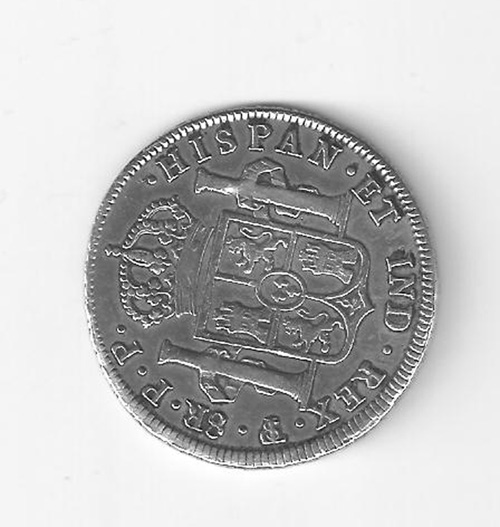
MathieuMa was correct the mint mark is the PTS monogram that stands for Potosi, Bolivia. The Spanish Colonial coins all used a similar pattern and only the mint and assayer initials indicated the place of origin. If you note, I didn't say country of origin because the individual countries actually existed more as states in the new world empire of Spain.
MathieuMa was also right on when he warned you about the existence of numerous counterfeits in this particular series. The following is a brief tutorial on how to avoid a fake.
First - know the person you are buying from. Buy only from people who will guarantee the coins as an original FOREVER. Next you need to know what an original coin looks like. There are many books available that show pictures and on line you can check hundreds of offerings to make sure it looks reasonably correct. You should also learn about how the coin was made so you know what to look for. In this case, Potosi used a manual OPEN SIDED screw press to strike 8R coins. You should also know what the silver content was and the exact weight of the coin when new. If possible learn the tolerances used. The open sided screw press means that a coin that is slightly out of round is OK.
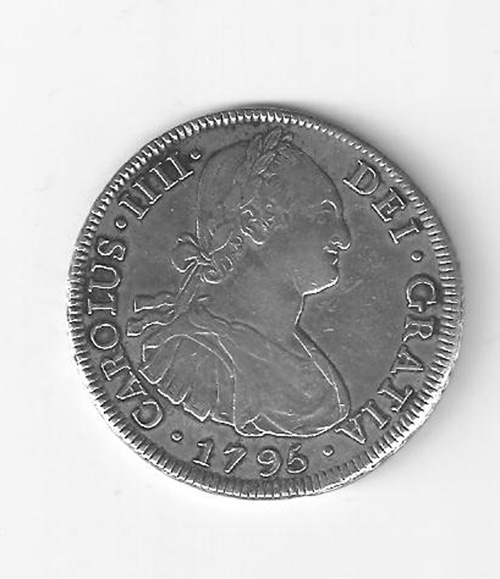
Begin with a visual examination of ALL THREE SIDES. Make sure it is correct looking. The correct King for the year 1795 is Charles IV (Carolus IIII), You would be surprised how often forgers get that fact wrong. Then check the assayer initials - they get these wrong too. Remember that although die sinkers did in fact make spelling errors on dies - most such errors are VERY VALUABLE and are unlikely to appear on ebay for example. BE CAUYIOUS.
The next step is to weigh the coin with an accurate scale. An original 8R in this condition with an intact edge (not saned off) should weigh MORE than 26.5 grams. A coin that weighs less than that is suspect.
Next get a magnet - no real silver coins are magnetic.
Third look at the edge design - Bolivia used the colonial edge pattern consisting of a rectangle and circle - alternating. The edges on Bolivia were bolder than Mexico City edges and NEVER show line segments at the edges (acting like a border.) The pattern MUST be VERY UNIFORM in size and shape. The pattern should NOT wave side to side. The circles should NOT have square outer corners.
The next thing to look for the method of application of the edge and the overlaps in the edge pattern. The original edges were applied to the planchet BEFORE it was struck. The dentils at the edge of the coin should COMPRESS the edge design NOT VICE VERSA. Because the coin was struck with no restraint - small cracks can sometimes be see near the edge of original coins BUT LONG SPLITS in the planchet may mean German Silver.
Finally - the overlaps mentioned by MathieuMa. There are always 2 overlaps in the edge design. These are the starting and ending points of the application of the design. The design was applied with TWO parallel edge dies that cut the edge design into the opposite sides of the planchet at the sane time. The planchet was rolled between the dies for ONE HALF a revolution to complete the edging process. The overlaps MUST BE THE SAME LENGTH and they must occur exactly opposite one another on the edge of the coin.
If your coin passes all these tests - then you can move onto a microscopic examination of the surfaces of the coin to see if it was struck or cast. All 1795 Potosi 8R coins were struck. Look for metal flow lines - silver is malleable - German Silver for example is NOT and will show no flow lines. Also look for silver plating. Many forgeries were made using Sheffield silver plate. The outer layers of silver tend to wear off on high points exposing the worthless metal beneath. Check the coin's high points for a subtle color difference.
Look for radial flow and die erosion lines. Erosion lines that are on an angle or sweep all in one direction as they approach the edge could indicate a centrifugal casting.
The next step is to determine the Specific Gravity of the coin to establish that it is the correct assay, SG for all real Spanish silver coins of this era is 10.3 to 10.31. A deviation of as little as 0.1 outside that range could mean trouble for authenticity.
After doing all these tests you can make an educated determination of originality.
Good luck and happy hunting.
I have been away from the forum working on my book about Portrait 8R counterfeits so I have missed some posts including yours.
MathieuMa was correct the mint mark is the PTS monogram that stands for Potosi, Bolivia. The Spanish Colonial coins all used a similar pattern and only the mint and assayer initials indicated the place of origin. If you note, I didn't say country of origin because the individual countries actually existed more as states in the new world empire of Spain.
MathieuMa was also right on when he warned you about the existence of numerous counterfeits in this particular series. The following is a brief tutorial on how to avoid a fake.
First - know the person you are buying from. Buy only from people who will guarantee the coins as an original FOREVER. Next you need to know what an original coin looks like. There are many books available that show pictures and on line you can check hundreds of offerings to make sure it looks reasonably correct. You should also learn about how the coin was made so you know what to look for. In this case, Potosi used a manual OPEN SIDED screw press to strike 8R coins. You should also know what the silver content was and the exact weight of the coin when new. If possible learn the tolerances used. The open sided screw press means that a coin that is slightly out of round is OK.
Begin with a visual examination of ALL THREE SIDES. Make sure it is correct looking. The correct King for the year 1795 is Charles IV (Carolus IIII), You would be surprised how often forgers get that fact wrong. Then check the assayer initials - they get these wrong too. Remember that although die sinkers did in fact make spelling errors on dies - most such errors are VERY VALUABLE and are unlikely to appear on ebay for example. BE CAUYIOUS.
The next step is to weigh the coin with an accurate scale. An original 8R in this condition with an intact edge (not saned off) should weigh MORE than 26.5 grams. A coin that weighs less than that is suspect.
Next get a magnet - no real silver coins are magnetic.
Third look at the edge design - Bolivia used the colonial edge pattern consisting of a rectangle and circle - alternating. The edges on Bolivia were bolder than Mexico City edges and NEVER show line segments at the edges (acting like a border.) The pattern MUST be VERY UNIFORM in size and shape. The pattern should NOT wave side to side. The circles should NOT have square outer corners.
The next thing to look for the method of application of the edge and the overlaps in the edge pattern. The original edges were applied to the planchet BEFORE it was struck. The dentils at the edge of the coin should COMPRESS the edge design NOT VICE VERSA. Because the coin was struck with no restraint - small cracks can sometimes be see near the edge of original coins BUT LONG SPLITS in the planchet may mean German Silver.
Finally - the overlaps mentioned by MathieuMa. There are always 2 overlaps in the edge design. These are the starting and ending points of the application of the design. The design was applied with TWO parallel edge dies that cut the edge design into the opposite sides of the planchet at the sane time. The planchet was rolled between the dies for ONE HALF a revolution to complete the edging process. The overlaps MUST BE THE SAME LENGTH and they must occur exactly opposite one another on the edge of the coin.
If your coin passes all these tests - then you can move onto a microscopic examination of the surfaces of the coin to see if it was struck or cast. All 1795 Potosi 8R coins were struck. Look for metal flow lines - silver is malleable - German Silver for example is NOT and will show no flow lines. Also look for silver plating. Many forgeries were made using Sheffield silver plate. The outer layers of silver tend to wear off on high points exposing the worthless metal beneath. Check the coin's high points for a subtle color difference.
Look for radial flow and die erosion lines. Erosion lines that are on an angle or sweep all in one direction as they approach the edge could indicate a centrifugal casting.
The next step is to determine the Specific Gravity of the coin to establish that it is the correct assay, SG for all real Spanish silver coins of this era is 10.3 to 10.31. A deviation of as little as 0.1 outside that range could mean trouble for authenticity.
After doing all these tests you can make an educated determination of originality.
Good luck and happy hunting.
Edited by swamperbob
04/10/2011 08:14 am
04/10/2011 08:14 am


