Coin Community Family of Web Sites Join Thousands of Coin, Bullion, & Money Collectors
Royal Estate Auctions - $1 Coin AuctionsRoyal Canadian Mint products, Canadian, Polish, American, and world coins and banknotes. Vancouvers #1 Coin and Paper Money Dealer Join Thousands of Coin, Bullion, & Money Collectors 300,000 items to help build your collection! Specializing in Modern Numismatics Coin, Banknote and Medal Collectors's Online Mall


Username:
Password:
Save Password
Forgot your Password?


This page may contain links that result in small commissions to keep this free site up and running.

Welcome Guest! Registering and/or logging in will remove the anchor (bottom) ads. It's Free!

New Photo

To participate in the forum you must log in or register.
Author Previous TopicReplies: 16 / Views: 5,146Next Topic
Page: of 2
Moderator
Learn More...
SsuperDdave's Avatar
United States
23522 Posts
 Posted 04/21/2011  02:10 am  Show Profile   Bookmark this reply Add SsuperDdave to your friends list Get a Link to this Reply
It's no big thing, Fuzzy; keep in mind, Bust Halves have been studied into complete boredom by some very capable people.

The specific locations of stars on individual Bust Half dies change by die. It's one of the two or three most important features to study when attributing them - the location of the first, seventh, eighth and thirteenth stars relative to the denticles is recorded for every single known Bust Half variety. A second major pickup (at least in the way I attribute Busties) is the location of the "I" in "PLURIBUS" relative to the "T" in "STATES." In a majority of cases, these two are enough to nail down an attribution.

With busthalf's specific coin here, we know that there are three varieties of "8 over 7." O-101, 102 and 103. The locations of the stars, and the obvious overdate, narrow it down to two choices.

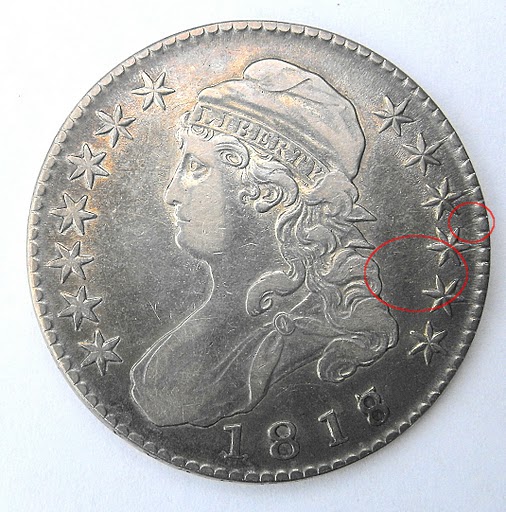
And here is where I have to admit my error: O-101 and O-103 use the same obverse, and only the obverse of this coin is shown. If you look closely, you will see a die crack on the coin in the areas I've circled in the picture here:

New-Photo

Late die states of O-101, and all of O-103, have this crack. They use distinctive and easily-differentiated reverses; the T-I relationship I mentioned above would nail that difference immediately, as would the appearance of "50 C" on the reverse.

Yet, the reverse is not shown. So, I cannot call this O-101, and in that way I'm wrong for having called it conclusively O-101 earlier.

So, which is it, busthalf?
  Previous TopicReplies: 16 / Views: 5,146Next Topic
Page: of 2

To participate in the forum you must log in or register.


Disclaimer: While a tremendous amount of effort goes into ensuring the accuracy of the information contained in this site, Coin Community assumes no liability for errors. Copyright 2005 - 2026 Coin Community Family- all rights reserved worldwide. Use of any images or content on this website without prior written permission of Coin Community or the original lender is strictly prohibited.
Contact Us  |  Advertise Here  |  Privacy Policy / Terms of Use

Coin Community Forum © 2005 - 2026 Coin Community Forums
It took 0.2 seconds to rattle this change. Forums