As I've searched
a few IHCs over the years, I thought it would be useful here to get a discussion going on how to detect (and avoid) the
glut of problem coins in the marketplace. My OP is
just a start; add your own comments, pics of damaged, cleaned, or corroded
IHC, and tell us what makes them so. Let's learn together.

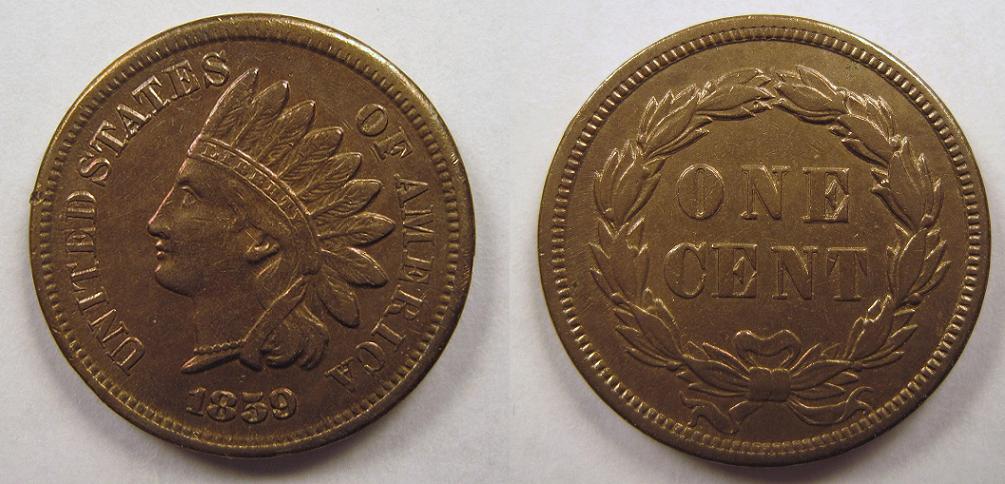
I'll start with 1859, a year that's particularly hard to find problem-free. First is a slabbed PCGS XF40 with the normal amount of dirt I'd expect to see:

Now for a slew of '59s from eBay--a
veritable wealth of numismatic problems.

The first I dub the
"Brillo '59": cleaned so harshly as to remove all original surfaces, leaving bare, bright metal. Is there an actual coin left?


Now for one I'll call
"XF details": an
IHC with so much corrosion that no amount of scrubbing will ever "fix".
While few sellers will admit this is "problem free", this was called "very nice" by this particular
ebay seller.
 "Honest cleaning"
 is one that many sellers (even some dealers) would call "problem free",
yet it shows sign of dirt removal in the devices, and perhaps some residual cleaning agent in OF and the feather tips.
IHCs this grade normally have dirt in the date and legends.
 "Blight"
 had corroded lumps removed, leaving discolored patches and visible signs of tooling around the feathers.
Sometimes, when original grime is removed from IHCs, there are patches of corrosion like this.
 "Struck down"
, a coin knocked around so much, the details are flattened to the cull category. How much would you discount this coin?
 "Kicked in the Denticles"
 has a brick-colored discoloration that may be due to environmental exposure.
That gash, corrosion, and harsh scrubbing add up to a "$25" coin worth no more than a cull's price.
 "(G)Rim"
 Here, the background is
conveniently obscuring the rim at 8 O'clock and possibly severe damage.
The edges are always an unseen hazard on coins bought online.
 "Nightmare on Elm Street"
 --just for laughs.

That's just a start--keep them coming!












 Posted 06/11/2011 6:49 pm


